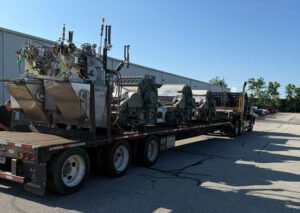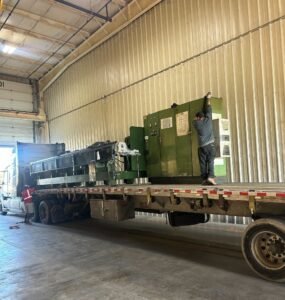
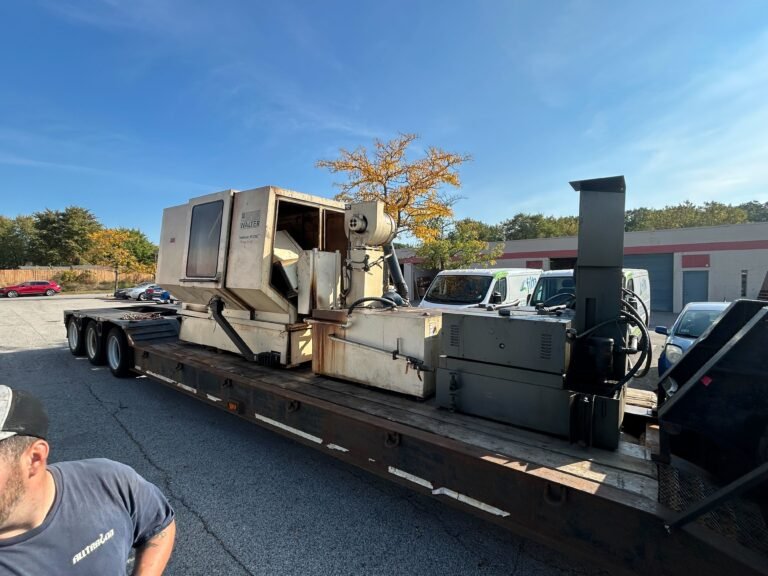
Transporting industrial equipment across states is a complex, high-stakes process that requires precision planning, regulatory compliance, technical expertise, and seamless coordination. Whether relocating a single CNC machine, transferring a full production line, or moving heavy presses and turbines to a new facility, interstate transportation introduces logistical, engineering, and legal challenges that must be carefully managed to avoid downtime, financial loss, and safety risks.
Unlike local moves, interstate transport demands advanced route analysis, multi-state permit coordination, axle load compliance, escort vehicle arrangements, crane scheduling, insurance coverage alignment, and meticulous load securing strategies. Companies that underestimate this process often face unexpected delays, penalties, damaged equipment, or production shutdowns that ripple through their supply chain.
This comprehensive guide explains everything manufacturers, plant managers, and operations leaders need to know about transporting industrial equipment across state lines—covering planning, disassembly, rigging, compliance, logistics coordination, risk management, cost considerations, and reinstallation best practices.
Understanding the Scope of Interstate Industrial Equipment Transport
Industrial equipment varies dramatically in size, weight, and complexity. A small fabrication shop machine may weigh a few thousand pounds, while large presses, injection molding machines, transformers, and turbines can exceed hundreds of thousands of pounds. When crossing state boundaries, each load must comply with different transportation regulations, bridge weight limits, and road restrictions.
Interstate moves are not simply about loading equipment onto a trailer and driving to another state. They require coordinated execution between engineers, riggers, transportation specialists, permitting agencies, and receiving-site teams. Each state has its own Department of Transportation requirements, and compliance is mandatory for legal and safe transport.
The scope of work often includes machinery disassembly, labeling of components, protection of electrical systems, hydraulic line sealing, structural bracing, lifting operations, specialized trailer selection, real-time route monitoring, unloading, and precision reinstallation.
Planning and Pre-Transport Engineering
Successful interstate equipment transport begins with detailed planning. Engineering assessments must determine equipment dimensions, center of gravity, lifting points, structural reinforcement requirements, and disassembly feasibility.
An on-site inspection is critical. Teams evaluate access points, ceiling heights, doorway clearances, slab load capacity, crane reach, and dock availability. If moving from an active facility, shutdown scheduling must align with production deadlines to minimize operational impact.
Route planning is equally important. Transportation engineers review bridge ratings, road width, construction zones, urban traffic constraints, toll roads, seasonal weather conditions, and state-by-state axle weight regulations. Some routes require structural surveys or temporary road modifications.
Time invested in early engineering analysis prevents costly delays during transport.
Permits and Multi-State Compliance
One of the most challenging aspects of transporting industrial equipment across states is regulatory compliance. Oversized or overweight loads require permits from every state through which the equipment will travel.
Permits vary depending on:
-
Gross vehicle weight
-
Axle distribution
-
Load height
-
Load width
-
Load length
Some states require escort vehicles for oversized loads. Others impose time-of-day restrictions, prohibiting travel during peak traffic hours. Certain routes may only be accessible at night or on designated days.
Failure to secure proper permits can result in fines, vehicle impoundment, or forced route changes that delay delivery schedules. Experienced logistics providers coordinate permit acquisition well in advance and monitor regulatory changes in real time.
Disassembly and Preparation of Equipment
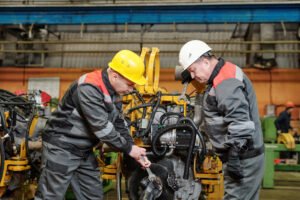
Most large industrial machines must be partially or fully disassembled before interstate transport. This reduces weight distribution challenges and allows safer loading onto trailers.
Electrical systems are carefully disconnected and labeled. Hydraulic and pneumatic lines are sealed to prevent contamination. Sensitive components are crated or cushioned to protect against vibration damage. Precision alignment markers are recorded to facilitate reinstallation.
Documentation is critical during this stage. Detailed photographic records, wiring diagrams, and component mapping ensure accurate reassembly at the destination facility.
Proper preparation protects both the physical equipment and the company’s operational continuity.
Rigging and Lifting Operations
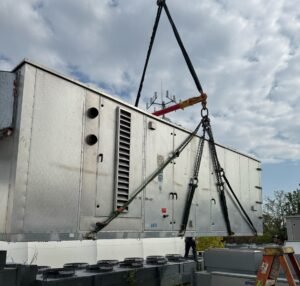
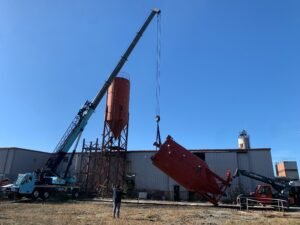
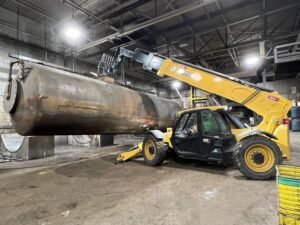
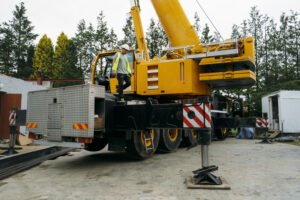
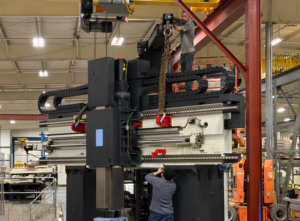
Industrial equipment often requires specialized rigging techniques for safe removal and loading. Heavy-duty cranes, hydraulic gantries, forklifts, and custom lifting frames are used depending on site constraints.
Rigging teams calculate load balance, sling angles, and lift sequencing. Improper rigging can cause catastrophic damage or workplace injury. Interstate projects demand certified riggers who understand the mechanical stress factors associated with large-scale lifting.
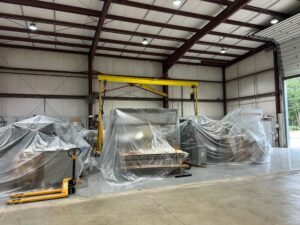
In facilities with limited vertical clearance, low-profile gantry systems are often deployed. For outdoor loading, weather conditions must be factored into lift planning to prevent instability.
Precision during this stage ensures equipment integrity before transport begins.
Trailer Selection and Transport Configuration
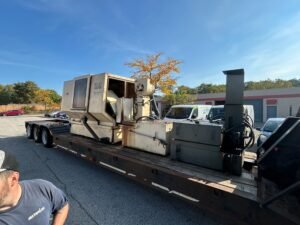
Transporting industrial equipment across states requires specialized trailers designed for heavy or oversized loads. Common options include multi-axle lowboys, double-drop trailers, extendable flatbeds, and hydraulic platform trailers.
Axle configuration must distribute weight within legal limits across all states on the route. Engineers determine whether load equalization systems are required. Improper weight distribution can lead to permit violations or structural damage to roadways.
Load securement is equally important. Industrial equipment must be anchored using chains, tensioning systems, bracing, and vibration control materials. Interstate transport exposes equipment to long durations of road vibration, temperature variation, and wind resistance.
Advanced monitoring systems sometimes track load stability during transit to detect potential movement.
Risk Management and Insurance Considerations
Transporting high-value industrial equipment across state lines involves significant financial risk. Comprehensive insurance coverage is essential.
Coverage should address:
-
Cargo insurance
-
Liability coverage
-
On-site rigging liability
-
Transit damage
-
Delay-related loss
Companies must verify policy limits and ensure alignment with equipment value. Some projects require additional endorsements for oversized or hazardous loads.
Risk mitigation also includes real-time communication between dispatch teams, drivers, and receiving facilities. GPS tracking provides transparency throughout transit.
Preventative measures are more cost-effective than post-incident recovery.
Weather and Environmental Factors
Interstate transport often spans multiple climate zones. Seasonal weather variations such as snow, ice, heavy rain, or extreme heat can impact transport schedules.
Temperature-sensitive equipment requires climate-controlled handling or protective coverings. Hydraulic systems can be affected by extreme cold. Electrical systems must be shielded from moisture exposure.
Professional logistics providers build contingency time into schedules to account for weather-related delays. Realistic planning reduces pressure and improves safety outcomes.
Coordination at the Receiving Facility
Transporting industrial equipment across states does not end at delivery. Receiving-site preparation is critical for successful reinstallation.
Facilities must ensure foundation readiness, anchor bolt placement, utility connection availability, and clearance for unloading equipment. Crane access must be confirmed prior to arrival.
Reinstallation teams align machinery precisely to manufacturer tolerances. Calibration, testing, and commissioning follow to restore operational functionality.
A poorly prepared receiving site can delay production restart, increasing downtime costs.
Managing Downtime During Interstate Equipment Transport
Minimizing downtime is often the primary objective of interstate equipment moves. Companies rely on strategic scheduling to reduce production disruption.
Some organizations stagger equipment transfers, maintaining partial operations while key assets are relocated. Others perform moves during planned shutdown periods or facility upgrades.
Communication between operations managers and relocation teams ensures alignment with production targets. Proper sequencing allows businesses to resume output efficiently.
Downtime management is both a logistical and financial priority.
Cost Factors in Interstate Equipment Transport
Costs associated with transporting industrial equipment across states vary widely depending on equipment size, distance, permit requirements, and complexity.
Key cost drivers include:
-
Disassembly labor
-
Rigging equipment rental
-
Crane services
-
Permit acquisition
-
Escort vehicles
-
Specialized trailers
-
Insurance coverage
-
Reinstallation services
Fuel costs and route complexity also influence pricing. Urban transport routes often require additional coordination compared to rural corridors.
Accurate upfront estimation prevents budget overruns.
Technology and Real-Time Monitoring
Modern interstate equipment transport increasingly leverages technology for safety and transparency. GPS tracking, digital documentation systems, and route optimization software improve coordination.
Some advanced providers use vibration sensors and load monitoring devices to ensure equipment stability throughout transit. Real-time communication platforms connect dispatch centers with drivers and project managers.
Technology enhances predictability and reduces uncertainty in complex moves.
Cross-Border and Multi-Jurisdictional Challenges
While interstate moves are complex, projects that pass through multiple jurisdictions require additional documentation. State line transitions often involve weigh station checks and compliance verification.
Transporters must anticipate jurisdictional differences in allowable axle loads and escort vehicle requirements. Advanced planning eliminates surprises during transit.
Expert providers maintain up-to-date knowledge of state-specific regulations.
Sustainability Considerations
Environmental responsibility is increasingly important in industrial logistics. Route optimization reduces fuel consumption. Consolidated shipping strategies minimize vehicle usage.
Some companies prioritize fuel-efficient transport vehicles and emissions-compliant equipment. Sustainable practices support corporate responsibility goals without compromising operational efficiency.
Common Mistakes to Avoid
Companies that attempt interstate equipment transport without specialized expertise often encounter issues such as underestimating permit timelines, failing to document disassembly properly, neglecting insurance alignment, or overlooking receiving-site preparation.
Experienced professionals anticipate these risks and mitigate them proactively.
Selecting the Right Interstate Equipment Transport Partner
Choosing a qualified service provider is the most critical decision in the process. Providers should demonstrate experience in heavy rigging, multi-state logistics, regulatory compliance, and precision installation.
Safety certifications, proven project history, and comprehensive insurance coverage are essential indicators of reliability.
A strong partner transforms a complex relocation into a structured, manageable process.
Future Trends in Industrial Equipment Transportation
The industrial logistics sector continues to evolve. Autonomous route planning systems, AI-based risk analysis, and predictive maintenance monitoring are shaping the future of equipment transport.
As supply chains become more interconnected, interstate equipment relocation will demand even higher levels of coordination and technological integration.
Companies that embrace advanced logistics strategies will maintain competitive advantage.
Conclusion
Transporting industrial equipment across states is a sophisticated operation that demands engineering precision, regulatory compliance, logistical expertise, and strategic coordination. From disassembly and rigging to permitting and reinstallation, every phase must be executed with care.
When handled professionally, interstate equipment transport enables facility expansion, modernization, consolidation, and growth without unnecessary disruption.
Businesses that invest in experienced partners, comprehensive planning, and risk management strategies ensure smooth transitions and sustained operational success.
Alltracon is a trusted leader in heavy equipment moving and interstate plant relocation. With expert rigging teams, advanced transport solutions, and proven project management, Alltracon ensures safe, compliant, and efficient industrial equipment transfers. Their precision-driven approach minimizes downtime and protects valuable assets every step of the way.