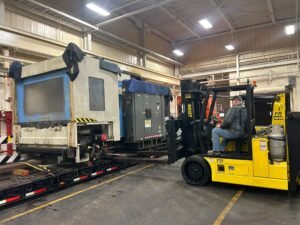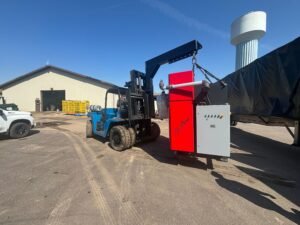
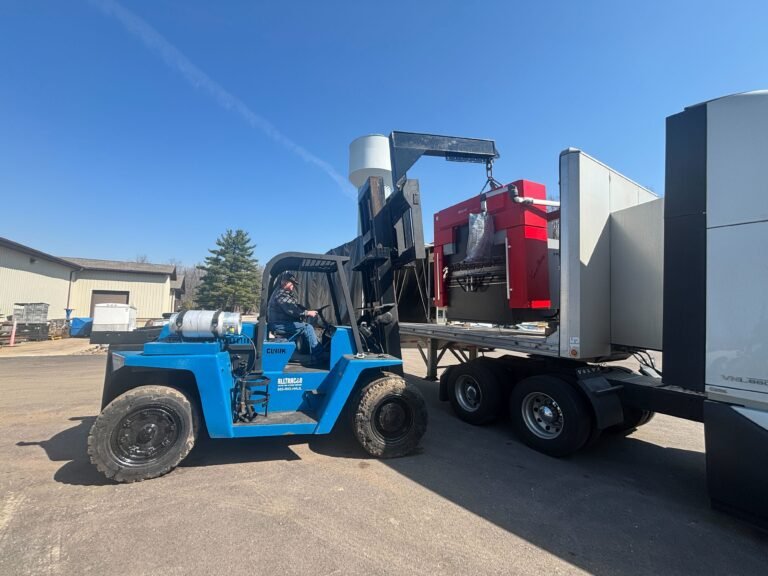
Freight delays rarely start on the highway. More often, they start at the dock — the moment a truck backs in and someone realizes there’s no way to get the pallet, crate, or machine off the trailer. Forklift-assisted unloading is one of the most common freight accessorial services in the logistics world, and it’s also one of the most misunderstood. Shippers often assume “the driver will handle it” or “the receiver has equipment,” only to find out on delivery day that neither is true.
This guide breaks down exactly what forklift-assisted unloading means, when you need it, how to arrange it, what it costs, and how to avoid the delays, damage, and unexpected fees that come from getting it wrong.
What Is Forklift-Assisted Unloading?
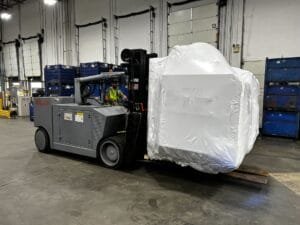
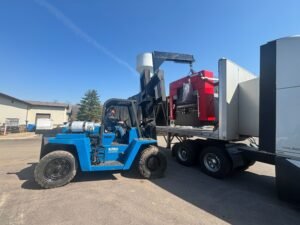
Forklift-assisted unloading is a freight service in which a forklift — and typically a trained operator — is used to remove palletized, crated, or heavy freight from a truck or trailer at the delivery point. It’s distinct from standard “dock-to-dock” delivery, where freight moves from a loading dock directly onto a receiving dock using nothing more than a pallet jack or manual labor.
The service becomes necessary any time freight:
- Is too heavy to move manually or with a pallet jack
- Isn’t on a dock-height trailer, meaning there’s no ramp or leveler to bridge the gap
- Needs to be moved from ground level, such as with a flatbed or straight truck
- Is oversized, irregularly shaped, or requires careful maneuvering to avoid damage
In practice, forklift-assisted unloading shows up constantly in industries like manufacturing, construction, agriculture, and heavy equipment transport, where the freight itself often is the machinery — engines, generators, compressors, structural steel, or full pieces of industrial equipment.
Why Forklift-Assisted Unloading Matters More Than People Think
Most shipping delays and disputes at the point of delivery trace back to a mismatch between what the freight requires and what’s actually available on-site. A few reasons this service deserves more attention before your shipment ships out:
1. Not every dock has a forklift on standby. Warehouses and distribution centers with regular freight traffic typically keep forklifts on-site. But job sites, small businesses, farms, and many commercial addresses do not. If your shipment is heading somewhere without built-in material handling equipment, forklift assistance has to be arranged in advance — not requested on the spot.
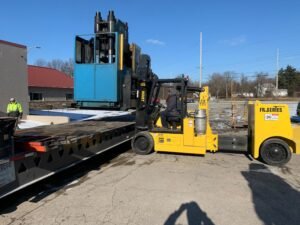
2. Trailer type changes everything. A shipment loaded onto a dry van with a dock-height trailer can often be unloaded with a pallet jack, assuming the receiving facility has a loading dock. But flatbeds, step-decks, and lowboys sit lower to the ground and have no ramp system, meaning a forklift (or crane, for extremely heavy loads) becomes mandatory, not optional.
3. Liability follows the freight. When freight is damaged during unloading because the wrong equipment was used, or because unqualified personnel attempted to move something beyond their capability, the resulting claims process can be lengthy and frustrating. Using a properly rated forklift with a trained operator significantly reduces this risk.
4. Delivery appointments can fall apart without it. Many carriers won’t wait indefinitely at a delivery site. If a truck arrives and there’s no way to unload the freight, the shipment may need to be rescheduled, and additional fees like detention charges or redelivery costs can apply.
Common Scenarios Where You’ll Need Forklift Assistance
Heavy Equipment and Machinery Deliveries
Compressors, generators, skid steers, pumps, and similar equipment are frequently shipped on flatbeds without ramps. Because of their weight — often several thousand pounds — manual unloading isn’t an option, and even a standard forklift may not be rated high enough. Equipment weight, dimensions, and center of gravity all need to be communicated ahead of time.
Construction and Job Site Deliveries
Job sites rarely have a loading dock. Materials like steel beams, palletized block, or bagged product often arrive on flatbeds and need ground-level forklift unloading, sometimes in tight or uneven terrain that requires an operator experienced with off-road or rough-terrain forklifts.
Agricultural Deliveries
Farms and rural properties are almost never equipped with docks. Equipment, feed, or bulk materials delivered to these locations typically require forklift-assisted unloading arranged through a third party, since the carrier’s driver is not responsible for unloading freight from the trailer.
Retail and Small Business Receiving
Small storefronts, restaurants, and offices that receive palletized freight (fixtures, appliances, bulk inventory) frequently lack a dock or forklift, making this one of the most common — and most frequently overlooked — situations requiring forklift assistance.
Who Is Responsible for Providing the Forklift?
This is where a lot of confusion (and cost) creeps in. By default, most freight carriers only guarantee “curb” or “dock” delivery — meaning the truck gets your freight to the delivery address, but unloading it is the receiver’s responsibility. Truck drivers are generally not permitted, insured, or equipped to operate unloading equipment at the delivery site.
That leaves three typical paths:
- The receiver’s own forklift and operator — the cheapest option if available, but it requires confirming in advance that the equipment on-site can safely handle the freight’s weight and dimensions.
- A liftgate service — useful for smaller palletized freight but limited by weight capacity, usually well under what’s needed for heavy machinery.
- A dedicated forklift-assisted unloading service — a third-party provider brings the right-capacity forklift and a trained operator directly to the delivery site, independent of what the carrier or receiver has available.
For heavy or oversized freight, especially equipment being delivered to a site without existing material handling infrastructure, the third option is usually the safest and most reliable.
What to Confirm Before Your Shipment Arrives
A little preparation prevents most forklift-related delivery problems. Before the shipment ships, confirm the following:
Weight and dimensions of the freight. The forklift being brought to the site needs a rated capacity that comfortably exceeds the actual weight of the load, not just matches it. A forklift rated close to the load’s weight creates real safety risk, especially if the center of gravity is off-center — common with irregularly shaped equipment.
Trailer type. Flatbeds, step-decks, and lowboys all sit at different heights and require different unloading approaches compared to dock-height dry vans.
Ground conditions at the delivery site. Gravel, dirt, slopes, or uneven pavement can all affect whether a standard forklift can operate safely, or whether a rough-terrain forklift is needed instead.
Access and clearance. Overhead wires, low doorways, tight turning radii, and narrow site access all need to be accounted for ahead of time, not discovered when the truck shows up.
Delivery appointment windows. Forklift-assisted unloading needs to be scheduled to align with the truck’s estimated arrival. A mismatch here is one of the most common causes of missed appointments and added detention fees.
Who is arranging the forklift. Confirm explicitly whether the carrier, the receiver, or a third-party service is responsible — assuming it’s “handled” without confirmation is the single biggest source of delivery-day surprises.
How Forklift-Assisted Unloading Is Typically Priced
Pricing varies by region, load weight, and provider, but a few consistent factors drive the cost:
- Base service fee for dispatching a forklift and operator to the site
- Load weight tier — heavier freight often requires a higher-capacity (and more expensive) forklift
- Distance/travel to the delivery location, particularly for rural or remote sites
- Wait time or detention, if the truck is delayed or the site isn’t ready when the crew arrives
- After-hours or weekend surcharges, if the delivery falls outside standard business hours
Requesting a quote in advance, once the shipment’s weight, dimensions, and delivery address are known, avoids being quoted a rushed (and often inflated) same-day rate.
Mistakes That Cause Delays or Damage
Assuming the carrier will unload the freight. Standard freight contracts almost always classify unloading as the receiver’s responsibility unless a specific accessorial service (like forklift assistance or liftgate) is added at booking.
Underestimating the forklift capacity needed. A forklift that’s technically “big enough” on paper can still struggle with an off-center or unusually shaped load. Always share accurate weight and dimension data, including the load’s center of gravity if known.
Not confirming ground conditions. A standard warehouse forklift isn’t built for a muddy job site or gravel lot. Rough-terrain equipment needs to be requested specifically.
Booking too late. Forklift-assisted unloading, especially for heavy equipment, often needs to be scheduled days in advance, particularly in rural areas where equipment availability is limited.
Skipping site access details. Low clearances, tight gates, and narrow lanes are the kind of details that seem minor until a forklift physically can’t reach the unloading point.
A Simple Pre-Delivery Checklist
Before your shipment is scheduled to arrive, it helps to walk through a short checklist:
- Confirm the exact weight and dimensions of the freight
- Confirm the trailer type being used for transport
- Confirm who is responsible for arranging unloading equipment
- Confirm the forklift’s rated capacity exceeds the load weight with a safety margin
- Confirm ground conditions and site access at the delivery location
- Confirm the delivery appointment window and align the forklift service accordingly
- Get a written quote and confirmation from the unloading provider ahead of time
Working through these points a few days before delivery — rather than the morning the truck arrives — is what separates a smooth unload from a stalled, expensive one.
Final Thoughts
Forklift-assisted unloading isn’t a minor add-on; for heavy, oversized, or awkwardly shaped freight, it’s often the difference between a shipment that arrives and gets placed safely, and one that sits on a truck while everyone scrambles to find equipment. The key is treating it as part of the shipping plan from the start, not an afterthought discovered at the dock.
Confirming weight, trailer type, site conditions, and responsibility for equipment well before the delivery date takes the guesswork — and the risk — out of the process.
Why Alltracon Is the Right Partner for Forklift-Assisted Unloading
Alltracon specializes in moving heavy equipment and freight that standard delivery methods simply can’t handle, which means forklift-assisted unloading is built into how the company operates, not treated as an afterthought. With rated equipment matched to each load’s actual weight and dimensions, experienced operators who know how to handle awkward or off-center loads, and coordination that aligns directly with delivery windows, Alltracon removes the guesswork that causes missed appointments and damaged freight. For shipments heading to job sites, farms, or facilities without their own material handling equipment, that kind of dedicated, equipment-matched service is exactly what keeps a delivery on schedule.