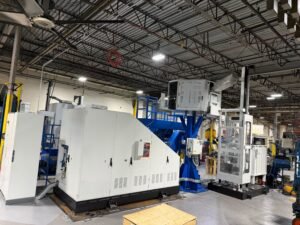
A CNC machine can be rigged perfectly, shipped without a bump and still arrive unable to hold tolerance. The problem is rarely the truck. It is usually a skipped step: an axis that wasn’t locked, a parameter file that wasn’t backed up, a foundation that wasn’t ready, or a leveling job that was rushed so production could restart a day early.
This CNC machine relocation checklist walks through every stage of the move in the order it actually happens. Use it whether you are moving one Haas VF-2 across the shop, shipping a 17,000 lb 5-axis mill to another state, or relocating an entire machining cell. Print it, assign owners to each line and work through it with your rigging contractor.
If you want the broader background on machine weights, rigging equipment and transport options first, start with our complete guide to CNC machine moving. This article focuses on the checklist: what has to be done, by whom, and when.
Why a CNC Machine Relocation Needs a Written Checklist
CNC machines combine three things that make them unforgiving to move: high weight, a high center of gravity and precision measured in tenths of a thousandth. A vertical machining center weighing 12,000 to 15,000 lbs sits on a casting that was leveled and stress-relieved for its current floor. Lift it, and that geometry changes. Set it down on a different slab, and it changes again.
A written checklist protects you in four ways:
- It prevents damage. Most CNC damage during a move comes from unsecured axes, tool changers and doors, or from lifting at the wrong points.
- It protects accuracy. Recording the machine’s condition before the move gives you a baseline to verify against after the move.
- It controls downtime. Utilities, foundations and trades booked in advance mean the machine starts cutting days sooner.
- It clarifies responsibility. Your maintenance team, the OEM service tech, the electrician and the rigging crew each know exactly which tasks belong to them.
The checklist below is split into three phases: before the move, during the move and after the move. A one-page summary table appears near the end.
Before the Move: Planning (4 to 8 Weeks Out)
Good CNC relocations are won in the planning phase. The more you know about the machine, both sites and the path between them, the fewer surprises your crew meets on moving day.
1. Document the Machine as It Runs Today
Before anyone touches a bolt, capture how the machine performs right now. This becomes your proof of condition and your benchmark for recommissioning.
- Run a ballbar test or the OEM’s geometric accuracy check and save the report.
- Record current backlash and pitch-error compensation values.
- Cut and measure a reference part, and keep the inspection report.
- Photograph the machine from every side, including the control cabinet wiring, coolant tank, chip conveyor and any existing damage.
- Note any alarms, leaks or known issues so they are not blamed on the move later.
If the machine is not running today, as with an auction purchase, document its visible condition carefully and agree on it in writing with the seller and the rigger.
2. Gather the Manufacturer’s Information
Every CNC builder publishes transport guidance. Haas, DMG MORI, Mazak, Okuma and others specify lifting points, shipping brackets, axis transport positions and recommended lifting equipment.
- Download the installation and transportation section of the operator or service manual.
- Confirm the machine’s shipping weight, overall dimensions and center of gravity.
- Locate the original shipping brackets and blocking. If they are lost, order replacements or have them fabricated before moving day.
- Ask the OEM or dealer whether a factory technician must be present to keep the warranty or service contract valid.
3. Survey Both Sites and the Route Between Them
A professional rigger should walk both locations before quoting. During the site survey, confirm:
- Door widths and heights, ceiling clearances, overhead pipes, cranes and lighting.
- Floor capacity along the move path, including trench drains, pits and old repairs.
- Where the truck can park, and whether a forklift, Versa-Lift, gantry or crane is needed to load it.
- Aisle widths and turning radii inside the building.
- Ramps, elevators or grade changes that affect how the machine travels.
Tight spaces are common in older Ohio and Midwest plants. Specialized equipment such as a Versa-Lift truck for precise load placement often solves access problems that a standard forklift cannot.
4. Prepare the Foundation at the New Location
This is the step most often left too late. Large CNC machines may need a specific slab thickness, isolated foundation or anchor pattern.
- Check the OEM’s foundation drawing for slab thickness, concrete strength and flatness.
- Mark the exact machine footprint, leveling-pad locations and service clearances.
- Allow concrete to cure properly before setting a heavy machine on new or repaired slabs.
- Plan chip conveyor discharge, coolant access and maintenance access around the footprint.
5. Book Utilities and Trades
A machine sitting on the floor without power is still downtime. Line up each trade with confirmed dates.
- Electrical: verify voltage, phase, amperage and disconnect location at the new site. A 230V machine moved into a 480V plant needs a transformer.
- Compressed air: confirm pressure, flow and dryer quality at the drop.
- Coolant and lubrication: order fresh way lube, spindle oil and coolant concentrate.
- Network: plan DNC, Ethernet or probing connections.
- OEM service: schedule the technician for power-up and calibration.
6. Back Up the Control
Machine parameters, offsets and programs are as valuable as the casting. Losing them can add days to a restart.
- Back up all parameters, pitch-error compensation tables, macro variables, work and tool offsets, and part programs.
- Store copies in two places, such as a USB drive and your network or cloud storage.
- Check the control’s memory backup battery and replace it if it is old. Some controls lose absolute encoder positions when the battery fails during transit.
- Record the software and firmware versions.
7. Get Quotes, Insurance and a Written Scope
Ask each rigging company for a written scope that lists who disconnects, who rigs, who transports, who sets and who reconnects. Confirm cargo and rigger’s liability coverage limits match the machine’s replacement value. Our 2026 guide to industrial rigging costs explains what drives the price so you can compare quotes fairly.
Before the Move: Machine Preparation (The Final Week)
With planning complete, the final week is about getting the machine physically ready to travel.
Clean, Drain and Remove Loose Items
- Remove all tooling from the spindle and tool changer. Store holders in labeled crates.
- Remove vises, fixtures, rotary tables and probes and ship them separately.
- Drain the coolant tank and clean out chips and sludge.
- Drain or secure lubricant reservoirs as the OEM recommends.
- Empty and remove the chip conveyor if it ships separately.
Lock Down Every Moving Component
This is where most transport damage originates. Ballscrews, linear guides and spindle bearings are not designed to absorb road shock.
- Move axes to the OEM’s specified transport position, usually centered or toward the column.
- Install shipping brackets on the table, saddle, head and any trunnion or rotary axes.
- Secure the tool changer carousel or arm so it cannot swing.
- Block or remove counterweights where the manual requires it.
- Tie down doors, pendants and sheet-metal guards.
Disconnect and Label
- Have a qualified electrician disconnect power and lock out the supply.
- Label every cable, hose and connection on both ends with tape or tags.
- Cap open hydraulic and pneumatic lines to keep out dirt.
- Photograph connections again after labeling.
Protect Against Moisture and Impact
CNC machines are vulnerable to rust and condensation, especially on long hauls or when equipment sits in storage between sites.
- Apply rust preventive to exposed ways, tables and machined surfaces.
- Place desiccant packs inside the electrical cabinet and seal it.
- Shrink-wrap or tarp the machine for open trailers.
- Use corner and edge protection where straps contact sheet metal.
Our article on protecting CNC machines from moisture and rust during shipping and storage covers this in more detail. If your new building is not ready on time, plan for secure industrial equipment storage rather than leaving the machine in a yard or trailer.
During the Move: Rigging, Loading and Transport
Moving day should feel uneventful. If the plan above was done well, it usually is.
Choose the Right Rigging Method
The best method depends on weight, footprint, floor conditions and building access. Common options include:
- Jack and slide or machinery skates for moving machines across a floor at low height.
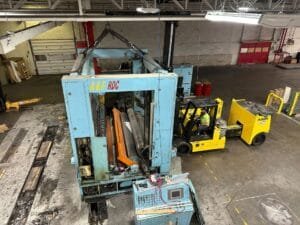
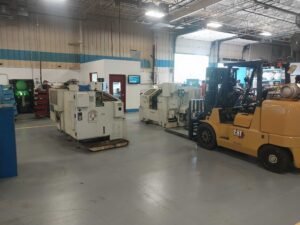
- Heavy-capacity forklifts with extended forks for machines designed for fork lifting.
- Versa-Lift or similar riggers’ forklifts for precise placement in tight bays.
- Gantry systems where overhead lifting is needed indoors.
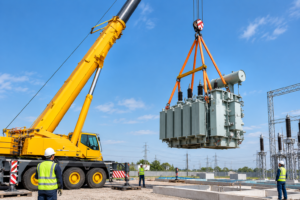
- Mobile cranes where a machine must be lifted over obstacles or through a roof opening.
Never lift a CNC machine by its sheet metal, spindle head or table. Use the OEM’s lifting points, rated spreader bars and slings with the correct angles. A miscalculated sling angle can bend a casting or crush a guard. See our list of common rigging mistakes that damage equipment for what to watch for.
Inspect the Move Path Again
On the morning of the move, walk the path. Confirm that nothing has been parked in the aisle, that floor plates are in place over trenches, and that the crew has the clearances from the survey.
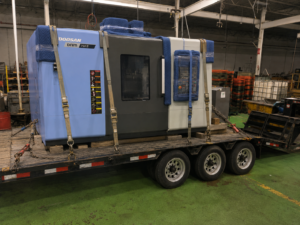
Load and Secure the Machine on the Trailer
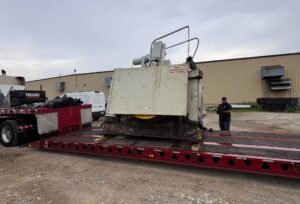
- Use a trailer suited to the load: flatbed, step deck, lowboy or air-ride, depending on height and sensitivity.
- Position the machine over the axles for correct weight distribution.
- Use chains or straps rated for the load, with edge protection, attached only at approved tie-down points.
- Block the machine against shifting forward, backward and sideways.
- Photograph the secured load before the truck leaves.
Transport
For short local moves, an experienced driver and careful routing are usually enough. For longer or interstate moves, the route, permits and trailer type matter more. Ask your carrier about air-ride suspension for sensitive machines and whether impact or tilt indicators should be fitted. Our heavy equipment moving and transport service covers both local and long-distance machine shipments.
Unload and Move Into Position
Unloading is the mirror of loading, often in a less familiar building. Confirm the receiving site has the right lifting equipment ready, and that the dock or door is clear. If you are relying on a forklift at the new site, read our tips on forklift-assisted unloading before your shipment arrives.
After the Move: Setting, Leveling and Recommissioning
A CNC relocation is not finished when the machine is on the floor. It is finished when the machine cuts good parts at the accuracy it had before.
1. Set the Machine on Its Footprint
- Place the machine on the marked footprint with leveling pads or jack screws positioned per the OEM drawing.
- Check service clearances for doors, panels and the chip conveyor.
- Anchor the machine if the manufacturer requires it.
2. Level the Machine
Leveling is not a formality. A twisted base produces inaccurate parts no matter how good the control compensation is.
- Use a precision machinist’s level, typically 0.0005 in/ft resolution or better.
- Level both along and across the table, and check for twist.
- Let the machine settle, then recheck. Heavy machines often need a second leveling after 24 to 72 hours, and again after several weeks on new concrete.
3. Remove Shipping Brackets and Reconnect Utilities
- Remove every shipping bracket and block. Keep a count so none are left installed. Running an axis into a bracket can cause a crash.
- Reconnect power, air, coolant, lube and network using the labels and photos.
- Verify incoming voltage and phase rotation before powering up.
- Refill lubricants and coolant.
4. Power Up in a Controlled Sequence
- Power the control first and check for alarms.
- Restore parameters and offsets from your backup if needed.
- Home each axis slowly while watching for interference.
- Warm up the spindle using the OEM’s break-in or warm-up program.
5. Recalibrate and Verify
- Run the same ballbar or geometry test you ran before the move and compare results.
- Adjust leveling first if results drift, then compensation.
- Recalibrate probes and tool setters.
- Cut the same reference part and compare it with the pre-move inspection report.
6. Close Out the Project
- Inspect the machine for transport damage and photograph it.
- File any damage claims promptly with the carrier or rigger.
- Update maintenance records with the new location, leveling date and calibration results.
- Schedule a follow-up leveling check.
If you prefer one contractor to handle everything from disconnection through power-up support, look for turnkey machine assembly and installation rather than a transport-only quote.
Common CNC Relocation Mistakes to Avoid
- Skipping the pre-move baseline. Without it, you cannot prove whether accuracy changed.
- Losing the shipping brackets. Improvised blocking rarely restrains axes as well as OEM hardware.
- Forgetting the backup battery. Lost encoder positions can mean a service call before the first cut.
- Setting the machine on uncured or undersized concrete. The machine settles and drifts out of level.
- Rushing the restart. One skipped leveling check can cost weeks of scrap.
- Choosing a general freight carrier. Truck drivers are not riggers. Moving CNC mills and lathes needs trained crews, which we explain in why professional riggers are needed.
Quick-Reference CNC Machine Relocation Checklist
| Phase | Task | Owner |
|---|---|---|
| 4 to 8 weeks before | Run baseline accuracy test and cut reference part | Maintenance or QC |
| 4 to 8 weeks before | Get OEM transport and foundation drawings | Maintenance |
| 4 to 8 weeks before | Site survey of both buildings and the route | Rigging contractor |
| 4 to 8 weeks before | Prepare foundation and mark the footprint | Facilities |
| 2 to 4 weeks before | Book electrician, air, network and OEM tech | Facilities |
| 1 week before | Back up parameters, offsets and programs | Programming |
| 1 week before | Remove tooling, drain coolant, clean chips | Operators |
| 1 to 2 days before | Install shipping brackets, secure ATC and doors | Rigger and maintenance |
| 1 to 2 days before | Disconnect, label and cap utilities | Electrician |
| Move day | Rig, load, secure, transport and unload | Rigging contractor |
| After setting | Level, remove brackets, reconnect, power up | Rigger, electrician, maintenance |
| After power-up | Recalibrate, compare to baseline, cut first part | OEM tech and QC |
| 1 to 4 weeks after | Recheck level and close out records | Maintenance |
Why Alltracon Is the Best Choice for CNC Machine Relocation
Alltracon has relocated CNC mills, lathes and machining centers for manufacturers since 2016. Our riggers, millwrights and drivers handle every step in-house: site surveys, disconnection, rigging, trucking, setting and leveling. With 24/7 support, WBE certification and ISNetworld compliance, Ohio manufacturers trust us to protect accuracy and meet deadlines.
Frequently Asked Questions About CNC Machine Relocation
How long does it take to relocate a CNC machine?
A single machine moved within the same building can often be disconnected, moved and set in one or two days. A move to another site typically takes two to five days including recommissioning. Planning should start four to eight weeks ahead.
Does a CNC machine need to be recalibrated after moving?
Yes, in almost every case. At minimum it must be releveled and checked against a baseline accuracy test. Many machines also need compensation adjustments, probe recalibration and a test cut.
Can I move a CNC machine with a regular forklift?
Small machines designed for fork lifting can be moved with a properly rated forklift. Larger machining centers usually need jacks, skates, a riggers’ forklift, a gantry or a crane, plus trained riggers who know the machine’s center of gravity.
What does it cost to move a CNC machine?
Cost depends on weight, distance, access at both sites, the rigging equipment required and how much disconnection and recommissioning is included. Ask for a written scope so you can compare quotes on the same basis.
Who should disconnect the electrical supply?
A licensed electrician should disconnect and reconnect the power supply. Your rigging contractor can coordinate the electrician as part of a turnkey move.
Plan Your CNC Relocation With Confidence
A CNC machine relocation goes smoothly when every step is planned, documented and assigned. Use this checklist as your starting point, then bring in an experienced rigging partner to fill in the details for your machine and your buildings.
Ready to move a mill, lathe or full machining cell? Request a free quote from Alltracon or call 440-941-6208 to talk through your project.