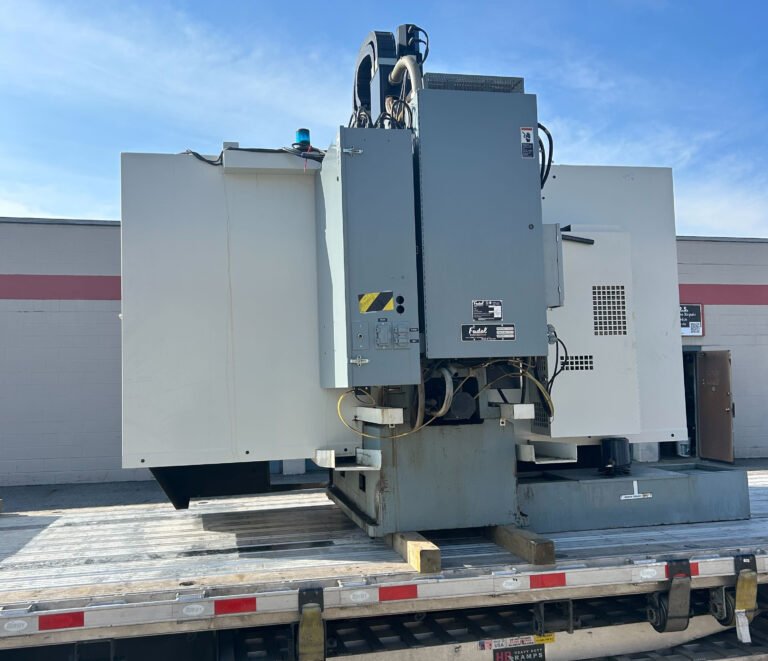
A CNC machine is often the most valuable asset on a shop floor. It can weigh anywhere from a couple of tons to well over fifty, carry hundreds of thousands of dollars in precision components and hold tolerances measured in microns. It also earns money every hour it runs, and loses money every hour it does not.
That is why CNC machine moving is not a job for a general mover or a forklift and a free weekend. Whether you are shifting one vertical machining center across the shop, bringing in a new 5-axis machine or relocating an entire machine shop, the move has to protect the machine’s accuracy, keep your people safe and get you back into production on schedule.
This guide covers the whole process from start to finish. You will learn what a professional CNC move involves, how to plan and prepare, which rigging and transport methods are used, what changes by machine type, how machines are installed and brought back to accuracy, what drives cost and how to choose the right mover.
What CNC Machine Moving Involves
CNC machine moving covers any job where a CNC machine is disconnected, moved and set up again in a new spot. Most moves fall into one of four types.
- In-plant moves. The machine moves within the same building, often to make room for new equipment or to improve workflow.
- Local moves. The machine goes to another building nearby, usually on a single truck.
- Long-distance moves. The machine travels across states or between countries, often with crating and special trailers.
- Plant relocations. An entire shop or plant moves, with many machines sequenced over weeks or months.
A new or used machine being delivered and installed follows the same steps, minus the removal.
The full scope of a professional move
A complete CNC move is much more than lifting and hauling. A turnkey contractor typically handles:
- Site survey and move planning
- Electrical disconnect and utility shutoff
- Draining coolant, oil and hydraulic fluid
- Securing axes, spindle heads and loose components
- Partial disassembly where needed for size or weight
- Rigging and moving the machine out
- Loading, securing and trucking
- Storage or crating if the new site is not ready
- Setting, leveling and anchoring at the new site
- Reassembly, reconnection and startup support
When one team owns every step, nothing falls between vendors. When three or four companies share the job, every handoff is a chance for delay or damage.
Why CNC Machines Need Specialist Movers
CNC machines are heavy, but weight is not the main challenge. Four things make them harder to move than most industrial equipment.
Precision. A CNC machine’s accuracy depends on the geometry of its castings, ways and spindle. Twisting the base during a lift, dropping it a few inches or setting it on an uneven surface can throw that geometry out. Some damage only shows up later as poor part finish or parts out of tolerance.
Weight distribution. Many CNC machines are top-heavy or have their center of gravity well off center because of the spindle head, column, tool changer or turret. Lifting them like a box can tip them. Riggers must find the center of gravity and lift only at approved points.
Sensitive components. Ballscrews, linear guides, spindles, encoders, scales and control electronics can all be damaged by shock, vibration or moisture. These are expensive parts with long lead times.
Downtime. Every day a CNC machine is down costs lost output, missed deliveries and idle operators. A good mover plans the move to keep that window as short as possible.
A general mover may have the trucks, but not the rigging equipment, millwright skills or machine knowledge to manage these risks.
Planning a CNC Machine Move
The success of a CNC move is mostly decided before the machine is touched. Good planning covers five areas.
Site survey
Your mover should visit both the current location and the destination. They will check the machine, its connections, the floor, the exit path and the setting location. For a new machine, the builder’s installation manual gives weight, footprint, lifting points and foundation requirements.
The path
Measure every doorway, aisle, ramp and overhead obstruction along the route, both out of the old building and into the new one. Watch for overhead cranes, pipes, lights, sprinkler heads and electrical conduit. If the machine will not fit, plan for partial disassembly, removing a wall panel or lifting through the roof.
Floors and foundations
Check that the floor along the path can carry the machine plus the rigging equipment. At the destination, confirm that the slab or foundation meets the builder’s requirements. Large and precision machines often need a dedicated foundation that is poured and cured weeks ahead of the move.
Utilities at the new location
Power, compressed air, network and coolant supply should be ready before the machine arrives. Confirm voltage and capacity against the machine’s nameplate.
Schedule and downtime
Build a schedule that works backward from your production needs. Many shops build extra inventory before the move, schedule work around weekends or planned shutdowns and move machines in a set order so the most critical ones are down the shortest time.
Preparing the Machine for the Move
Once the plan is set, the machine itself has to be made ready. These steps protect it from damage and make reinstallation faster.
- Record its condition. Note current accuracy, any known issues and recent test results. Photograph the machine and its connections. If you have ballbar or laser data, keep it for comparison after the move.
- Back up the control. Save parameters, programs, PLC logic, pitch error compensation and tool data. Store copies off the machine.
- Position the axes. Move axes to the shipping position given in the builder’s manual, usually centered so weight is balanced and screws are protected.
- Disconnect safely. Shut down, lock out and have a qualified electrician disconnect power. Disconnect air, coolant lines and network cables, and label everything.
- Drain fluids. Empty coolant tanks, chip conveyors and, where required, hydraulic and lubrication reservoirs.
- Install shipping brackets. Fit the builder’s shipping brackets and axis locks to hold the table, saddle, spindle head and turret in place. Without them, axes can slam against their stops on the road and damage screws and bearings.
- Secure loose parts. Remove or tie down tool magazines, chip conveyors, doors, pendants, bar feeders and accessories. Remove tools from the magazine.
- Protect precision surfaces. Clean and coat bare steel with rust preventive and wrap the machine if it will be stored or shipped long distances.
If you no longer have the shipping brackets, ask the builder for drawings or have your mover fabricate replacements before moving day.
Rigging Methods for CNC Machines
The right rigging method depends on the machine’s weight, shape and lifting points, and on the space around it. Most moves use a combination of these.
| Method | When it is used | Watch out for |
| Toe jacks and hydraulic jacks | Raising the machine to get skates or cribbing underneath | Lifting only at approved points, raising evenly |
| Machine skates | Rolling the machine across a floor, through doors and tight spaces | Floor condition, cracks and seams that stop rollers |
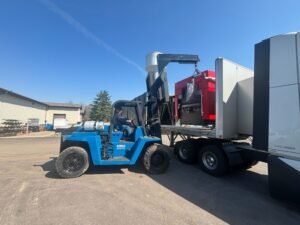
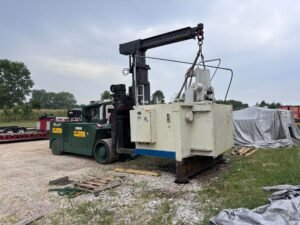
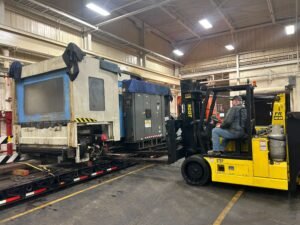
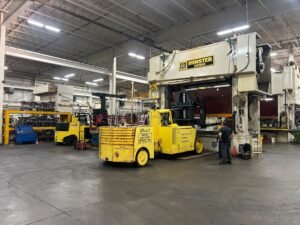
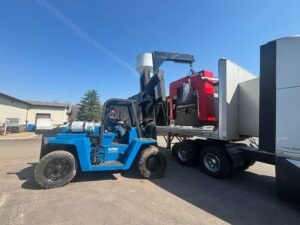
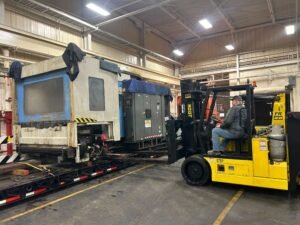
| Counterweight forklifts | Lifting and carrying machines on open floors and loading trucks | Rated capacity at the load’s center, visibility, tipping |
| Hydraulic gantry | Lifting heavy machines indoors where a crane cannot reach | Floor loading under the gantry legs, level track |
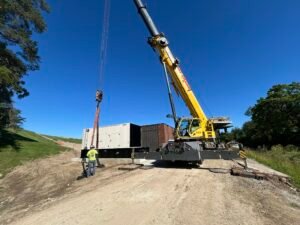
| Mobile crane | Lifting out of or into buildings through roofs or large doors, and loading heavy machines | Lift plan, ground conditions, overhead hazards |
| Air casters | Moving very heavy loads across smooth, sealed floors | Floors must be flat and non-porous |
Whatever the method, the rigging plan should name the machine’s weight, center of gravity, lifting points, equipment capacities and the people in charge. Spreader bars are often used to keep slings off covers, sheet metal and the control cabinet.
Transport, Crating and Storage
Once the machine is out of the building, the trip has its own risks.
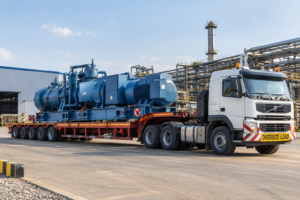
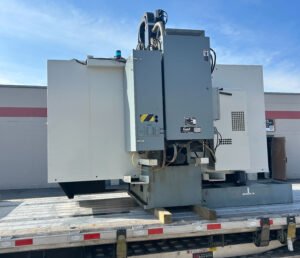
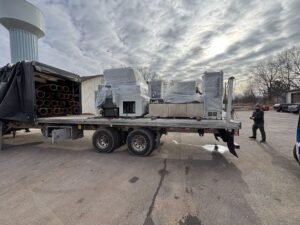
Choosing the trailer. Air-ride trailers reduce shock and vibration and are preferred for precision CNC machines. Flatbeds and step decks handle taller machines. Lowboys and multi-axle trailers carry the heaviest machines and may need oversize or overweight permits.
Securing the load. Chains and binders go on the machine’s base or skid, never on sheet metal, guards or way covers. Blocking keeps the base from sliding. The load should be checked after the first few miles and at stops.
Weather protection. Tarp machines on open trailers and protect them from rain and winter road salt. Moisture is one of the most common causes of damage in transit.
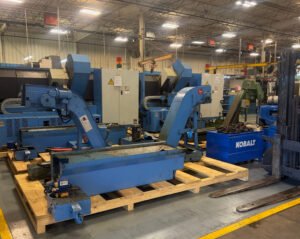
Crating. Long-distance and export moves usually call for a skid and crate. Export crates must use ISPM 15 heat-treated wood. Crated machines are typically wrapped in VCI film or sealed barrier bags with desiccant inside.
Storage. If the new building is not ready, the machine may need to be stored. Indoor, dry storage is strongly preferred for CNC equipment, with the machine kept off bare concrete and checked on a schedule.
Considerations by Machine Type
The basic process is the same for every CNC machine, but each type has its own weak points.
| Machine type | Key moving considerations |
| Vertical machining centers (VMC) | Top-heavy column and spindle head, shipping brackets for table and head, tool changer secured |
| Horizontal machining centers (HMC) | Pallet changer and pool, rotary table, often moved in sections, tight leveling at reinstall |
| CNC lathes and turning centers | Turret and tailstock secured, bar feeder disconnected and realigned, chuck protected |
| 5-axis machines | Trunnion or swivel head locked, rotary axes protected, full accuracy check after the move |
| Swiss-type lathes | Compact but precise, guide bushing and bar feeder alignment critical |
| Grinders | Very sensitive ways and spindles, wheel removed, strict leveling |
| Wire and sinker EDMs | Dielectric drained, filters and wire system secured, precise leveling |
| Fiber laser cutting machines | Long gantry frames, chiller and optics protected, often partly disassembled |
| Press brakes | Very top-heavy, lifted only at approved points, ram and back gauge secured |
| Large boring, gantry and bridge mills | Moved in sections, crane or gantry lifts, foundation and geometry restored on site |
The builder’s manual is always the first reference. It lists lifting points, shipping brackets, axis positions and leveling requirements for that exact model.
Installation, Leveling and Recommissioning
A CNC machine is not moved until it is making accurate parts again. Installation is where millwright skill matters most.
- Set the machine. Place it on the marked location, on leveling pads or anchor bolts as the builder specifies.
- Level it. Use a precision machinist’s level to bring the machine within the builder’s tolerance. Leveling is not only about making the machine flat. It also removes twist from the base, which directly affects axis straightness and squareness.
- Anchor and grout if required. Some machines are bolted or grouted to their foundation. Recheck the level after tightening.
- Remove shipping brackets. Remove every bracket and axis lock before any axis is moved. Keep them for future moves.
- Reassemble and reconnect. Refit removed components, then reconnect power, air, coolant and network. Check motor rotation and voltages.
- Restore the control. Load parameters and programs from the backup and confirm nothing was lost.
- Check accuracy. Run test cuts, a ballbar test or a laser alignment check and compare with results from before the move. Adjust geometry if needed.
- Recheck after settling. New concrete and grout can settle. Recheck the level after a few weeks of production.
For machines under warranty or with complex systems, the builder may require its own technician to perform or approve startup.
Why Alltracon Is Ohio’s Best Choice for CNC Machine Moving
Alltracon is Ohio’s go-to CNC machine mover. From our Medina base, our millwrights and riggers handle disconnect, draining, rigging, trucking, storage, setting, leveling and reconnection under one contract. We plan every move around your production deadline, so your CNC machines get back to making accurate parts fast, with no excuses.
What Does CNC Machine Moving Cost?
There is no standard price for moving a CNC machine, because every move is different. A small machine moved across the same shop may take a few hours. A large horizontal machining center moved to another state may take a crew several days at each end. These are the factors that drive the quote.
- Machine size and weight, which set the rigging equipment and trailer needed.
- Access, including tight doors, upper floors, basements and long paths.
- Disassembly, if the machine must be split into sections to fit or meet weight limits.
- Distance and trailer type, from an in-plant move to a long-distance haul with permits.
- Scope, such as whether the mover also handles disconnect, reconnection, leveling and startup support.
- Crating and storage, if the machine will be exported or stored before installation.
- Timing, since night, weekend and holiday work costs more but can save a lot of downtime.
- Foundation and site work, if new pads, pits or electrical drops are needed.
The cheapest quote is rarely the lowest total cost. Damage to a spindle, a ballscrew or a control can cost far more than the move itself, and a slow restart costs lost production every day. Compare quotes on scope, experience, insurance and schedule, not just price.
How to Choose a CNC Machine Mover
Ask these questions before you sign a contract.
- Have you moved this type and size of machine before? Ask for examples and references from similar jobs.
- Will you visit the site before quoting? A quote without a site survey is a guess.
- What exactly is included? Get disconnect, draining, rigging, trucking, setting, leveling and reconnection spelled out in writing.
- Do you have your own millwrights? Movers with in-house millwrights can level, align and reassemble the machine instead of dropping it and leaving.
- What equipment do you own? Skates, gantries, forklifts and trucks on hand mean fewer scheduling delays.
- What insurance do you carry? Ask for rigger’s liability and cargo coverage that matches the machine’s value, and a certificate of insurance.
- What is your safety record? Ask about safety programs, training and incident history.
- How will you protect my schedule? A good mover builds the plan around your production deadlines and tells you what they need from you and when.
A mover who asks you as many questions as you ask them is usually a good sign.
Common CNC Moving Mistakes
- Skipping shipping brackets. Axes that are free to move can damage ballscrews and bearings on the first bump.
- Lifting at the wrong points. Slings on covers, guards or the column can twist the machine or tip it.
- Not backing up the control. A lost parameter set can keep a machine down for days.
- Leaving coolant in the machine. Coolant spills on the road and leaves a corrosive film behind.
- Ignoring the floor. Weak slabs, seams and trench covers can crack or give way under heavy loads.
- Rushing the install. A machine set out of level will make bad parts and wear out faster.
- Using too many vendors. Splitting the job between a rigger, a trucker and an electrician without one person in charge invites delays.
Frequently Asked Questions
How long does it take to move a CNC machine?
A single machine moved within a plant can often be disconnected, moved, set and reconnected in one or two days. Long-distance moves usually take several days including transport. A full machine shop relocation can take weeks, depending on the number of machines and how the move is phased.
Can I move a CNC machine with a forklift?
Some smaller CNC machines can be moved with a properly rated forklift, using the builder’s approved lifting points. Many machines are too heavy, too top-heavy or too sensitive for a forklift alone. If in doubt, ask a professional rigger.
Do I need to relevel a CNC machine after moving it?
Yes. Every CNC machine should be leveled after a move, and its accuracy should be checked. Even a short move across the shop can change how the machine sits on the floor.
Will moving my CNC machine void the warranty?
It can, if the builder requires its own technician to approve relocation. Check your warranty terms before the move and involve the builder when required.
What should I do with the machine’s tools and workholding?
Remove tools from the magazine and spindle, and take off chucks, vises and fixtures where the builder recommends it. Pack them separately and label them by machine.
How far in advance should I book a CNC machine mover?
For a single machine, a few weeks is often enough. For a plant relocation or a move that needs a crane, permits or new foundations, start planning several months ahead.
Conclusion
CNC machine moving is a precision job from start to finish. The machine has to be planned for, prepared, rigged, transported and installed in a way that protects its accuracy and gets it back into production as quickly as possible.
The essentials are simple: survey the site and the path, back up the control, install shipping brackets, lift only at approved points, protect the machine on the road, level it carefully at its new home and verify accuracy before running parts. Above all, choose an experienced mover who can manage every step as one project.
Moving a CNC machine or a full machine shop in Ohio or the surrounding states? Request a quote or call Alltracon to schedule a site visit.