Relocating a factory is one of the most demanding logistical undertakings a business can face. Unlike moving an office or a warehouse, factory relocation involves transporting machinery that can weigh tens or hundreds of tons, often with delicate calibration requirements, irregular shapes, and zero tolerance for damage. Add in tight production deadlines, multi-story layouts, and the need to keep downtime to a minimum, and it becomes clear why complex factory relocations demand far more than a standard moving crew.
This is where specialized crane and rigging solutions become essential. From engineering the lift plan to executing precision moves in confined spaces, professional rigging teams bring the technical expertise required to relocate an entire factory without compromising safety, timelines, or equipment integrity. In this article, we’ll break down exactly how crane and rigging solutions address the unique challenges of complex factory relocations — and what to look for when choosing a provider for your next project.
For many manufacturers, a factory relocation happens only once in a decade — or once in a company’s entire history. That infrequency means most internal teams simply don’t have the muscle memory to plan and execute a move of this scale. Rigging specialists, on the other hand, run these projects continuously, which is why their involvement so often determines whether a relocation stays on schedule and on budget, or spirals into costly delays.
What Makes a Factory Relocation “Complex”?
Not every factory move is created equal. A relocation is typically classified as complex when it involves one or more of the following factors:
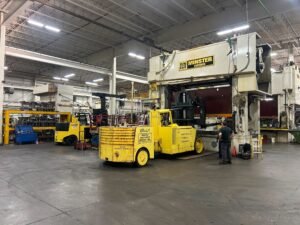
- High-value or oversized equipment such as stamping presses, CNC machines, turbines, or reactor vessels
- Multiple production lines that must be disassembled, transported, and reassembled in sequence
- Tight facility access, including narrow doorways, low ceiling clearances, or multi-floor layouts
- Aggressive timelines driven by lease expirations, production commitments, or contractual deadlines
- Cross-jurisdictional transport requiring permits, escorts, or road closures for oversized loads
- Sensitive or hazardous materials that require specialized handling during the move
When any of these variables come into play, the relocation shifts from a straightforward move into a project that requires detailed engineering, specialized equipment, and a highly coordinated rigging team.
It’s also worth recognizing that complexity often compounds. A single oversized press might be manageable on its own, but combine it with a tight production deadline, a multi-story destination facility, and permitting requirements for interstate transport, and the project’s risk profile increases exponentially rather than linearly. This is precisely why experienced crane and rigging providers approach complex relocations holistically — evaluating how each variable interacts with the others — rather than treating each piece of equipment as an isolated lift.
The Role of Crane and Rigging Solutions in Factory Relocation
1. Comprehensive Site Assessment and Lift Engineering
Before any equipment is touched, experienced rigging providers conduct a full site assessment covering both the origin and destination facilities. This includes:
- Verifying equipment weights, dimensions, and center of gravity
- Assessing floor load capacity and structural integrity at both locations
- Identifying access constraints such as doorways, stairwells, and ceiling heights
- Reviewing overhead obstructions like sprinkler systems, ductwork, or lighting fixtures
- Mapping the safest and most efficient equipment travel path
This engineering-first approach ensures that every lift is planned around real, verified data rather than assumptions — a critical distinction when a single miscalculation could damage a multi-million-dollar piece of equipment.
Many providers also conduct a parallel assessment of the destination facility long before the first machine leaves the origin site. This means confirming that foundations, utility hookups, and floor space at the new location can actually accommodate the equipment as planned — including clearances for future maintenance access. Catching a mismatch between equipment footprint and destination layout during the planning phase, rather than on move day, can save weeks of costly rework.
2. Custom Rigging Configurations for Irregular Loads
Factory equipment rarely has a uniform shape or evenly distributed weight, which makes generic rigging approaches risky. Professional crane and rigging teams design custom configurations for each piece of equipment, including:
- Spreader bars to distribute load across multiple lift points
- Custom-fabricated lifting lugs or brackets for equipment without factory-installed lift points
- Sling angle calculations to avoid overstressing rigging hardware
- Counterweighted rigging for asymmetrical loads
This level of customization prevents damage to sensitive components and ensures that even irregularly shaped machinery — such as extrusion lines, robotic arms, or large tanks — can be lifted and transported safely.
3. Selecting the Right Crane and Equipment Mix
Complex factory relocations often require more than one type of lifting equipment, depending on the location and stage of the move. Common solutions include:
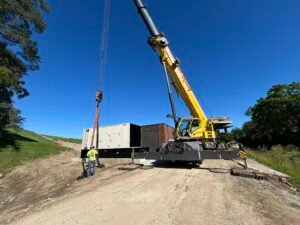
- Mobile and all-terrain cranes for outdoor loading and unloading
- Crawler cranes for heavy lifts on soft or uneven ground
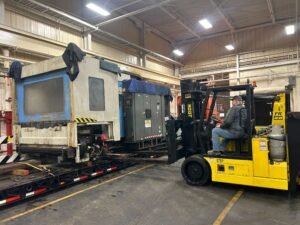
- Hydraulic gantry systems for indoor moves where a traditional crane can’t access the space
- Skidding and rolling systems for horizontal repositioning without lifting
- Overhead bridge cranes for repetitive indoor lifts within the facility
A skilled rigging provider will often combine several of these methods within a single relocation project — for example, using a gantry system to extract equipment from a tight production area, then a crawler crane to load it onto a transport trailer.
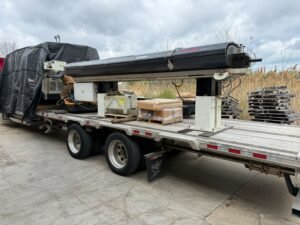
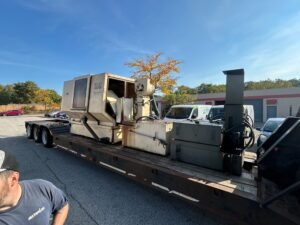
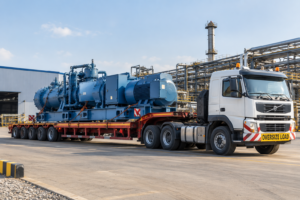
Equipment selection also extends to transport itself. Complex factory relocations frequently require specialized trailers — such as lowboys, hydraulic platform trailers, or multi-axle configurations — matched to the weight and dimensions of each load. Choosing the wrong trailer type can result in permitting delays or unsafe road transport, which is why experienced providers coordinate crane selection and transport logistics as a single integrated plan rather than two separate decisions.
4. Disassembly, Transport, and Reassembly Coordination
Many factory relocations require equipment to be partially or fully disassembled before it can be moved, then reassembled and recalibrated at the new location. Crane and rigging providers often coordinate this entire process, working alongside millwrights and equipment manufacturers to ensure:
- Components are labeled and documented for accurate reassembly
- Sensitive parts are protected during transport
- Reassembly sequencing minimizes installation time
- Equipment is releveled and aligned to manufacturer specifications post-move
This end-to-end coordination reduces the risk of miscommunication between separate moving, transport, and installation teams — a common source of delays in poorly managed relocations.
5. Sequencing Multi-Line Moves to Minimize Downtime
When an entire factory is relocating, moving everything at once simply isn’t feasible. Instead, experienced rigging teams develop a phased sequencing plan that considers:
- Which production lines can be moved first without halting overall output
- How to stage equipment at the new facility so installation can begin before the entire move is complete
- Coordinating parallel workstreams, such as running new utility connections while old equipment is still operating
- Building in buffer time for unexpected complications without derailing the overall schedule
This phased approach is one of the most effective ways crane and rigging solutions reduce total downtime during a complex factory relocation, allowing portions of the facility to resume production while other areas are still being moved.
Safety Considerations in Complex Factory Relocations
Given the scale and risk involved in factory relocation, safety must be built into every phase of the rigging process. Key safety practices include:
- Pre-lift safety briefings for all crew members before each major lift
- Established exclusion zones to keep non-essential personnel clear of active lifting areas
- Routine equipment inspections to catch mechanical wear or damage before it causes a failure
- Weather and environmental monitoring, particularly for outdoor crane operations
- Strict adherence to OSHA and ANSI rigging standards, including certified operator requirements
Because factory relocations often involve working around live utilities, existing production equipment, and employees still on-site, safety planning must also account for coordination with facility staff — not just the rigging crew itself.
This coordination is often formalized through a joint safety orientation between the rigging crew and the client’s facility team before work begins, ensuring everyone understands exclusion zones, emergency procedures, and communication protocols. In facilities where production continues in adjacent areas during the move, this kind of cross-team alignment is essential to prevent accidental interference between rigging operations and ongoing manufacturing activity.
Common Challenges in Factory Relocation and How Rigging Solutions Solve Them
Equipment too large for standard doorways or hallways
Solution: Rigging teams use hydraulic gantries, skid systems, or partial disassembly to navigate equipment through constrained spaces without structural modifications to the building.
Uneven or insufficient floor load capacity
Solution: Engineers calculate ground bearing pressure and use load-spreading mats, cribbing, or alternative crane placement to prevent structural damage.
Equipment sensitive to vibration or tilt
Solution: Custom rigging configurations and slow, controlled lifts using precision leveling equipment protect delicate machinery from shock damage.
Tight relocation deadlines
Solution: Phased sequencing and parallel workstreams allow portions of the facility to resume operations before the entire relocation is finished.
Coordinating multiple vendors and contractors
Solution: A single rigging provider managing the full scope of the lift, transport, and reinstallation reduces communication gaps between separate teams.
Recalibration and downtime after reassembly
Solution: Rigging teams coordinate closely with millwrights and OEM technicians so machines are releveled, aligned, and tested immediately after reinstallation, cutting the gap between “equipment on-site” and “equipment producing.”
Technology’s Growing Role in Crane and Rigging Solutions
Modern rigging providers increasingly rely on technology to improve accuracy and reduce risk during complex factory relocations:
- 3D site scanning and digital modeling to plan equipment travel paths before mobilization
- Load monitoring sensors that provide real-time weight and stress data during lifts
- Digital load charts for instant crane capacity calculations based on boom angle and radius
- Project management software to coordinate scheduling across disassembly, transport, and reinstallation teams
These tools allow rigging providers to identify potential issues — such as a doorway that’s a few inches too narrow, or a floor that can’t support a planned crane placement — before they become costly on-site surprises.
Some providers are also adopting cloud-based dashboards that give clients real-time visibility into project status, from equipment tagged for transport to reassembly milestones at the new facility. For plant managers overseeing a relocation alongside their normal responsibilities, this kind of transparency reduces the need for constant status check-ins and makes it easier to flag issues early.
The Value of a Single-Source Rigging Partner
One of the most overlooked benefits of working with a dedicated crane and rigging provider is consolidation. Rather than separately hiring a crane rental company, a trucking firm, a millwright crew, and a project manager to stitch it all together, businesses can engage a single provider who owns accountability for the entire lift-to-reinstallation process. This reduces the number of handoffs — and the number of places where miscommunication can creep in — while also simplifying contracts, insurance coordination, and on-site scheduling. For a project as high-stakes as a factory relocation, that single point of accountability is often worth as much as the equipment itself.
Questions to Ask When Choosing a Crane and Rigging Provider for Factory Relocation
- Do you have experience relocating equipment similar to ours?
- Can you provide a detailed lift and sequencing plan before the project begins?
- Are your riggers and crane operators certified?
- How do you handle disassembly, transport, and reassembly coordination?
- What safety protocols are in place for lifts around active production areas?
- How do you manage permits and compliance for oversized transport?
- What contingency plans do you have for unexpected site conditions?
A provider who can answer these questions with specific, detailed responses — rather than generic assurances — is far more likely to deliver a smooth, well-managed relocation.
Why Alltracon Is a Trusted Choice for Crane and Rigging Solutions
For complex factory relocations, Alltracon brings the heavy haul and rigging expertise businesses need to move equipment safely and efficiently. With experienced crews, well-maintained equipment, and a strong focus on careful planning and safety compliance, Alltracon delivers dependable crane and rigging support tailored to the demands of large-scale industrial relocations.
Conclusion
Complex factory relocations demand more than brute lifting power — they require engineering precision, custom rigging solutions, and carefully sequenced execution to protect valuable equipment while minimizing downtime. From initial site assessment through disassembly, transport, and reassembly, professional crane and rigging providers bring the specialized expertise needed to navigate tight spaces, irregular loads, and aggressive timelines without compromising safety.
For businesses planning a factory relocation, partnering with an experienced rigging team isn’t just a convenience — it’s the difference between a costly, disruptive project and a smoothly executed transition that keeps production moving. As facilities grow larger and equipment becomes more specialized and costly to replace, the value of a rigging partner who can engineer, coordinate, and execute the entire move under one roof will only continue to grow.