Automated welding machines have become essential assets in modern manufacturing plants. From automotive production and metal fabrication to aerospace, heavy equipment, and industrial component manufacturing, automated welding systems help companies improve speed, consistency, accuracy, and productivity. These machines are designed to perform welding operations with minimal manual intervention, often using robotic arms, programmable controls, welding fixtures, turntables, positioners, and safety enclosures.
Because these systems are highly valuable and technically complex, transporting them requires careful planning. Moving an automated welding machine is not the same as moving ordinary shop equipment. It involves handling precision components, electrical controls, robotic systems, welding power sources, sensors, cabling, gas lines, and sometimes complete welding cells. If the equipment is not moved correctly, the result can be downtime, calibration problems, production delays, or expensive repairs.
For manufacturing plants, successful automated welding machine transport depends on proper preparation, professional rigging, safe loading, secure transportation, and accurate reinstallation. Every stage of the move must be managed with attention to safety, equipment protection, and production continuity.
What Is an Automated Welding Machine?
An automated welding machine is a system designed to perform welding tasks automatically or semi-automatically. Instead of relying only on manual welding, these machines use programmed motion, controlled welding parameters, and mechanical positioning to create consistent welds.
Automated welding equipment may include:
- Robotic welding arms
- Welding power sources
- Wire feeders
- Welding torches
- CNC or PLC control systems
- Turntables and positioners
- Fixtures and clamps
- Safety fencing or enclosures
- Fume extraction systems
- Cooling systems
- Gas supply connections
- Vision or seam-tracking sensors
These systems are commonly used where repeatability, speed, and weld quality are important. In manufacturing plants, automated welding helps reduce labor dependency, increase throughput, and maintain consistent quality across large production runs.
Why Automated Welding Machine Transport Requires Special Care
Automated welding systems are not only heavy; they are also sensitive. A robotic welding cell may contain moving arms, servo motors, control cabinets, sensors, cables, programming modules, and precision fixtures. Even small misalignment can affect weld quality after reinstallation.
For example, if a robotic arm is shifted incorrectly or a fixture is damaged, the machine may not weld in the exact programmed location. If control cables are not labeled properly, reconnecting the system can become difficult. If the welding power source or controller is exposed to vibration or moisture during transport, it may cause electrical faults.
The main risks include:
- Damage to robotic arms or axes
- Misalignment of welding fixtures
- Cable and connector damage
- Control panel or PLC issues
- Gas line or coolant line problems
- Loss of calibration
- Production downtime
- Safety hazards during lifting or loading
This is why manufacturing plants should treat automated welding machine transport as a specialized industrial relocation project.
Common Types of Automated Welding Equipment Moved in Manufacturing Plants
Automated welding systems vary widely depending on the industry and production process. Some are compact, while others are large integrated systems that require partial dismantling before transport.
Robotic Welding Cells
Robotic welding cells usually include a robot arm, controller, welding power supply, safety fencing, fixtures, and sometimes a turntable or positioner. These systems are common in automotive, fabrication, and equipment manufacturing.
Cobot Welding Systems
Collaborative robot welding systems, often called cobot welders, are smaller and designed to work near human operators. They may still require careful handling because the robotic arm, controller, and welding equipment must remain protected during movement.
Seam Welding Machines
Seam welding machines are used for continuous welds on tanks, pipes, cylinders, and sheet metal assemblies. They may include rollers, linear tracks, welding heads, and control systems.
Spot Welding Machines
Automated spot welding machines are widely used in sheet metal and automotive production. They may have heavy frames, electrodes, pneumatic systems, and control cabinets.
Welding Positioners and Turntables
Many automated welding setups include rotating tables or positioners that hold parts in place during welding. These can be heavy and must be moved without damaging bearings, motors, or alignment surfaces.
Complete Welding Lines
Some manufacturing plants use full welding lines with conveyors, multiple robots, fixtures, indexing tables, and safety systems. Moving these systems requires a detailed dismantling and reassembly plan.
Planning the Transport Project
The first step in automated welding machine transport is planning. A proper plan helps reduce risk, avoid delays, and make sure the equipment reaches the new location safely.
Before the move begins, the project team should answer important questions:
- What type of automated welding system is being moved?
- What are the machine dimensions and weight?
- Does it need to be dismantled?
- Are there robotic arms, fixtures, or controllers that must be removed separately?
- What utilities need to be disconnected?
- Is there enough clearance through doors, aisles, and loading areas?
- What lifting equipment is required?
- Does the machine need special protection during transport?
- Who will reconnect and test the system after delivery?
For larger manufacturing plants, the move should be coordinated with production schedules. Many companies prefer to move equipment during planned shutdowns, weekends, or low-production periods to reduce operational disruption.
Site Inspection Before Moving
A professional site inspection is one of the most important parts of the process. The rigging or machinery moving team should inspect both the current location and the destination.
At the origin site, they should review:
- Machine access
- Aisle width
- Door height and width
- Floor condition
- Overhead obstructions
- Utility connections
- Loading dock access
- Crane or forklift access
- Safety requirements
At the destination site, they should check:
- Final placement area
- Floor load capacity
- Electrical supply
- Gas and air connections
- Ventilation or fume extraction setup
- Clearance for operation and maintenance
- Anchoring or leveling requirements
- Path from unloading point to final location
This inspection helps determine whether the machine can be moved in one piece or whether it must be separated into components.
Documenting the Machine Before Transport
Before disconnecting or moving the automated welding machine, the system should be fully documented. This is especially important for robotic welding cells and multi-component systems.
Documentation should include:
- Photos of the machine from all sides
- Photos of cable connections
- Photos of gas lines and air lines
- Control cabinet layout
- Robot arm position
- Fixture setup
- Safety enclosure layout
- Welding parameter backups
- Software and program backups
- Serial numbers and model details
Labeling is equally important. Every cable, hose, connector, and removable component should be tagged clearly. This saves time during reinstallation and reduces the risk of mistakes.
Disconnecting Utilities Safely
Automated welding machines often depend on several utility connections. These may include electricity, compressed air, shielding gas, cooling water, data cables, exhaust systems, and grounding connections.
Before transport, qualified technicians should safely disconnect:
- Main electrical power
- Welding power source connections
- Shielding gas lines
- Compressed air lines
- Water or coolant lines
- Network cables
- Safety interlock wiring
- Fume extraction ducts
- Grounding cables
The machine should be shut down according to the manufacturer’s recommended procedure. Improper shutdown can cause controller errors, software issues, or safety faults when the equipment is restarted.
Protecting Robotic Arms and Precision Components
Robotic welding systems contain sensitive mechanical and electronic parts. The robot arm should be secured in a safe transport position. If required, the arm may be locked, braced, or removed from its base.
Important components to protect include:
- Robot joints and axes
- Servo motors
- Welding torch
- Cable harnesses
- Teach pendant
- Control cabinet
- Welding power source
- Wire feeder
- Sensors and cameras
- Fixtures and clamps
- Positioners and turntables
Loose components should be removed and packed separately. Sensitive electronics should be protected from moisture, impact, dust, and vibration.
Rigging and Lifting Automated Welding Machines
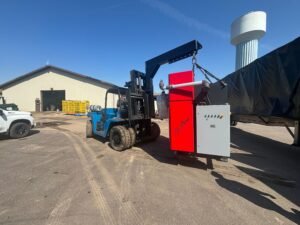
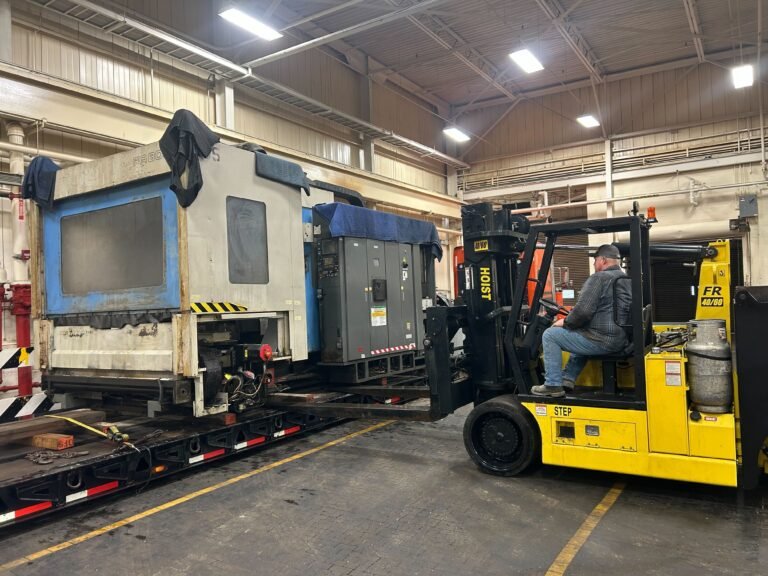
Rigging is the process of lifting, moving, and positioning heavy equipment using specialized tools and techniques. Automated welding machines may require forklifts, cranes, machinery skates, toe jacks, gantries, or Versa-Lift equipment depending on the size and location.
The lifting plan should consider:
- Machine weight
- Center of gravity
- Approved lifting points
- Fragile components
- Floor condition
- Clearance restrictions
- Operator safety
- Load balance
Using the wrong lifting point can bend frames, damage robot bases, or affect alignment. For complete robotic cells, the system may need to be dismantled into sections before lifting.
Loading the Equipment for Transport
Once the machine is removed from the plant floor, it must be loaded carefully onto a suitable truck or trailer. The type of transport depends on the equipment size, weight, distance, and protection requirements.
Possible transport options include:
- Enclosed truck
- Flatbed trailer
- Step-deck trailer
- Lowboy trailer
- Air-ride trailer
- Crated export shipment
For sensitive automated welding equipment, air-ride transport may be preferred to reduce vibration. If the machine is transported on an open trailer, it should be properly wrapped, tarped, or crated to protect it from weather and road debris.
Securing the Machine During Transport
Proper load securement is critical. The equipment must be blocked, braced, and tied down to prevent shifting during transit. However, tie-downs must not be placed on delicate components such as robotic arms, control cabinets, cables, or sensors.
Safe securement may include:
- Heavy-duty straps or chains
- Blocking and bracing
- Protective padding
- Corner guards
- Crates or skids
- Shock protection for sensitive parts
- Weatherproof coverings
The goal is to prevent movement while also avoiding unnecessary stress on the machine structure.
Transporting the Machine to the New Facility
During transport, the route should be planned carefully. For oversized or heavy automated welding systems, route planning may include checking road restrictions, bridge clearances, permits, and access to the destination facility.
For local plant-to-plant moves, timing is still important. Traffic, dock availability, crane scheduling, and receiving crew readiness can all affect the move.
For long-distance transport, communication between the moving team, plant manager, truck operator, and receiving team is essential. Everyone should know when the machine will arrive and what equipment is needed for unloading.
Preparing the Destination Site
Before the automated welding machine arrives, the destination site should be ready. Delays often happen because the site is not properly prepared.
The plant should confirm:
- Floor is clean and ready
- Space is cleared
- Electrical supply is available
- Gas and air lines are ready
- Fume extraction system is prepared
- Safety fencing area is marked
- Anchoring points are available if needed
- Technicians are scheduled
- Lifting equipment is on-site
- Final layout is approved
If the machine is part of a production line, the layout should be checked carefully to ensure material flow, operator access, and maintenance clearance.
Unloading and Final Placement
At the destination, unloading should be done with the same care as loading. The machine should be lifted only from approved points and moved slowly into place.
Final placement may involve:
- Forklift unloading
- Crane lifting
- Skating across the floor
- Jacking and lowering
- Aligning with production lines
- Positioning near utilities
- Setting fixtures and accessories
- Reinstalling safety enclosures
The equipment should not be forced into position. Sudden movements or impact can damage frames, controls, or robotic components.
Reinstallation and Reconnection
After placement, technicians reconnect the system. This stage requires accuracy because automated welding systems depend on electrical, mechanical, pneumatic, gas, and software connections.
Reinstallation may include:
- Reconnecting electrical power
- Reconnecting gas lines
- Reconnecting compressed air
- Reinstalling wire feeders
- Reconnecting control cabinets
- Reinstalling robotic arms or fixtures
- Connecting safety interlocks
- Restoring fume extraction
- Checking grounding
- Loading software programs
All labeled connections should be matched carefully. Safety systems must be tested before production begins.
Calibration and Testing After Transport
After the machine is reinstalled, calibration and testing are essential. Even if the equipment appears undamaged, the welding system may require adjustment before returning to production.
Post-move testing may include:
- Power-on checks
- Robot movement tests
- Axis calibration
- Fixture alignment
- Safety interlock testing
- Welding parameter verification
- Trial welds
- Inspection of weld quality
- Production sample approval
For robotic welding systems, program points may need to be verified or touched up. Fixtures should be checked to ensure parts are held in the correct position.
Reducing Downtime During the Move
Manufacturing plants depend on automated welding machines for production output. Long downtime can affect delivery schedules, customer commitments, and revenue. A well-planned move helps reduce disruption.
Ways to reduce downtime include:
- Planning the move during shutdown periods
- Preparing the destination site in advance
- Labeling all connections clearly
- Backing up robot programs
- Scheduling technicians ahead of time
- Moving accessories and spare parts together
- Using experienced machinery movers
- Testing immediately after installation
The more organized the process is, the faster the machine can return to production.
Safety Considerations During Transport
Safety must remain a priority throughout the entire project. Automated welding machines can be heavy, unbalanced, and difficult to move through tight spaces.
Important safety practices include:
- Using trained riggers
- Locking out electrical power
- Depressurizing gas and air lines
- Wearing proper PPE
- Keeping unauthorized workers away
- Using rated lifting equipment
- Securing loads properly
- Following plant safety rules
- Inspecting equipment before lifting
- Communicating clearly during movement
A rushed move can create serious risks for both workers and equipment.
Cost Factors in Automated Welding Machine Transport
The cost of transporting an automated welding machine depends on several factors. No two moves are exactly the same.
Major cost factors include:
- Machine size and weight
- Number of components
- Distance of transport
- Need for dismantling
- Crane or forklift requirements
- Access difficulty
- Packaging or crating
- Permits and escorts
- Reinstallation complexity
- Technician involvement
- Insurance requirements
- Urgency of the move
A simple in-plant move may be relatively straightforward, while relocating a full robotic welding line across states may require detailed project management and specialized transport.
Why Professional Machinery Movers Are Important
Professional machinery movers understand how to handle heavy, sensitive, and high-value industrial equipment. They know how to assess access, choose the right lifting method, protect components, secure loads, and coordinate transport.
For automated welding machines, experience matters because the equipment includes both mechanical and electronic systems. A general moving crew may not understand the importance of protecting robot axes, cables, controllers, fixtures, and safety systems.
Professional movers help reduce:
- Equipment damage
- Worker safety risks
- Production delays
- Reinstallation problems
- Unexpected costs
- Facility damage
For manufacturing plants, hiring the right moving partner can protect both the machine and the production schedule.
How Alltracon Supports Automated Welding Machine Transport
Alltracon is a trusted choice for automated welding machine transport because the team understands the complexity of moving heavy, sensitive, and production-critical equipment. From planning and rigging to loading, transport, unloading, and final placement, Alltracon provides safe and reliable solutions for manufacturing plants. Their experience with industrial machinery helps reduce downtime, protect valuable equipment, and ensure each move is handled with precision.
Final Thoughts
Automated welding machine transport requires more than basic equipment moving. These systems are valuable, complex, and essential to manufacturing productivity. Whether moving a robotic welding cell, cobot welder, seam welding system, spot welding machine, or complete welding line, every step must be handled carefully.
A successful move starts with planning. The machine must be inspected, documented, disconnected, protected, lifted, transported, unloaded, reinstalled, and tested properly. When each stage is managed professionally, manufacturing plants can avoid unnecessary damage, reduce downtime, and return to production faster.
For any plant planning to move automated welding equipment, the safest approach is to work with experienced industrial machinery movers who understand both the physical and technical requirements of the equipment. Proper transport protects the machine, the facility, and the company’s production schedule.