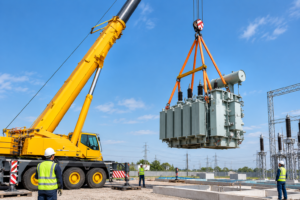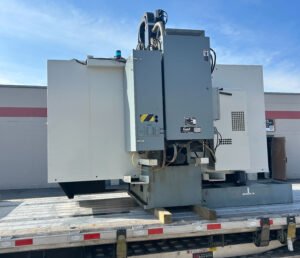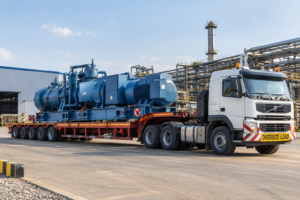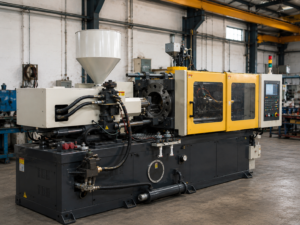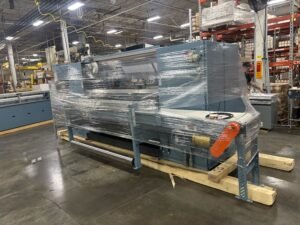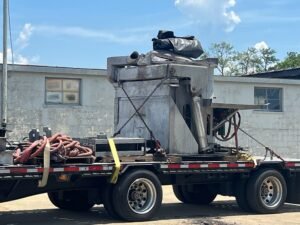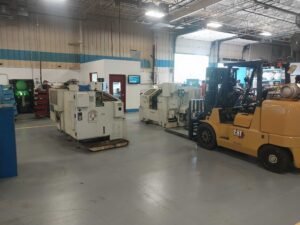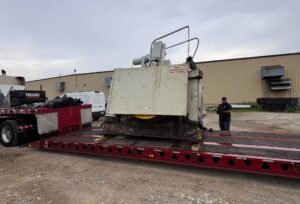
Some loads are simply too big for an ordinary truck. A 65-foot heat exchanger weighing 350,000 lbs, a large power transformer, a pressure vessel or a press frame cannot travel the whole way by road. These components usually cross most of the country by rail, then finish the trip on specialized highway equipment for the last few miles to the plant.
That last stretch is where the hardest work happens. The load must come off the rail car, onto a heavy haul trailer, along a permitted route and onto its foundation without damage and without endangering anyone. This guide explains how heavy haul transport for oversize loads works from rail siding to job site, using the kind of project we are regularly asked to price: four heat exchangers offloaded in Cleveland and moved about 40 miles by road to a power station.
What Makes a Load a Superload?
Most oversize loads, such as a wide machine or a tall press, move with routine state permits. A superload is a load that exceeds the limits a state will approve through its routine permit process. Each state sets its own thresholds, but loads become superloads when they are very heavy, very wide, very long or very tall. As a rough guide, many states treat gross weights above about 120,000 to 200,000 lbs, or widths above about 16 feet, as superloads.
Superloads typically require:
- Engineering analysis of every bridge and culvert on the route.
- A physical route survey.
- Special travel times, often at night or on weekends.
- Police escorts and traffic control.
- Temporary removal of signs, signals or utility lines.
- Weeks or months of permit review.
A 350,000 lb heat exchanger, with the trailer and tractors added, can easily push the gross combination weight past 600,000 lbs. That is several times the normal legal limit of 80,000 lbs and firmly in superload territory.
Why Superloads Often Travel by Rail First
Rail is often the best way to move very heavy components long distances.
- Rail lines are built to carry heavy concentrated loads.
- Specialized cars such as heavy-duty flatcars, depressed-center cars and Schnabel cars can carry hundreds of tons.
- A single rail move can replace a long, complex chain of state highway permits.
- Rail avoids most bridge, height and traffic restrictions found on highways.
The trade-off is that very few plants have a rail siding at the exact spot where the equipment will be installed. A rail-to-truck transload near the destination is the usual solution.
Phase 1: Planning and Engineering
A superload project begins months before the rail car arrives. Planning usually includes:
Gather Load Data
- Exact weight, length, diameter or width, and height.
- Center of gravity, which may not be in the middle for vessels with internal parts.
- Lifting lugs, trunnions and saddle locations and their rated capacities.
- Shipping saddles and how the load is secured on the rail car.
- Any limits on tilt, shock or point loads set by the manufacturer.
Choose the Transload Site
The offload point should be as close to the destination as practical while still offering:
- A rail siding where the railroad allows heavy lifting operations.
- Firm, level ground for cranes, gantries or jacking equipment, or room to build it with crane mats and engineered fill.
- Room for the trailer to pull alongside the rail car.
- A permitted exit route to the highway.
Railroads have their own safety rules, insurance requirements and approvals for work on or near the track, and these can take time to arrange.
Engineer the Lifts and the Route
- Lift plans and rigging calculations for the transload and the final set.
- Ground bearing calculations for cranes and trailers.
- Trailer configuration and axle loads.
- Bridge and culvert analysis along the route.
- A route survey that records clearances, turns, grades, overhead lines and pavement condition.
Our article on crane and rigging solutions for complex factory relocations explains how lift planning works on large projects.
Phase 2: Offloading From the Rail Car
There are several proven ways to transfer a superload from a rail car to a trailer. The right choice depends on weight, site conditions and available space.
Single or Tandem Crane Lifts
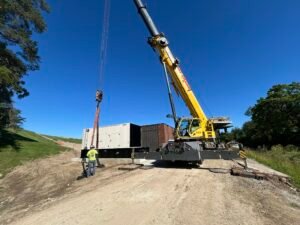
Large crawler or mobile cranes can lift the load off the rail car and set it onto the trailer. Very heavy loads may need two cranes working together in a tandem lift. Tandem lifts require careful planning because each crane’s share of the load changes as the load moves.
Crane lifts are fast once the cranes are set up, but large cranes take days to deliver and assemble and need well-prepared ground. Our crane service page covers how cranes fit into heavy rigging projects.
Hydraulic Gantry Systems
A hydraulic gantry can straddle the rail car, lift the load, let the rail car pull away, and lower the load onto a trailer positioned underneath. Gantries need less ground space than large cranes and work well in tight rail yards.
Jacking and Sliding
In some cases, the load is jacked off the rail car, slid sideways on skid beams onto the trailer, and jacked down. This method keeps the load low and is very controlled, but it needs a carefully built transfer structure between car and trailer.
Strand Jacks and Lifting Towers
For the heaviest loads, lifting towers and strand jacks can raise very heavy items where cranes would be impractical.
| Offload method | Strengths | Limitations |
|---|---|---|
| Single crane | Fast, flexible | Large crane needs space, setup time and strong ground |
| Tandem cranes | Handles very heavy, long loads | Complex planning and coordination |
| Hydraulic gantry | Compact, precise, good in tight yards | Needs level track or runway |
| Jack and slide | Low and highly controlled | Slower, needs transfer structure |
| Strand jacks or towers | Extreme capacity | Highest setup effort |
Phase 3: Choosing the Right Heavy Haul Equipment
Ordinary flatbeds and lowboys cannot carry superloads. Heavy haul transport uses equipment designed to spread weight over many axles and keep loads level.
Multi-Axle Hydraulic Platform Trailers
These modular trailers are built from axle lines that bolt together. Each line spreads the weight across several tires, and hydraulic suspension keeps the deck level on uneven ground. Steering on many axles helps the trailer turn in tight spaces.
Self-Propelled Modular Transporters
SPMTs are self-powered platform trailers controlled remotely. They can move in any direction, turn in place and set loads precisely. They are ideal for slow, short moves, such as inside a plant or across a job site, and are sometimes used for full road moves at low speed.
Schnabel Trailers
For long cylindrical loads like vessels and heat exchangers, a Schnabel trailer uses the load itself as part of the trailer structure. The load hangs between two trailer sections, which keeps it low and spreads weight effectively.
Dual-Lane Trailers
Dual-lane trailers spread weight across a wider footprint, reducing the load on bridges. They are useful where bridge capacity is the limiting factor.
Prime Movers
Heavy haul tractors pull, and sometimes push, these trailers. A superload may use two or three tractors in a push-pull arrangement to control speed on grades.
Phase 4: Permits, Route and Traffic Control
In Ohio and most other states, superload permits are issued by the state department of transportation after engineering review. Local roads may also need approval from cities, counties or townships.
What the Route Plan Covers
- Bridges that must be avoided, crossed at reduced speed or crossed in the center of the road.
- Intersections where traffic signals, signs or poles must be temporarily removed.
- Overhead utility lines that must be lifted or de-energized by the utility.
- Railroad crossings that need coordination.
- Turn locations where the trailer may need to steer around tight corners.
- Staging areas where the load can park safely if the move pauses.
Travel and Escort Requirements
Superloads usually travel at low speed, often during night hours when traffic is lighter. Permits may require police escorts, pilot vehicles, flaggers and traffic control. A 40-mile superload route might take one night or several nights, depending on the number of obstacles and staging stops.
Phase 5: Delivering to the Job Site
Arriving at the gate does not mean the job is done.
Site Access
- Plants and utilities often have strict site access rules, especially power generation facilities. Security clearances, escorts and background checks can be required for every crew member and vehicle.
- Internal roads may need reinforcement with crane mats or temporary surfacing.
- Gates and fences may need temporary removal.
Final Setting
The load must be placed on its foundation, saddles or supports. Common methods include:
- Crane lifts from the trailer to the foundation.
- Jacking and skidding from the trailer onto the foundation.
- SPMTs that drive the load into position and lower it.
Final setting often needs precise alignment with anchor bolts, piping connections or existing equipment. This is where millwright skills matter. Our industrial machine assembly and installation services cover alignment and setting after delivery.
A Worked Example: Four Heat Exchangers, Rail to Plant
Here is how a project like the one we were asked to estimate typically comes together. Each of four heat exchangers is 65 feet long, 14 feet in diameter and about 350,000 lbs. They arrive by rail in Cleveland and must travel about 40 miles by road to a power station.
- Engineering and permits. Gather drawings, design the trailer configuration, survey the route and submit superload permits with bridge analysis. Coordinate with the utility for overhead lines and with local authorities for traffic control.
- Transload site preparation. Agree on the offload location with the railroad, prepare crane or gantry pads and arrange insurance and approvals.
- Offload. Lift each unit off its rail car with a crane, tandem cranes or a gantry, and set it onto a multi-axle hydraulic trailer or Schnabel trailer.
- Secure and stage. Secure the vessel on saddles and hold it in a staging area until the travel window opens.
- Road move. Travel at night under escort, with crews removing and replacing signs and signals as needed.
- Site entry. Clear site security, travel internal roads and position for final setting.
- Final set. Lift or jack each heat exchanger onto its foundation and align it.
- Repeat. Units may move one at a time or in a planned sequence, depending on equipment and permit conditions.
With 14-foot diameters, these loads would also be very wide and tall once on a trailer, which affects which roads and bridges can be used and whether utility lines must be raised.
Safety Risks in Superload Moves
| Risk | Control |
|---|---|
| Crane or gantry overload | Engineered lift plans, load monitoring, verified weights |
| Ground failure under cranes or trailers | Ground bearing calculations, crane mats, site preparation |
| Load shift during transport | Engineered securement, saddles, regular checks |
| Bridge damage | Bridge analysis, center-of-road crossings, speed limits |
| Power line contact | Utility coordination, line lifts, height checks |
| Traffic accidents | Night travel, police escorts, traffic control |
| Rail yard incidents | Railroad approvals, protection, blue flag procedures |
What Drives the Cost of Heavy Haul Transport?
Superload projects are always quoted individually. Main cost drivers include:
- Load weight and dimensions, which decide trailer type and number of axle lines.
- Crane, gantry or jacking equipment for the transload and final set.
- Engineering, route surveys and bridge analysis.
- Permit fees and escort requirements.
- Utility line lifts and traffic control.
- Site preparation such as crane mats and temporary roads.
- Number of loads and whether they move together or separately.
- Schedule constraints and standby time.
Our 2026 guide to industrial rigging costs explains many of these cost factors for rigging work.
How Long Does a Superload Project Take?
| Phase | Typical timing |
|---|---|
| Engineering, route survey and permit applications | 4 to 12 weeks or more |
| Railroad coordination and transload site prep | 2 to 8 weeks |
| Crane or gantry mobilization | Several days |
| Offload per unit | 1 to 2 days |
| Road move | 1 or more nights per load |
| Final setting per unit | 1 to 3 days |
Early planning is the best way to keep superload projects on schedule.
Who Is Involved in a Superload Project?
A superload move is a team effort. Knowing who does what helps owners set realistic expectations and avoid delays.
| Party | Role |
|---|---|
| Equipment owner or EPC contractor | Sets the schedule, approves plans and prepares the receiving site |
| Manufacturer | Supplies drawings, weights, lifting points and handling limits |
| Railroad | Approves offloading on or near its tracks and sets safety rules |
| Rigging and heavy haul contractor | Plans and performs the transload, transport and final set |
| Engineers | Check lifts, ground bearing, trailer loads and bridges |
| State DOT and local road authorities | Issue permits and approve routes |
| Utilities | Raise, move or de-energize overhead lines |
| Police and traffic control | Escort the load and manage traffic |
| Site security | Controls access at plants and power stations |
The heavy haul contractor usually acts as the coordinator between these parties, but the owner still needs to make timely decisions and keep the receiving site on schedule.
How to Prepare Your Site for a Superload Delivery
The receiving site is the owner’s responsibility in most projects, and it is the most common cause of delays at the end of a long move. Before the load arrives:
- Build or confirm the access road. Heavy trailers need firm, level ground with enough width and turning room. Temporary roads may need engineered stone or crane mats.
- Check underground utilities. Buried pipes, cables and vaults can be crushed under axle loads. Locate and protect them.
- Clear overhead obstructions. Pipe racks, cable trays and lines inside the site may block tall loads.
- Prepare the setting area. Cranes need level, compacted pads. Jacking and skidding needs a clear path and solid supports.
- Complete foundations early. Foundations, saddles and anchor bolts should be finished and cured before the load arrives.
- Arrange security clearances. At power stations and secured plants, background checks and badging for every worker and vehicle can take weeks.
- Plan a staging area. If the load arrives before the setting crew or equipment is ready, it needs a safe place to wait.
A site that is ready when the load arrives saves standby costs for trailers, cranes, escorts and crews, which can add up quickly on a superload.
Why Alltracon Is the Best Choice for Heavy Haul Projects
Alltracon plans oversize moves from the first measurement to the final set. Our team coordinates lift plans, cranes, rigging, trucking and permits under one point of contact. Proven on projects like our 1.5 million pound press relocation, we deliver heavy, high-value equipment safely and on schedule.
Frequently Asked Questions
What is the difference between an oversize load and a superload?
An oversize load exceeds legal size or weight limits but fits within routine permit rules. A superload exceeds routine permit limits and needs special engineering review, route surveys and conditions.
Why are very heavy loads shipped by rail?
Rail can carry very heavy, concentrated loads over long distances with fewer restrictions than highways. Road transport is then used for the final miles to the site.
How is a superload taken off a rail car?
Common methods include large single cranes, tandem crane lifts, hydraulic gantries, jacking and sliding, and strand jacks. The choice depends on weight, space and ground conditions.
How fast do superloads travel?
Superloads usually travel at low speeds, often under 10 to 25 miles per hour, and much slower over bridges and through turns. Many travel at night.
How far in advance should a superload be planned?
Plan at least two to three months ahead, and longer for very heavy loads or routes with many bridges and utility lines.
Plan Your Oversize Load With an Experienced Partner
Moving a superload from rail car to job site combines engineering, rigging, transport and coordination with railroads, utilities and permit offices. Starting early and using one accountable team keeps risk low and schedules realistic.
See our heavy equipment moving and transport services, browse our completed projects, or request a free quote for your next oversize move.