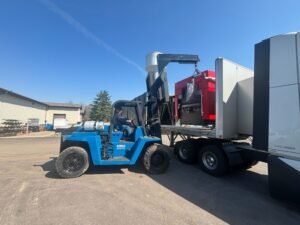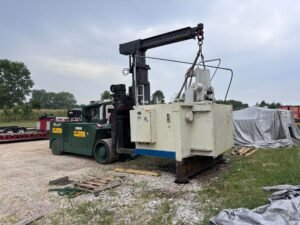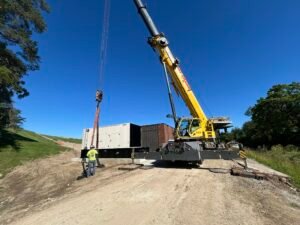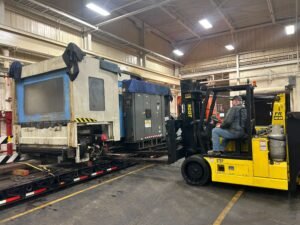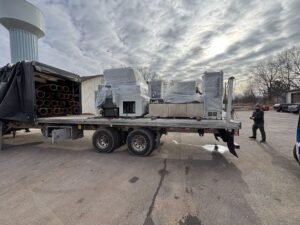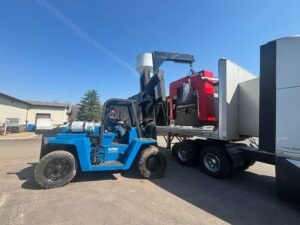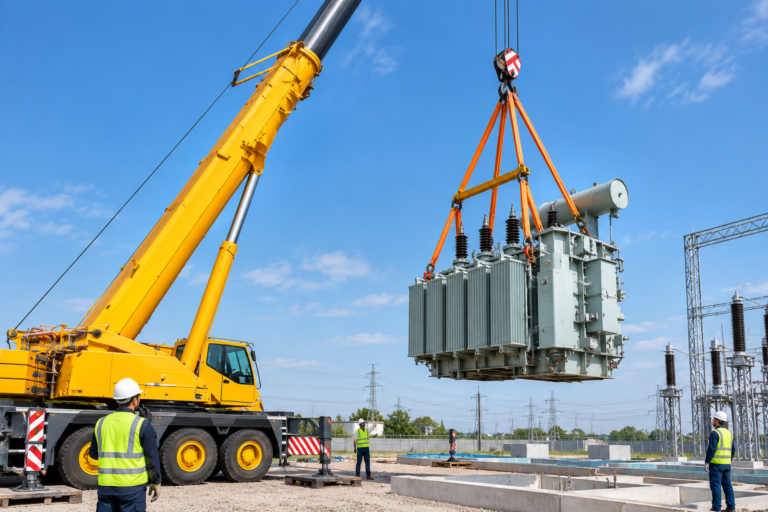
Few pieces of equipment combine weight, value and fragility the way a transformer does. A large unit can weigh dozens or even hundreds of tons, cost far more than the building around it and take many months to replace. Yet its insides are delicate. A hard jolt can shift the core and windings, and a damaged bushing can put the whole unit out of service.
That is why transformer rigging is specialist work. Whether you are setting a new pad-mounted unit at a manufacturing plant, swapping out a failed transformer in a substation, moving a dry-type unit inside a building or relocating electrical gear during a plant move, the job demands careful planning, the right equipment and close coordination with utilities and electricians.
This guide explains how heavy transformers are rigged, moved and set. It covers the main transformer types, the planning and preparation involved, the rigging and transport methods used, how units are set and tested, special situations and the safety rules that apply.
Types of Transformers and How Each Changes the Job
The word “transformer” covers a wide range of equipment. The type decides the rigging method, the preparation and the risks.
| Transformer type | Typical setting | What it means for rigging |
| Dry-type transformers | Indoors in electrical rooms, plants and commercial buildings | Lighter, no oil, but often in tight rooms with limited access; enclosures and coils are easy to damage |
| Pad-mounted oil-filled transformers | Outdoors on concrete pads at plants, campuses and commercial sites | Moderate weight, often moved with a crane or boom truck; oil adds weight and spill risk |
| Unit substation transformers | Plants, hospitals, data centers | Bolted to switchgear sections, so alignment at setting is critical |
| Substation and power transformers | Utility and large industrial substations | Very heavy; often shipped with oil drained and accessories removed; usually moved with jack-and-slide systems or large cranes |
| Generator step-up transformers | Power plants | Among the heaviest loads; moved by specialist heavy-haul and jacking methods |
Even within one type, weights vary widely by rating and manufacturer. Always confirm the actual shipping weight and center of gravity from the nameplate or the manufacturer’s outline drawing.
Why Transformer Rigging Is High-Risk Work
Transformers are not just heavy boxes. Several features make them unusually unforgiving.
Sensitive internals. The core and windings are held in place inside the tank. A sharp impact or excessive tilt can shift them, loosen supports or damage insulation. The damage may not be visible from outside and may only show up during testing or, worse, after energizing.
Shock and tilt limits. Manufacturers set limits on how much acceleration and tilt a transformer can tolerate. Large units are often shipped with impact recorders that log every bump, and a reading outside the limits can void the warranty or trigger a full inspection.
Fragile accessories. Bushings, radiators, cooling fans, conservator tanks, gauges and tap changers stick out from the tank. They are easy to hit and expensive to replace. None of them can ever be used as a lifting or tie-down point.
Oil. Oil-filled units hold hundreds or thousands of gallons of insulating oil. A leak during a move is an environmental incident, and older units may contain PCBs that bring strict handling rules.
Electrical hazards. Transformers are usually in electrical rooms, substations or near overhead lines. Every move involves energized equipment nearby.
Long replacement times. Large transformers can take many months or longer to build and deliver. If one is damaged during a move, the site may have to run on temporary power for a long time.
Planning a Transformer Move
Good transformer rigging starts with paperwork, not equipment.
Gather the manufacturer’s data
The outline drawing and installation manual are the most important documents on the job. They give the shipping and operating weights, the center of gravity, the location and rating of lifting lugs and jacking pads, the allowable tilt and shock limits, and any special shipping instructions. For an older unit without paperwork, the manufacturer can often supply drawings from the serial number.
Survey the site and the path
Riggers walk the full route from the current location to the new one. They check doorways, ceiling heights, floor and ground capacity, slopes, overhead lines and underground utilities. In substations, they note the clearances to energized equipment that will stay live during the move.
Check ground and floor capacity
Crane outriggers and jacking systems put very high loads on small areas. Soft soil, buried vaults, trench drains and old slabs may need crane mats or engineering review before a lift.
Coordinate the outage
The utility, the facility’s electrical team and the rigging contractor must agree on the outage window. Replacement work is often planned for nights or weekends, with temporary generators or backup feeds to keep critical loads running.
Write the lift or move plan
The plan should name the load weight, rigging gear, crane or jacking equipment, crane setup location, exclusion zones and the people in charge. Lifts near power lines, tandem crane picks and very heavy units usually call for an engineered lift plan.
Electrical and Oil Preparation
No rigger should touch a transformer until it has been made electrically safe and its oil has been planned for.
- De-energize and isolate. The utility or a qualified electrical contractor switches the transformer out of service, then applies lockout/tagout and grounding. Electrical work follows NFPA 70E and, on utility systems, OSHA’s rules for power generation and distribution work.
- Disconnect cables and bus. Primary and secondary connections are removed and labeled. Cable ends are protected and secured away from the travel path.
- Test the oil if the unit is older. Units built before the late 1970s may contain PCBs. A lab test of the oil confirms whether special handling under federal PCB rules is needed before the unit is moved, drained or scrapped.
- Decide whether to drain. Small and medium units are often moved full of oil, within the manufacturer’s limits. Large power transformers are usually drained and filled with dry nitrogen or dry air for shipping. Drained oil must be stored in clean, sealed containers or a tanker so it can be processed and returned.
- Remove vulnerable accessories. On large units, bushings, radiators, fans, conservator tanks, surge arresters and control cabinets are often removed, crated and shipped separately. Openings are sealed to keep moisture out.
- Plan spill control. Have absorbents, drip pans and a spill response plan on site. Oil-filled equipment may fall under your facility’s spill prevention plan.
Record every step with photos. They are valuable during reassembly and if a warranty question comes up later.
Rigging Methods for Transformers
The right method depends on weight, location and how much room there is to work. Large jobs often combine more than one.
| Method | Best for | Key precautions |
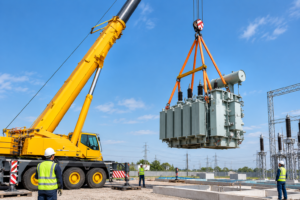
| Mobile crane lift | Pad-mounted units, rooftop and yard installs, loading and unloading trucks | Lift only from the lifting lugs, use a spreader bar to keep slings vertical, keep clear of power lines |
| Jack and slide (skidding) | Heavy substation and power transformers where cranes cannot reach or ground is limited | Jack only at marked jacking pads, raise evenly, keep tilt inside limits |
| Hydraulic gantry | Heavy units indoors or in tight yards | Level track, floor capacity under the legs |
| Machine skates and rollers | Moving dry-type and smaller units across floors into electrical rooms | Smooth floors, low speed, blocking on slopes |
| Forklifts | Smaller dry-type and pad-mount units at ground level | Rated capacity at the load center, forks only where the base is designed for them |
A few rules apply to every method:
- Use only the designated points. Lift from the lifting lugs and jack from the jacking pads. Lugs on the cover or radiators are often meant only for lifting those parts, not the whole transformer.
- Keep slings vertical. Angled slings pull sideways on lugs and can bend them or the tank wall. Spreader bars and lifting beams keep the load straight.
- Lift level and slow. Raise and lower smoothly. Sudden starts and stops create the shocks that impact recorders are watching for.
- Protect the accessories. Keep slings, tag lines and equipment clear of bushings, radiators and gauges.
Transporting a Transformer
Transport is where many transformers take their hardest hits. Potholes, rail crossings and hard braking can all create shocks beyond the manufacturer’s limits.
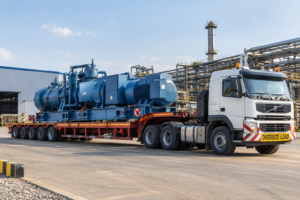
Choose the right trailer. Small units travel on flatbeds or step decks. Heavier units need lowboys or multi-axle trailers, and the largest power transformers may need specialized heavy-haul equipment or rail.
Fit an impact recorder. For valuable units, an impact recorder mounted on the tank logs shocks in every direction during the trip. Review the readings before accepting delivery, and keep the record for the warranty file.
Secure the load properly. Chain only to the tie-down points shown on the drawing, never to bushings, radiators or the cover. Block the base to prevent sliding.
Plan the route. Heavy units may need oversize or overweight permits, escort vehicles and route surveys for bridge limits, low wires and tight turns. Route planning can take weeks for the heaviest loads.
Protect from weather. Seal openings and cover accessories so moisture cannot get into the tank or terminal compartments. Moisture is a serious problem for transformer insulation.
Drive carefully. Slow speeds, smooth stops and careful turns keep acceleration inside the limits.
Setting the Transformer on Its Pad
Setting is the most precise part of the job. The transformer has to land in exactly the right spot, at the right orientation, on a pad that is ready for it.
Prepare the pad. The concrete pad or foundation must be cured, level and sized for the operating weight, including oil. Check anchor bolt or embed locations against the drawing before the unit arrives. For pad-mounted units, conduit stub-ups must line up with the cable compartments. Outdoor oil-filled units often sit inside a containment area designed to hold oil in case of a leak.
Confirm orientation. Mark the pad with the final position and which side faces which direction. A transformer set backward cannot easily be turned once cables are in place.
Lower slowly and evenly. Bring the unit down level, guided by tag lines, with the crew watching for contact with conduits, bolts and nearby equipment.
Align with connected equipment. Unit substation transformers bolt to switchgear sections on one or both sides. The throat connections must line up exactly, so these sets often need fine adjustment with jacks and pry bars.
Anchor and ground. Secure the unit to the pad as the design requires, including any seismic anchoring. Connect the ground grid before any electrical work begins.
Reinstall accessories. On large units, bushings, radiators, conservators and fans go back on, usually under the supervision of the manufacturer’s service technician.
Inspection, Testing and Energizing
A transformer that looks fine after setting is not yet proven fine. Testing confirms that nothing inside was damaged during the move.
- Inspect the exterior. Check the tank, welds, gaskets, bushings, radiators and gauges for dents, cracks and leaks. Review the impact recorder data if one was used.
- Check for moisture. On units shipped filled with nitrogen or dry air, a dew point or pressure check confirms the tank stayed sealed.
- Fill or top up the oil. Large units are usually filled under vacuum with processed oil by a qualified service team. Smaller units are checked for correct oil level.
- Run electrical tests. Qualified testing technicians typically perform insulation resistance, turns ratio and winding resistance tests, and often power factor tests on larger units. Oil samples may be sent for lab analysis. Results are compared with factory or previous test data.
- Make final connections. Electricians terminate cables or bus, set the tap position and verify protection settings.
- Energize under controlled conditions. The utility or electrical contractor energizes the unit, often with no load at first, while the team watches temperatures, sounds and readings.
Keep all test reports with the transformer’s records. They become the baseline for future maintenance.
Why Alltracon Is Ohio’s Best Choice for Transformer Rigging
Alltracon is Ohio’s trusted choice for transformer rigging. From our Medina base, our experienced riggers plan every critical lift, then handle crane work, jacking, trucking and precise setting on your pad. We coordinate with your utility and electricians to keep outages short, protect your equipment and finish safely on schedule.
Special Situations
Substations. Work inside an energized substation means tight clearances to live equipment, strict access rules and often limited room for cranes. Jack-and-slide systems are common because they move heavy units low to the ground without swinging a load near live bus.
Vaults and basements. Many urban and older buildings have transformers in underground vaults or basement electrical rooms. Units may need to be lowered through grates or hatches, then skated into place. Some must be partly disassembled to fit.
Rooftops and upper floors. Rooftop and penthouse installations need a crane lift plan, a structural check of the roof or platform and often a street permit for the crane setup.
Data centers and hospitals. These sites cannot lose power. Transformer replacements are planned around backup power, with tight windows and detailed step-by-step procedures.
Plant relocations. When a plant moves, transformers and switchgear are often among the first items set at the new site, because the rest of the equipment cannot start without power.
Safety and Compliance
Transformer work sits where rigging safety and electrical safety meet. These are the main rules and practices that apply.
- Crane rules. OSHA 1926 Subpart CC governs crane operations, including qualified operators, qualified riggers and signal persons, and inspection of cranes and rigging.
- Power line clearance. Under OSHA 1926.1408, cranes working near power lines must keep set clearances unless the lines are de-energized and grounded. For lines up to 350 kV, the basic minimum is 20 feet, with greater distances for higher voltages.
- Electrical safety. NFPA 70E covers arc flash and shock protection for work near energized equipment. Work on utility systems falls under OSHA 1910.269.
- Lockout/tagout. Every source of energy must be isolated and verified before work begins.
- Oil and PCBs. Spill prevention and response plans apply to oil-filled equipment, and any oil containing PCBs must be handled and disposed of under federal rules.
- Exclusion zones. Barricade the lift area and the crane’s swing radius, and keep everyone not directly involved out of it.
What Drives the Cost of Transformer Rigging
Every transformer job is quoted individually, but the same factors set the price:
- Weight and size, which decide the crane, jacking system and trailer needed
- Access, such as substations, vaults, rooftops and tight electrical rooms
- Distance and route, including permits, escorts and route surveys for heavy loads
- Oil handling, if the unit must be drained, stored and refilled
- Accessory removal and reinstallation on large units
- Engineering, such as lift plans and ground bearing checks
- Outage timing, since night and weekend work costs more
- Testing and service technicians, often contracted separately
The cheapest quote is rarely the cheapest outcome. A damaged transformer can cost many times the rigging bill, plus months of temporary power.
Transformer Rigging Checklist
Planning
- ☐ Get the outline drawing, weights, center of gravity, lifting and jacking points
- ☐ Confirm shock and tilt limits from the manufacturer
- ☐ Survey the path, ground capacity, overhead lines and clearances
- ☐ Agree the outage window with the utility and electrical team
- ☐ Write the lift or move plan
Preparation
- ☐ De-energize, lock out and ground
- ☐ Disconnect and label cables and bus
- ☐ Test oil for PCBs on older units
- ☐ Drain oil or confirm it can travel full
- ☐ Remove and crate vulnerable accessories
- ☐ Stage spill response materials
Move and set
- ☐ Lift or jack only at designated points
- ☐ Fit an impact recorder for valuable units
- ☐ Secure to approved tie-downs and plan the route
- ☐ Set on a ready pad with correct orientation
- ☐ Align, anchor and ground
Startup
- ☐ Inspect, review impact data and check for moisture
- ☐ Fill or top up oil
- ☐ Complete electrical tests
- ☐ Energize under controlled conditions
Frequently Asked Questions
Can a transformer be moved full of oil?
Many small and medium transformers can be moved full of oil if the manufacturer allows it and tilt and shock stay within limits. Large power transformers are usually drained and shipped filled with dry nitrogen or dry air.
Where can you lift a transformer?
Only from the lifting lugs designated for lifting the complete unit, and only jack at the marked jacking pads. Never lift by bushings, radiators, cover lugs meant for the cover alone or the cooling fins.
What is an impact recorder?
An impact recorder is a device mounted on the transformer that logs shocks during transport and handling. Its readings show whether the unit stayed within the manufacturer’s limits.
Do I need a crane to set a transformer?
Not always. Small dry-type units can be moved with skates or forklifts, and heavy substation units are often moved with jack-and-slide systems. Cranes are common for pad-mounted units, rooftops and loading trucks.
How long does a transformer replacement take?
A small pad-mounted swap can sometimes be completed in a single outage shift. Large substation transformer replacements can take days to weeks, including oil processing, accessory installation and testing.
Who disconnects and reconnects the transformer?
The utility or a qualified electrical contractor handles de-energizing, disconnection, reconnection and energizing. The rigging contractor handles the physical move and setting, working closely with them.
Conclusion
Transformer rigging leaves very little room for error. The units are heavy, valuable and sensitive, and they sit in some of the most hazardous locations on any site. Success comes from following the manufacturer’s data, planning around the electrical outage, using the right lifting or jacking method, protecting the unit in transit, setting it precisely and proving it with testing before it is energized.
Need a transformer rigged, moved or set in Ohio or the surrounding states? Request a quote or call Alltracon to plan your lift with an experienced team.