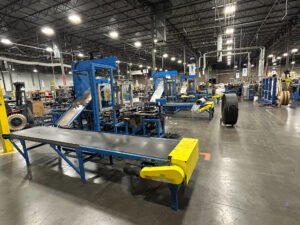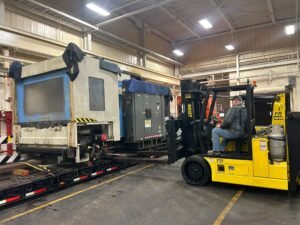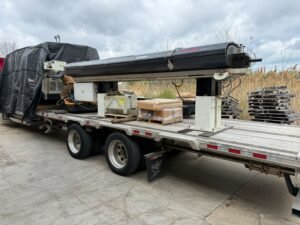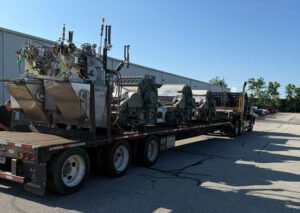
The last truck has been unloaded. Every machine is sitting on its new foundation. On the project schedule, the plant relocation looks finished.
It is not. A plant relocation is only complete when the new facility is making good parts at full rate, safely and reliably. The stretch between “equipment set” and “full production” is called startup and commissioning, and it is where many relocations lose the time they worked so hard to save.
A machine that was moved perfectly can still fail at startup because of a reversed motor, a missing parameter, an air leak or a sensor knocked out of position. Small issues like these can add days to a schedule when they are found one at a time.
This guide walks through plant startup after relocation, phase by phase. It covers what to plan before the move, the checks each machine and system needs, how to run trials and win customer approval, and how to protect the plant in the first 90 days of production.
What Startup and Commissioning Mean
People often use “startup” and “commissioning” as if they mean the same thing, but they describe different steps. Commissioning is the structured process of proving that each machine and system is installed correctly and works as intended. Startup is the moment the plant begins running those systems for real production. Commissioning comes first, and it makes startup safe and predictable.
After a relocation, the work usually moves through five stages:
- Mechanical completion. Every machine is set, leveled, anchored and reconnected. Nothing has been powered up yet.
- Pre-commissioning. Static checks are done with power off or locked out, such as inspections, alignment, lubrication and wiring checks.
- Systems are energized and tested one by one, then together. Motors are bumped, controls are checked and safety devices are proven.
- Trial production. The line runs real material at reduced speed. Parts are measured and approved.
- Ramp-up. Output climbs to full rate while the team watches closely for early failures.
Treating these as separate stages with clear sign-offs keeps problems from being carried forward. A wiring fault found during pre-commissioning takes minutes to fix. The same fault found during trial production can scrap material and damage the machine.
Why Relocated Equipment Struggles at Startup
Most startup problems after a move fall into a handful of familiar groups. Knowing them in advance tells you where to look first.
- Alignment and geometry. Machines that were twisted in transit or set on an uneven floor lose accuracy. Couplings, belts and conveyors drift out of line.
- Electrical and controls. Wires are landed on the wrong terminal, motors run backward, and sensors or limit switches are bumped out of position. Battery-backed memory in older controls can be lost if a machine sat unpowered for too long.
- Air pressure is low, the electrical supply is a different voltage or phase arrangement, cooling water flow is weak, or the new piping is full of debris from construction.
- Contamination and storage damage. Moisture, dust and rust collect on machines that were stored or shipped. Hydraulic and lubrication systems pick up dirt when lines are opened.
- Missing parts and information. A small bracket, a guard, a cable or a parameter backup goes missing, and the whole line waits for it.
- Operators and maintenance staff are working in a new layout, sometimes with new team members who never ran the equipment at the old site.
None of these are unusual, and all of them can be caught early with a structured commissioning plan.
Plan Commissioning Before the First Machine Moves
The best commissioning work happens at the old plant, before anything is disconnected. Once a machine is on a truck, the chance to record how it ran is gone.
Capture baseline data
For every critical machine, record how it performs today. That means cycle times, output rates, scrap rates, key part dimensions, hydraulic and air pressures, motor amps, spindle or bearing temperatures and vibration readings. These numbers become the standard the machine must meet at the new site. Without them, “it’s running fine” is just an opinion.
Back up every control
Save PLC programs, HMI files, CNC parameters, robot programs, servo settings and drive configurations. Store copies in two places. Label each backup with the machine, date and software version. Many relocated lines have waited days for a program that only existed on the machine that was just unplugged.
Define acceptance criteria
Agree in writing what “done” means for each machine and line. For example, the line runs at 95% of its old rate for three full shifts with scrap at or below its old level. Clear criteria prevent arguments at the end of the project.
Line up people and parts
Book OEM service technicians, controls integrators and electricians for startup week well in advance, since their schedules fill quickly. Order spare parts that often fail at startup, such as fuses, sensors, belts, seals, filters and hydraulic hoses, and have them on site before the first machine is powered.
Phase 1: Verify Utilities and Infrastructure
No machine should be powered until the systems that feed it are proven. Commissioning starts with the building.
Electrical supply. Confirm voltage, phase rotation and grounding at every machine drop before connecting. A plant that moved between utilities or buildings may have a different supply than the old one. Check that breakers and disconnects are sized for each machine’s nameplate load.
Compressed air. Start the air system, then check pressure and flow at the far end of the header, not just at the compressor. Blow out new lines to clear construction debris before connecting machines. Check that dryers are working, since wet air damages valves and cylinders.
Cooling water and process fluids. Flush new chilled water and process piping before connecting it to machines. Confirm flow rates, temperatures and water treatment.
Other services. Check natural gas, exhaust, dust collection, vacuum, network connections and any process gases. Confirm that the plant’s fire protection and emergency lighting are active.
Floors and foundations. Make sure concrete has cured to strength before heavy machines are loaded and anchored, and that grout under machine bases has set.
Record the readings from each check. They will help later if a machine underperforms and someone asks whether the supply is the problem.
Phase 2: Mechanical Checks
Mechanical checks are done with each machine locked out. This is millwright work, and it is the foundation for everything that follows.
- Check every machine with a precision level and adjust to the manufacturer’s tolerance. Precision machines such as CNC machining centers and grinders need tighter leveling than presses or conveyors.
- Torque anchor bolts to specification after final leveling, then recheck the level, because tightening can pull a machine out.
- Laser align motor couplings, pumps, fans and gearboxes. Check belt tension and pulley alignment. Align conveyors, transfer systems and any equipment that hands parts from one machine to the next.
- Shipping hardware removed. Remove every shipping bracket, axis lock, blocking and tie-down. A forgotten bracket can cause serious damage the moment an axis moves.
- Lubrication and fluids. Refill hydraulic tanks, gearboxes, way oil and coolant with the correct fluids. Replace filters, especially on hydraulic systems that were opened during the move.
- Reassembly check. Confirm that all guards, covers, doors and parts removed for shipping are back on and secure. Use the match marks and photos taken during disassembly.
Each item should be signed off by the person who did it. A machine that passes this phase is ready to be powered.
Phase 3: Electrical and Controls Checks
Electrical commissioning should be done by qualified electricians and controls technicians, following lockout/tagout rules until each circuit is ready to energize.
- Inspect terminations. Check every connection made during reinstallation against the labels and wiring diagrams. Tighten terminals that may have loosened in transit.
- Test insulation. Run insulation resistance tests on motors and cables, especially for equipment that was stored or exposed to moisture. A failed test before power-up is far cheaper than a burned motor after.
- Energize in stages. Power the main panel first, then control power, then each motor circuit. Check voltages at each step.
- Bump motors. Briefly start each motor to confirm rotation. Reverse rotation on pumps, fans and hydraulic units can cause damage within seconds.
- Restore and verify programs. Load the PLC, HMI, CNC and robot backups. Confirm software versions match and that parameters were not lost.
- Check every input and output. Walk each sensor, switch, valve and indicator to confirm the control system sees it correctly. This step catches most of the small faults that would otherwise stop the line later.
- Reconnect networks. Restore communication to plant networks, data collection, MES or ERP systems, and remote support connections.
Keep a running list of every fault found and how it was fixed. That list becomes valuable reference material for the maintenance team.
Phase 4: Dry Runs and Safety System Validation
Before any material goes through a machine, prove that it moves correctly and stops safely.
Safety first
Test every emergency stop, guard interlock, light curtain, safety mat, two-hand control and area scanner. Each one should stop the machine within its designed response. On presses, confirm stopping performance and that point-of-operation guarding is in place. Do not bypass a safety device to keep commissioning moving.
This is also the time to update the paperwork. Under OSHA 1910.147, each machine needs a written energy control procedure, and a new installation often changes isolation points, so lockout procedures should be reviewed and updated. Post updated procedures at each machine and confirm that guarding meets OSHA machine guarding rules in its new position.
Dry cycling
Run each machine through its full cycle without material, first at slow speed, then at normal speed. Watch for unusual noise, vibration, leaks, overheating or alarms. For CNC machines, home every axis and run test programs. For hydraulic equipment, check pressures and look for leaks at fittings that were opened during the move.
Line integration
Once single machines run reliably, connect them as a line. Check handshakes between machines, conveyor timing, robot hand-offs and part tracking. Integration is where many problems appear for the first time, so allow time for it in the schedule.
Phase 5: Production Trials, First Article and Customer Approval
With safety proven and the line integrated, it is time to make parts.
Start slow. Run the first trials at reduced speed with an experienced operator and a maintenance technician at the line. Make a small batch, stop and inspect.
Inspect the first article. Measure the first good parts fully against the drawing. For precision machining, verify machine accuracy with a ballbar test or test cuts before relying on part measurements alone. Compare results to the baseline data recorded at the old plant.
Check process capability. Once parts are in tolerance, run a longer batch and check that the process is stable and repeatable, not just capable of making one good part.
Get customer approval where required. Many customers require notice before production moves to a new location, and some require formal re-approval. In the automotive industry, a change of production site usually triggers a PPAP submission, so parts from the new plant cannot ship until the customer approves them. Medical device, aerospace and food manufacturers have similar validation and audit requirements. Plan these submissions early, and build enough inventory before the move to cover the approval period.
Measure against acceptance criteria. Run the line at increasing rates until it meets the criteria agreed before the move. When it does, the line is formally accepted and handed over to production.
Why Alltracon Is Ohio’s Best Choice for Plant Startup After Relocation
Alltracon is Ohio’s trusted partner for plant startup after relocation. From our Medina base, our millwrights handle leveling, anchoring, alignment, reassembly and reconnection, then support final tuning through trial runs to fix issues fast. One team moves your equipment and brings it back online, so your production restarts on schedule.
Ramp-Up, Handover and the First 90 Days
Acceptance is not the end of commissioning. The first weeks of full production are when hidden problems tend to show up.
Close the punch list. Every open item from commissioning, from a missing guard bolt to a sensor that needs a better bracket, goes on one list with an owner and a due date. Walk the list weekly until it is empty.
Hand over the documents. Production and maintenance should receive updated layouts, electrical drawings, program backups, lockout procedures, baseline readings and the commissioning fault log.
Train the team. Operators and maintenance staff need time on each machine in its new setting, especially new hires who never saw it at the old site.
Watch closely for 90 days. Recheck leveling and anchor bolt torque after a few weeks of running, since new concrete and grout can settle. Repeat alignment and vibration checks on rotating equipment. Check hydraulic and lubrication filters early, because contamination from the move often shows up there first. Track output, scrap and downtime against the baseline, and act on any trend before it becomes a breakdown.
How Long Does Commissioning Take?
There is no single answer, but these rough ranges help with planning. They assume utilities are ready and the equipment arrived undamaged.
| Scope | Typical commissioning time |
| Single standalone machine, such as a CNC machining center | 1 to 3 days |
| Press, molding machine or other large machine with auxiliaries | 3 to 7 days |
| Integrated production line with robots and conveyors | 1 to 3 weeks |
| Full plant, commissioned line by line | Several weeks to a few months |
Customer approvals such as PPAP can add weeks on top of these figures. The biggest time savers are baseline data, program backups, spare parts on hand and a single contractor responsible for reinstallation and startup support.
Plant Startup and Commissioning Checklist
Before the move
- ☐ Record baseline performance for every critical machine
- ☐ Back up all PLC, HMI, CNC, robot and drive programs
- ☐ Write acceptance criteria for each machine and line
- ☐ Book OEM, controls and electrical support for startup
- ☐ Order common startup spare parts
- ☐ Notify customers and plan any required re-approvals
At the new site
- ☐ Verify power, air, water and other utilities at each drop
- ☐ Level, anchor and align every machine
- ☐ Remove all shipping brackets and blocking
- ☐ Refill fluids and replace filters
- ☐ Check terminations and test motor insulation
- ☐ Energize in stages and confirm motor rotation
- ☐ Restore programs and check every input and output
- ☐ Test every safety device and update lockout procedures
- ☐ Dry cycle each machine, then integrate the line
Production and handover
- ☐ Run slow trials and inspect first articles
- ☐ Compare results to baseline and acceptance criteria
- ☐ Submit customer approvals where required
- ☐ Close the punch list and hand over documents
- ☐ Train operators and maintenance staff
- ☐ Recheck leveling, alignment and filters within 90 days
Frequently Asked Questions
What is the difference between commissioning and recommissioning?
Commissioning usually refers to bringing new equipment into service for the first time. Recommissioning is the same process applied to existing equipment after it has been moved, stored or rebuilt. After a plant relocation, most of the work is recommissioning.
Who is responsible for commissioning after a plant move?
Responsibility is usually shared. The rigging and millwright contractor handles setting, leveling, alignment and reassembly. Electricians and controls technicians handle power and programs. OEM technicians may be needed for complex machines or warranty reasons. The plant’s own team owns trials, quality approval and acceptance. One project lead should coordinate all of them.
Do relocated machines need to be recalibrated?
Precision machines almost always need their accuracy verified after a move, and many need adjustment. Leveling, geometry checks and ballbar or laser testing are common for CNC equipment. Measuring instruments and gauges should also be checked after the move.
Can production restart before commissioning is complete?
It is possible to run approved lines while other lines are still being commissioned, which is how phased relocations work. Running a single line before its own safety and trial checks are complete is a serious risk and should be avoided.
What causes the most delays at startup?
Missing program backups, utilities that are not ready, parts lost during the move and waiting for outside technicians cause the most delays. All four can be prevented with planning before the move.
Do I need to tell my customers about a plant relocation?
In many industries, yes. Automotive, aerospace and medical customers commonly require notice of a production site change, and may require samples or formal re-approval before you ship from the new plant. Check your supply agreements early.
Conclusion
A plant relocation succeeds or fails at startup. Moving the equipment is the visible part of the job, but commissioning is what turns a building full of machines back into a working plant.
The formula is straightforward: record how everything ran before the move, prove the utilities first, check each machine mechanically and electrically, validate every safety system, run careful trials against clear criteria and keep watching for the first 90 days. Done this way, startup becomes a planned step rather than a scramble.
Planning a plant relocation in Ohio or the surrounding states? Request a quote or call Alltracon to talk through your move, reinstallation and startup plan.