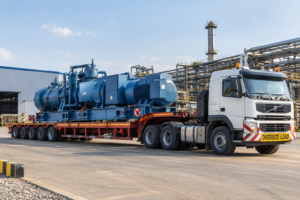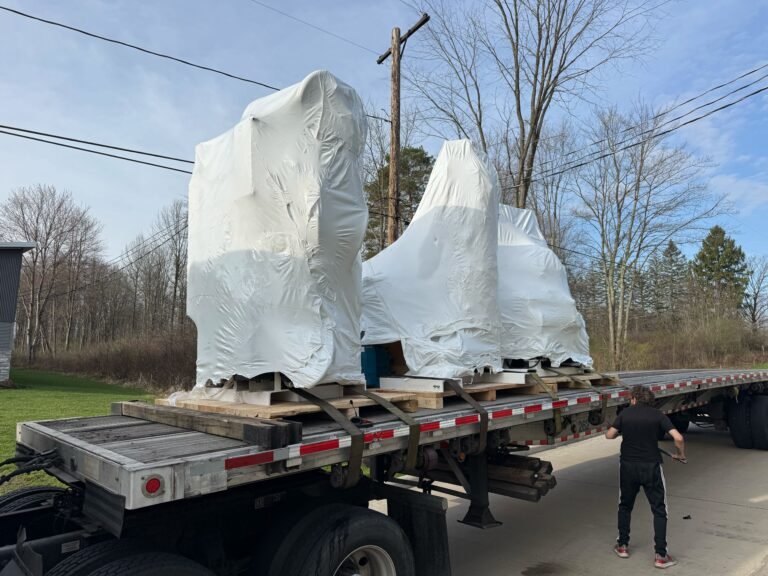
A machine that travels across town is a rigging job. A machine that travels from Ohio to Missouri, Illinois or Indiana is a rigging job, a trucking job and a regulatory job at the same time. Every state on the route has its own size and weight rules, its own permit office and its own travel restrictions.
This guide explains what goes into moving machinery across state lines: how to tell whether your load is legal or oversize, which trailer it needs, how permits work, how long the whole process takes and what drives the cost. Real examples from the kinds of requests we see every week, such as a 17,000 lb 5-axis mill headed from northeast Ohio to Missouri, show how the decisions play out.
Interstate Machinery Moves Start With One Question: Legal or Oversize?
Everything about an interstate move, from trailer choice to timeline to cost, depends on whether the loaded truck stays within standard legal limits.
Federal rules and state rules work together. On the Interstate Highway System, the widely used federal limits are:
- Gross vehicle weight: 80,000 lbs for a standard five-axle tractor-trailer.
- Axle weights: about 20,000 lbs on a single axle and 34,000 lbs on a tandem axle.
- Width: 8.5 feet (102 inches).
Height is set by each state rather than federally. Most states in the Midwest allow about 13 feet 6 inches of total height, and a few allow 14 feet or more. Length limits for trailers also vary by state.
A truck and trailer usually weigh 30,000 to 35,000 lbs empty, so a standard rig can legally carry roughly 40,000 to 48,000 lbs of machinery, depending on the trailer. If your machine (and anything shipped with it) fits within those weight limits, is no wider than 102 inches when loaded, and stays under the height limit on the chosen trailer, it moves as a legal load. If it exceeds any limit, it is an oversize or overweight load and needs permits from every state on the route.
State rules change and exceptions exist, so always confirm current limits with your carrier or each state’s permit office before you plan around them.
Step 1: Get Accurate Dimensions and Weight
Permits, trailers and quotes are only as good as the numbers you give your mover. Before requesting a quote, gather:
- Shipping weight of the machine, plus accessories, tooling and crates.
- Length, width and height in its transport configuration, including anything that sticks out, such as pendants, chip conveyors, cabinets and guards.
- Lifting and tie-down points from the OEM manual.
- Pickup and delivery addresses with dock, door and access details.
- Desired dates and any hard deadlines.
Dimensions matter more than many shippers expect. Removing a chip conveyor, electrical cabinet or tool changer can turn a permitted load into a legal one and save both time and money. Our guide on how to safely disassemble and load industrial equipment explains what is commonly removed for transport.
Step 2: Choose the Right Trailer
The trailer determines how tall a load can be while staying legal, how heavy it can be and how easily it can be loaded. These are the most common trailers for interstate machinery transport:
| Trailer type | Typical deck height | Approx. legal cargo height | Best for |
|---|---|---|---|
| Flatbed (48 to 53 ft) | About 5 ft | About 8.5 ft | Lower machines, crated equipment, multiple pieces |
| Step deck (drop deck) | About 3.5 ft | About 10 ft | Taller machining centers, presses, balers |
| Double drop / lowboy | About 2 ft or less | About 11.5 ft | Very tall or heavy machines and construction equipment |
| Removable gooseneck (RGN) | About 2 ft | About 11.5 ft | Tracked equipment like dozers that drive on from the front |
| Air-ride enclosed van | About 4 ft | Limited by box height | Sensitive electronics, lighter machines, weather protection |
| Multi-axle heavy-haul trailer | Varies | Varies | Very heavy loads that need weight spread over more axles |
Heights assume a typical 13 ft 6 in total limit and vary by trailer model and state.
A Worked Example: Haas VF-3D on the Road
Consider a Haas VF-3D vertical machining center listed at about 152 in long, 99 in wide and 106 in tall, weighing about 11,720 lbs.
- Weight: well within legal limits.
- Width: 99 inches is under the 102-inch limit, so no width permit is needed.
- Height: 106 inches is about 8 ft 10 in. On a 5 ft flatbed deck, the total height would be close to 13 ft 10 in, which exceeds 13 ft 6 in in most states.
The solution is a step deck. With a deck around 3.5 ft high, total height drops to about 12 ft 4 in, and the machine moves as a legal load with no permits at all. Choosing the right trailer is often the cheapest way to avoid permit costs and delays.
Tracked and Self-Propelled Equipment
Construction equipment such as a Cat D4 dozer or a skid steer can usually drive onto an RGN or lowboy trailer, which reduces rigging needs. A dozer and skid steer can often share one trailer if combined weight and dimensions stay within limits. Dozer blades sometimes exceed legal width, which can trigger a width permit.
Step 3: Understand Oversize and Overweight Permits
If your load exceeds legal limits, your carrier must obtain a permit from each state the truck will travel through. A move from Cleveland to central Illinois might cross Ohio and Indiana before reaching Illinois, and each state issues and prices its own permit.
What a Permit Specifies
A typical oversize or overweight permit lists:
- The exact load dimensions and weight.
- The approved route, road by road.
- Allowed travel days and times.
- Escort or pilot car requirements.
- Signage, flag and lighting requirements.
Drivers must follow the permitted route exactly. A detour without approval can lead to fines and delays.
Common Permit Conditions
- Daylight-only travel. Many oversize loads may move only from sunrise to sunset.
- Weekend and holiday restrictions. Most states restrict oversize movement on weekends and major holidays, and sometimes during rush hours in large cities.
- Pilot cars. Escort vehicles are commonly required once width passes a state-specific threshold, often around 12 feet, and for very long or tall loads.
- Route surveys and police escorts. Very large loads may need a pre-trip route survey, utility line lifts or a police escort.
- Bridge analysis. Heavy loads may need an engineering review of bridges on the route.
Superloads
Loads that exceed a state’s routine permit limits, often around 120,000 to 150,000 lbs gross or more than 16 feet wide depending on the state, are commonly called superloads. They need special engineering review and can take many weeks to permit. We cover these in detail in our guide to heavy haul transport for oversize loads.
Step 4: Plan the Route
The shortest route is often not the permitted route. Your carrier will consider:
- Low bridges and overpasses, especially for tall loads.
- Weight-restricted bridges and roads, including seasonal frost laws in northern states.
- Construction zones with narrowed lanes.
- Tight turns in older industrial areas near pickup and delivery sites.
- Toll roads with their own oversize rules.
- Delivery-site access, including whether the truck can turn into the lot and reach the door.
The last mile is often the hardest. A plant on a narrow street may need the load moved to a smaller trailer, a different delivery time or a crane at the curb.
Step 5: Prepare the Machine for a Long Haul
Interstate moves mean more hours of vibration, weather exposure and handling than a local move. Preparation should match.
- Secure moving parts with OEM shipping brackets, especially axes, spindles, tool changers and rotary tables.
- Drain fluids such as coolant and, where required, hydraulic oil.
- Protect against weather with shrink-wrap or tarps, desiccant in electrical cabinets and rust preventive on machined surfaces.
- Use impact and tilt indicators on sensitive machines so you know whether rough handling occurred.
- Document condition with photos before loading and after unloading.
Rust and condensation are a real risk when a machine spends days on the road or waits between locations. See our guide to protecting CNC machines from moisture and rust during shipping and storage. If the delivery site isn’t ready, short-term industrial equipment storage is safer than leaving a machine on a trailer.
Step 6: Coordinate Loading and Unloading at Both Ends
Interstate moves fail most often at the two ends, not on the highway. The truck needs a rigging crew and equipment at pickup, and another at delivery.
- Pickup: riggers disconnect, move the machine out of the building and load it. Depending on access, this may use jacks and skates, a riggers’ forklift or a crane service.
- Delivery: the receiving site needs equipment that can safely lift the machine off the trailer. A small shop forklift is often not enough. Read our tips on forklift-assisted unloading before your shipment arrives.
Hiring one company that handles rigging at both ends and the trucking between avoids gaps in responsibility. When different companies hand off a machine, it becomes harder to know who is accountable if damage occurs.
Interstate Machinery Moving Timeline
How long does it take to move machinery to another state? The answer depends mainly on whether permits are needed. These ranges are typical for planning:
| Move type | Typical planning lead time | Typical transit time |
|---|---|---|
| Legal load, single machine, 300 to 700 miles | 1 to 2 weeks | 1 to 2 days |
| Oversize load with routine permits | 2 to 4 weeks | 2 to 4 days, daylight only |
| Multiple machines or full plant relocation | 4 to 12 weeks | Phased over days or weeks |
| Superload with engineering review | 6 weeks to several months | Varies widely |
Add time for disconnection before the move and setting, leveling and recommissioning after. For a single CNC machine, that is often one to three days at each end.
What Slows Interstate Moves Down
- Incomplete or inaccurate dimensions that require permits to be reissued.
- Waiting for the delivery site’s foundation, power or door to be ready.
- Weekend and holiday travel restrictions, which can add days to a trip.
- Weather, especially winter storms and high winds for tall loads.
- Seasonal weight restrictions in spring.
What Drives the Cost of Moving Machinery Across State Lines?
Every move is quoted individually, but these factors drive the price:
- Distance and route. More miles mean more fuel, driver time and sometimes overnight costs.
- Legal vs. oversize. Permits, escort vehicles and travel restrictions add direct costs and slower transit.
- Trailer type. Specialized trailers such as lowboys and multi-axle heavy-haul units cost more than standard flatbeds.
- Rigging at each end. Building access, floor conditions and the equipment required for loading and unloading.
- Disconnection and reinstallation. Electrical, millwright and recommissioning work.
- Number of pieces. Several machines may fit on one truck, while a large machine may need its own.
- Insurance and value. High-value equipment may need added cargo coverage.
- Schedule. Rush moves, weekend work and tight deadlines cost more.
Our 2026 guide to industrial rigging costs breaks down the rigging part of the price in more detail.
How to Get an Accurate Quote
Send your mover the machine make and model, weight, dimensions, both addresses, photos of the machine and the access at both sites, and your target dates. The more complete the information, the fewer change orders later.
Interstate Move Checklist
- Confirm the machine’s shipping weight and dimensions in transport configuration.
- Decide which components can be removed to reduce size.
- Choose a trailer that keeps the load legal where possible.
- If oversize, allow time for permits from every state on the route.
- Confirm route, delivery-site access and unloading equipment.
- Book electricians, millwrights and OEM technicians at both ends.
- Secure, drain, wrap and document the machine.
- Confirm insurance coverage and who is responsible at each stage.
- Inspect and document the machine on arrival.
- Set, level, reconnect and recommission.
When the Move Is Part of a Bigger Relocation
If several machines or a whole production line are moving to another state, the trucking becomes one part of a larger project with phasing, layout planning and downtime management. In that case, treat it as a plant relocation rather than a series of single machine moves.
Common Interstate Machinery Moving Mistakes
Most problems on cross-state moves are avoidable. These are the mistakes we see most often, and how to prevent them.
Quoting From Catalog Dimensions
Brochure dimensions rarely include pendants, chip conveyors, coolant tanks, guards or the shipping skid. A load that was quoted as legal can turn out to be two inches too wide or six inches too tall once it is on the trailer. Measure the machine in its actual transport configuration, or have the rigger measure it during the site survey.
Booking the Truck Before the Rigging
A truck that arrives before the machine is disconnected and ready to load sits idle, and detention charges add up quickly. Schedule disconnection and rigging first, then book the truck for a time when the machine will be at the door.
Forgetting the Receiving End
Shippers often focus on getting the machine out and forget who will take it off the trailer at the other end. A delivery to a building with a small forklift, a narrow door or no dock can stall the whole move. Confirm unloading equipment and crew before the truck leaves.
Ignoring Travel Restrictions
A permitted load that leaves on Thursday afternoon may not be allowed to travel again until Monday morning in some states. Build weekend, holiday and daylight restrictions into the schedule rather than discovering them on the road.
Splitting Responsibility Across Too Many Vendors
When one company rigs out, a second trucks and a third rigs in, nobody owns the whole result. If something is damaged, each vendor may point to another. A single accountable contractor for the full move simplifies planning, insurance and communication.
Skipping Documentation
Photos and condition notes at pickup and delivery are the only proof of the machine’s condition at each handoff. Without them, damage claims become difficult to resolve.
How to Choose an Interstate Machinery Moving Company
Not every trucking company can move machinery, and not every rigger can manage interstate logistics. Ask these questions before you hire:
- Do you handle rigging at both ends as well as the trucking? One team for the full move reduces risk and handoffs.
- Will you visit the site before quoting? A site survey catches access problems early.
- Who obtains permits and plans the route? Make sure this is clearly assigned in the quote.
- What trailer will you use, and why? A good mover explains how trailer choice affects legal status and cost.
- What insurance coverage do you carry? Confirm cargo and liability limits against the machine’s value.
- What is your safety record and program? Look for documented safety programs and third-party compliance, such as ISNetworld.
- Can you disconnect, reinstall and level the machine? Movers with millwrights on staff can restore production faster.
- What happens if the schedule changes? Ask about storage options and standby costs before the move.
The answers show whether a company is set up to manage the full move or only one piece of it.
Why Alltracon Is the Best Choice for Interstate Machinery Moves
Alltracon manages interstate machinery moves from start to finish: rigging out, trucking, permits and rigging in. Based in Medina, Ohio, we serve Ohio, Michigan, Kentucky, Pennsylvania and Indiana, and move equipment nationwide. One accountable team, 24/7 support and safety-first crews keep your machine protected and on schedule.
Frequently Asked Questions
Do I need a permit to move machinery to another state?
Only if the loaded truck exceeds legal size or weight limits. Many single machines move as legal loads on the right trailer. Oversize or overweight loads need a permit from each state on the route.
What is the maximum legal width for a truckload?
The standard legal width on most U.S. highways is 8.5 feet, or 102 inches. Wider loads need oversize permits and may require pilot cars.
How long does an interstate machine move take?
A legal load of 300 to 700 miles typically needs one to two weeks of planning and one to two days in transit. Permitted loads usually take longer because of permit processing and travel-time restrictions.
Can several machines ship on one truck?
Yes, if combined weight and dimensions stay within legal limits and each machine is properly secured. Combining loads can lower the cost per machine.
Who is responsible if a machine is damaged in transit?
That depends on the contract and insurance. Using one company for rigging and trucking makes responsibility clearer. Always confirm coverage limits before the move.
Move Your Equipment to Another State With Confidence
Moving machinery across state lines is manageable when you start with accurate data, choose the right trailer and leave enough time for permits and preparation. The right partner handles the details so you can focus on production.
Planning a move out of Ohio or into it? Request a free quote or explore our heavy equipment moving and transport services. You can also see the industries we serve.