In most plant relocations, the production machines get all the attention. Presses, CNC machines and molding lines are on the move schedule from the first meeting. The air compressors, chillers and other utility equipment that keep those machines running are often added later, almost as an afterthought.
That is a costly mistake. A press line cannot cycle without compressed air. An injection molding machine cannot hold tolerances without chilled water. A paint line will not run without its air makeup unit and its dust collector. If the utilities at the new site are not running first, every production machine you move will sit idle waiting for them.
This guide covers how to plan and carry out the relocation of heavy air compressors, industrial chillers, cooling towers and other plant utility equipment. You will learn what makes this equipment different, how to sequence the move, how each type is disconnected, rigged and reinstalled, and what to check before you sign off on startup. Whether you are moving a single 200 HP compressor across the building or relocating a full utility room to a new facility, the same principles apply.
Why Utility Equipment Is Harder to Move Than It Looks
A 10-ton air compressor may weigh less than a large machining center, but it is often the more complicated move. Utility equipment brings risks that production machines usually do not.
It is under pressure or full of fluid. Compressors, receiver tanks and dryers hold compressed air and lubricating oil. Chillers hold refrigerant, oil and water or glycol. Boilers hold water and connect to fuel lines. Every one of these must be safely drained, depressurized or recovered before anyone puts a jack under it.
It is tied into the whole building. A production machine usually has a power drop and maybe an air line. A chiller can have high-voltage power, controls wiring, a condenser water loop, a chilled water loop, refrigerant relief piping and a building management system connection. Each one has to be documented, disconnected and rebuilt.
It is often in the worst possible location. Utility rooms get tucked into corners, basements, mezzanines and rooftops. Doorways were sized for construction, not for removal. Many chillers and boilers were set before the walls went up.
It runs everything else. When a compressor or chiller is down, production stops. That makes the timing of a utility move far tighter than almost anything else on the schedule.
Regulations apply. Refrigerant handling, pressure vessels and electrical work all carry legal and code requirements. Cutting corners can lead to fines, voided warranties or an injury.
What Counts as Plant Utility Equipment?
Plant utility equipment is anything that supplies air, cooling, heat, power or clean air to the production floor. These are the main types that come up in a relocation, and what makes each one tricky.
| Equipment | Typical weight | Main relocation concerns |
| Rotary screw air compressors | 1 to 10+ tons | Oil drain, depressurization, motor and airend alignment, vibration isolation |
| Centrifugal air compressors | 5 to 25+ tons | Precision alignment, gearbox protection, intercoolers, OEM startup |
| Air dryers, filters and receiver tanks | Under 1 to 5 tons | Pressure vessel inspection, desiccant handling, tall and top-heavy tanks |
| Air-cooled chillers | 2 to 20+ tons | Size, coil protection, often rooftop or pad mounted |
| Water-cooled and centrifugal chillers | 5 to 40+ tons | Refrigerant handling, tube bundles, tight mechanical rooms, may need disassembly |
| Cooling towers | Varies widely | Sectional teardown, fill media, structural supports, basin |
| Industrial boilers | 5 to 50+ tons | Refractory, fuel lines, stack, pressure vessel rules |
| Transformers and switchgear | 1 to 30+ tons | Utility coordination, oil-filled units, shock and tilt limits |
| Pumps, vacuum systems and dust collectors | Under 1 to 10+ tons | Shaft alignment, ductwork, filter housings, tall structures |
Weights vary by make and model, so always confirm the shipping weight from the nameplate or the manufacturer before planning a lift.
Planning the Move: Get the Utilities Running First
The golden rule of utility relocation is simple: utilities go in first and come out last. At the new site, compressed air, cooling and power need to be ready before production equipment arrives. At the old site, they need to keep running until the last machine is shut down. Good planning makes both possible.
1. Survey the existing system
Start with a walk-through of the utility room and every piece of equipment you plan to move. Record the make, model, serial number, nameplate weight and dimensions. Photograph every connection: power, controls, air piping, water piping, drains and ductwork. Note the condition of each unit, because moving is the right time to decide whether an old compressor is worth relocating at all.
2. Map the loads at the new site
List every machine that will draw air, chilled water or power at the new facility. Compare total demand with what your existing equipment can supply. Many companies find that their old system was oversized, undersized or patched together over the years. A relocation is the cheapest moment to right-size it.
3. Plan the path out and the path in
Measure doorways, hallways, ceiling heights and floor loads along the full route. Check whether the equipment can go out the way it came in, or whether a wall panel, roof hatch or crane lift is needed. Do the same at the new site, before the pads and piping are installed.
4. Decide on temporary utilities
If the plants must overlap, rental compressors and portable chillers can bridge the gap. Renting one unit for two weeks is usually far cheaper than shutting down a line for two days.
5. Build the sequence
A common order is: install new pads and piping at the new site, move or install backup utility units, move the main utilities, commission them, then move production equipment line by line. The old site’s utilities are moved last or decommissioned.
How to Relocate an Industrial Air Compressor System
An air compressor system is more than the compressor. It includes dryers, filters, receiver tanks, drains, controls and the piping that ties them together. Here is how a professional air compressor relocation typically runs.
- Shut down and lock out. Stop the compressor through its normal shutdown sequence. Then isolate electrical power and apply lockout/tagout under OSHA 1910.147. Close the isolation valves to the plant air header.
- Depressurize everything. Bleed down the compressor, dryer, filters and receiver tanks to zero pressure. Confirm with gauges. Never assume a tank is empty because the compressor is off.
- Drain the fluids. Drain lubricating oil from the sump and oil separator, and drain cooling water if the unit is water-cooled. Capture condensate and dispose of it properly, because compressor condensate often contains oil.
- Document and disconnect. Label every wire and pipe. Take photos. Disconnect power, controls, air piping, condensate drains and any heat recovery ducting.
- Secure internal parts. Some compressors have motor and airend mounts that need shipping bolts or blocking so they do not shift in transit. Check the manufacturer’s manual for shipping instructions.
- Rig and move. Lift only from the designated lifting points or the skid base. Most rotary screw packages are moved with a forklift, machine skates or a gantry. Keep the unit level, because tilting can push oil into places it should not go.
- Handle receivers with care. Receiver tanks are pressure vessels. Inspect them for damage before reuse, check that the relief valves are in date and rated correctly, and never weld on a tank or modify it in the field.
- Set, level and isolate. Place the compressor on a level pad with proper vibration isolation. Leave service clearance on all sides and make sure cooling air can flow freely.
One point is often missed. Larger and centrifugal compressors usually need a factory-trained technician to supervise startup. Check your warranty and service agreement before the move so the startup is not delayed.
How to Relocate an Industrial Chiller and Cooling Tower
Industrial chiller relocation needs more coordination than almost any other utility move, because it involves refrigerant, water systems and often a cooling tower. Here is the usual sequence.
- Handle the refrigerant correctly. Under Section 608 of the Clean Air Act, refrigerant work must be done by an EPA-certified technician. Depending on the chiller design and the manufacturer’s guidance, the refrigerant is either pumped down and isolated in the condenser or recovered completely. This decision affects how the unit can be rigged and shipped, so make it early.
- Drain the water and glycol loops. Drain the evaporator and condenser completely. Water left in tubes can freeze during a winter move and split them, which is one of the most common and expensive chiller moving mistakes. Glycol should be captured for reuse or proper disposal.
- Disconnect and document. Disconnect power, controls, the building management system connection, chilled and condenser water piping, and relief vent piping. Label and photograph every connection.
- Protect the vulnerable parts. Cap all open pipe connections. Protect control panels, gauges, sight glasses and condenser coils. On air-cooled chillers, coils can be damaged by a single sling in the wrong place.
- Plan the lift. Chillers must be lifted only at their designated lifting points, usually with a spreader bar to keep slings off the shell and piping. Rooftop and pad-mounted air-cooled chillers often need a mobile crane.
- Consider disassembly for tight rooms. Large water-cooled and centrifugal chillers sometimes will not fit through the mechanical room door. In that case they can be split into sections, such as the compressor, evaporator and condenser, then moved separately and rebuilt. This should be planned with the manufacturer or a qualified service contractor.
- Relocate the cooling tower in sections. Cooling towers are usually taken apart rather than moved whole. Fill media, drift eliminators, fans and motors are removed first, then the casing and structure. Inspect the fill and basin while they are apart, since replacement is often cheaper during a move.
- Reinstall on proper supports. At the new site, set the chiller on a level pad or steel with vibration isolators, and give the cooling tower a structure rated for its operating weight with water in the basin.
After reinstallation, the system is pressure tested, evacuated and recharged before startup. Water treatment for the new condenser loop should be in place from day one.
Moving Other Plant Utility Equipment
Industrial boilers
Boilers are pressure vessels, and moving one involves fuel shutoff, draining, removing the stack and breeching, and careful handling of refractory, which can crack if the boiler is twisted or dropped. Most states, including Ohio, require boilers to be inspected and certified before they can operate at a new location. Schedule that inspection early, because inspector availability can hold up startup.
Transformers and switchgear
Electrical gear is moved only after the utility or a licensed electrical contractor has de-energized and disconnected it. Oil-filled transformers have limits on tilt and shock, and some are shipped with impact recorders to prove they were handled correctly. Switchgear is usually moved in its shipping sections and must be kept dry. Testing before re-energizing is essential.
Pumps and vacuum systems
Pumps and vacuum pumps are smaller, but they share one big risk: shaft alignment. When the pump and motor sit on a common base, moving them can twist that base enough to throw the coupling out of alignment. Plan for laser alignment after every move.
Dust collectors and air makeup units
Dust collectors are tall, top-heavy and connected to long runs of ductwork. They are usually moved in sections: the hopper, filter housing, fan and stack. Air makeup units are often on the roof and need a crane. Both should be cleaned before moving, since combustible dust is a fire and explosion hazard during cutting or welding.
Rigging and Transport Methods
The right method depends on the weight, the location and the path. Experienced riggers will often use several methods on the same piece of equipment.
- Machine skates and jacks move compressors and chillers across a floor and through tight utility rooms where a forklift cannot turn.
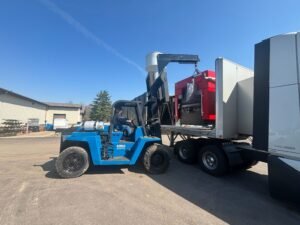
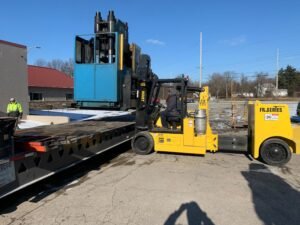
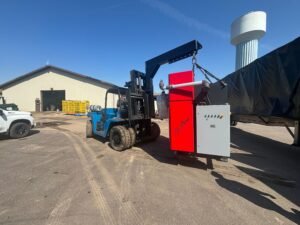
- Forklifts with counterweight or boom attachments handle skid-mounted compressors, dryers and pumps on open floors.
- Hydraulic gantries lift heavy chillers and boilers indoors where a crane cannot reach, and set them precisely on new pads.
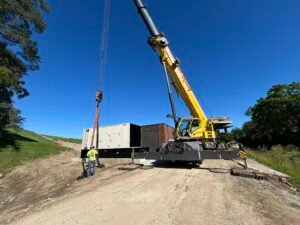
- Mobile cranes handle rooftop units, cooling towers, air makeup units and equipment lifted out through a roof opening. Every crane lift needs a written lift plan.
- Spreader bars and lifting beams keep slings from crushing coils, piping and control panels.
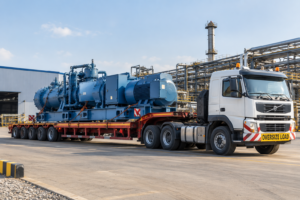
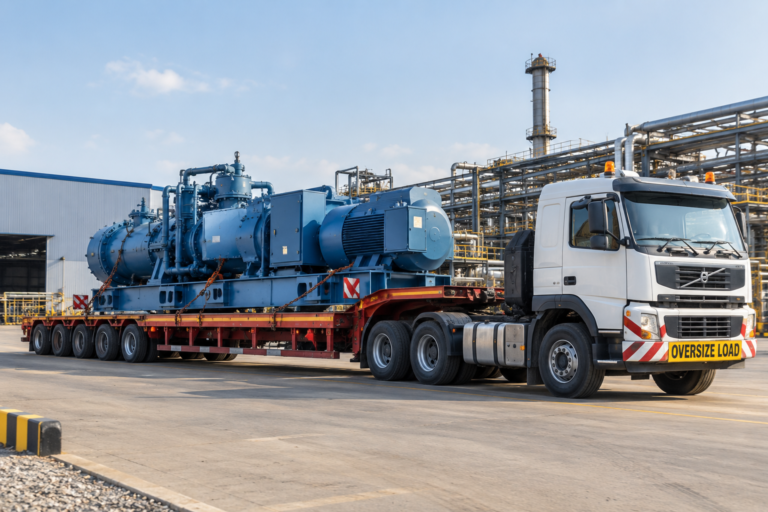
- Air-ride trailers reduce vibration on the road and are the safer choice for chillers, controls and electrical gear. Flatbeds and lowboys carry larger and heavier items.
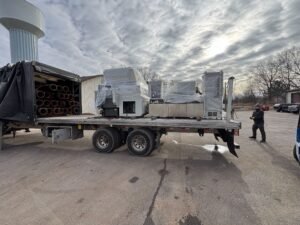
Load securement matters as much as the lift. Equipment should be blocked and chained to its skid or base, never by its piping or sheet metal, and tarped to keep out rain and road salt.
Reinstallation, Alignment and Startup
Setting the equipment down is only half the job. How it is reinstalled decides whether it runs reliably for the next ten years or starts failing in the first ninety days.
Pads and foundations. Concrete pads must be level, cured and sized for the operating weight, including oil, water and refrigerant. Anchor bolts should match the equipment base before it arrives, not after.
Leveling and vibration isolation. Compressors and chillers must sit level so oil returns properly and drains work. Isolators and spring mounts should be installed and adjusted to the manufacturer’s settings.
Alignment. Any motor that drives a pump, fan or compressor through a coupling should be laser aligned after the move. Check for soft foot, where one mounting foot does not sit flat, because it can undo good alignment.
Reconnection. Piping should be supported independently so it does not hang its weight on the equipment. Use flexible connectors where vibration is expected. Power and controls are reconnected by qualified electricians, and motor rotation is checked before full startup.
Testing and startup. Pressure test air and water piping and check for leaks. Recharge the chiller and check the refrigerant charge. Start each unit following the manufacturer’s procedure, then record pressures, temperatures, amps and vibration readings as your new baseline. Run the system under real load before moving production equipment in.
Why Alltracon Is Ohio’s Best Choice for Utility Equipment Relocation
Alltracon is Ohio’s go-to partner for utility equipment relocation. From our Medina base, our millwrights and ironworkers handle disconnect, draining, rigging, crane lifts, trucking, storage, reinstallation and reconnection under one contract. We plan every move around your deadline, because we know an idle compressor or chiller means an idle plant.
What Drives the Cost, and How to Cut Downtime
Every utility relocation is priced differently, but the same factors drive the cost up or down:
- Weight and size, which decide whether you need skates, a gantry or a crane.
- Access, such as basements, rooftops, mezzanines and tight mechanical rooms, which add time and equipment.
- Disassembly, especially for chillers and cooling towers that must be split into sections.
- Specialty trades, including refrigerant technicians, electricians, pipefitters and OEM startup technicians.
- Distance and trailer type, from an in-plant move to a multi-state haul.
- Timing, since nights, weekends and holiday shutdowns cost more but often save far more in lost production.
- New site work, such as pads, piping, electrical and structural steel.
To keep downtime as short as possible, move backup units first, use rental equipment to cover the gap, pre-build pads and piping at the new site, and schedule the switchover during a planned shutdown. Above all, hire one contractor who can manage the whole sequence. When the rigger, millwright and trucking company are three different vendors, every handoff is a chance for delay.
Utility Equipment Relocation Checklist
Before the move
- ☐ Inventory every unit with make, model, serial number, weight and dimensions
- ☐ Photograph and label all power, control, piping and duct connections
- ☐ Confirm air, cooling and power demand at the new site
- ☐ Survey the removal and installation paths
- ☐ Book refrigerant, electrical and OEM startup technicians
- ☐ Arrange rental compressors or chillers if the plants overlap
- ☐ Pour and cure pads, and install piping and power at the new site
During the move
- ☐ Lock out, depressurize and drain every unit
- ☐ Recover or isolate refrigerant through a certified technician
- ☐ Cap open connections and protect coils, panels and gauges
- ☐ Lift only at designated points, with a written lift plan for crane picks
- ☐ Secure loads by their bases and use air-ride trailers for sensitive gear
After the move
- ☐ Level, anchor and set vibration isolators
- ☐ Laser align motors, pumps and fans
- ☐ Pressure test and leak check all piping
- ☐ Complete required inspections, such as boiler certification
- ☐ Start up per the manufacturer and record baseline readings
- ☐ Run under load before moving production equipment in
Frequently Asked Questions
Can an industrial air compressor be moved without draining the oil?
Small units are sometimes moved over short distances with oil in place, but only if they stay level. For truck transport or any lift where the unit may tilt, draining the oil is the safer choice. Always follow the manufacturer’s shipping instructions.
Does a chiller have to be emptied of refrigerant before it is moved?
Not always. Many chillers can have their refrigerant pumped down and isolated in the condenser for the move. Others, or long-distance moves, may call for full recovery. An EPA-certified technician should make that call based on the unit and the manufacturer’s guidance.
How long does it take to relocate a compressor or chiller?
A single compressor moved within the same plant can often be done in one or two shifts. A full utility room with chillers, a cooling tower and piping can take one to several weeks, depending on disassembly, new site readiness and startup. Good planning shortens the actual downtime to a fraction of that.
Should I move my old equipment or buy new?
Compare the age, condition, efficiency and capacity of the old unit with your needs at the new site. If a compressor or chiller is near the end of its life, or is badly sized for the new plant, buying new can cost less over time than moving it.
Can rooftop chillers and cooling towers be moved without a crane?
Rarely. Most rooftop equipment needs a mobile crane, a written lift plan and, in many cities, a street use permit. Some units can be lowered in pieces through roof openings, but that usually costs more time than a crane lift.
Who should I hire for utility equipment relocation?
Look for a contractor with experienced riggers and millwrights, the right equipment for heavy lifts, a strong safety record and the ability to coordinate refrigerant, electrical and OEM trades. A single-source contractor reduces handoffs and keeps the schedule on track.
Conclusion
Air compressors, chillers and other plant utilities are the backbone of every production line. Moving them takes more than a forklift and a truck. It takes careful planning, the right rigging, qualified trades and a startup process that proves the system works before production depends on it.
Put utilities at the front of your relocation plan, keep the old system running until the new one is proven, and choose a partner who can manage the whole job from disconnect to startup.
Planning a compressor, chiller or utility room move in Ohio or the surrounding states? Request a quote or call Alltracon to schedule a site visit.