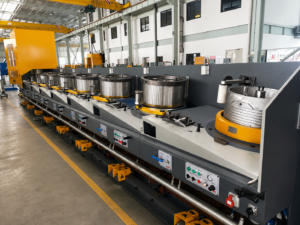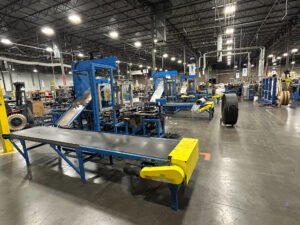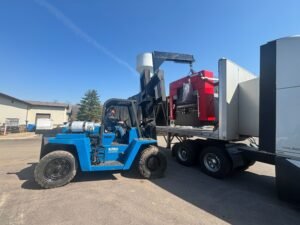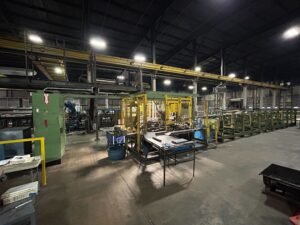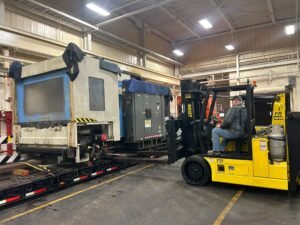
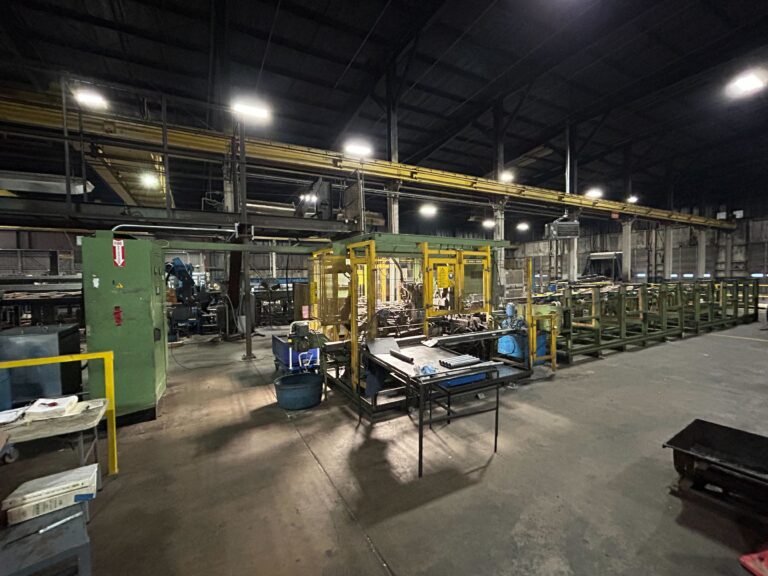
Moving a cabinet shop or metal fabrication facility is nothing like moving an office. You’re not just packing desks and monitors — you’re disconnecting CNC routers, panel saws, edgebanders, dust collection systems, welders, plasma tables, and dozens of tons of raw material and work-in-progress inventory, then getting all of it running again in a new building without missing a beat with customers who are waiting on orders.
For shop owners, the real fear isn’t the move itself. It’s the production gap — the days or weeks where machines sit disconnected, crews stand around with nothing to do, and delivery dates slip. In a competitive fabrication or cabinetry market, a few weeks of downtime can mean lost contracts, frustrated clients, and cash flow problems that take months to recover from.
The good news: with the right planning, a facility relocation doesn’t have to mean a production shutdown. Shops that treat the move as an engineering project — not just a logistics job — routinely cut downtime from weeks to days, and in some cases keep partial production running throughout the transition. Here’s how it’s done.
Why Cabinet Shops and Fabrication Facilities Are Uniquely Hard to Move
Unlike a typical warehouse or office relocation, cabinet shops and fabrication facilities present a specific set of challenges:
Heavy, precision equipment. CNC routers, panel saws, edgebanders, beam saws, laser cutters, press brakes, and CMMs are not only heavy — they’re calibrated to extremely tight tolerances. A machine that gets jostled, tilted past its rated angle, or set down unevenly can lose calibration entirely, requiring a costly re-certification or re-leveling process before it can run a single part.
Utility dependencies. Most fabrication equipment isn’t just plugged into a wall outlet. Machines run on three-phase power, compressed air lines, dust collection ductwork, ventilation systems, and sometimes gas lines for welding or finishing operations. None of that exists on day one in a new building — it all has to be engineered, installed, and inspected before machines can even be powered on.
Work-in-progress and material handling. A shop mid-production usually has partially completed cabinets, cut sheets, fabricated parts, and raw material staged at various points in the workflow. Moving that inventory without losing track of what belongs to which job, and without damaging finished edges or coated surfaces, requires careful labeling and sequencing.
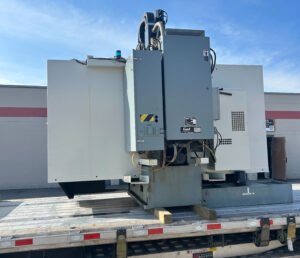
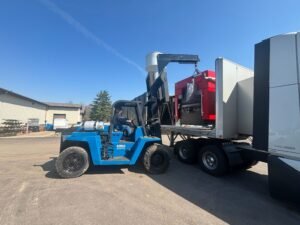
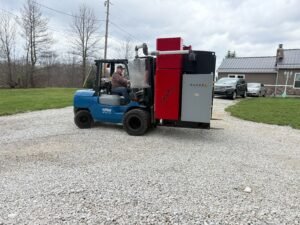
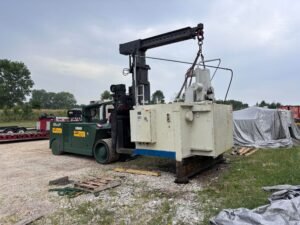
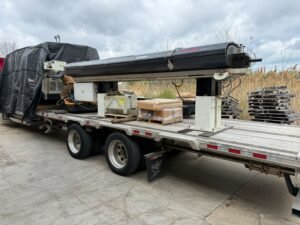
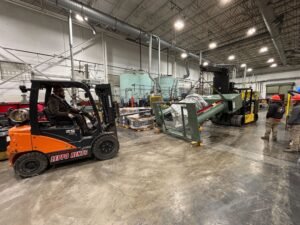
Rigging and access constraints. Getting a five-ton beam saw or a large press brake out of an existing building and into a new one often means dealing with narrow doorways, low ceilings, loading dock heights, and floor load ratings that weren’t designed with that equipment in mind. This is where professional riggers, not general movers, become essential.
Customer commitments that don’t pause. Cabinet shops and fabricators typically have backlogs and delivery dates already committed to clients, builders, or GCs. A relocation has to work around — or actively protect — those commitments, not ignore them.
Because of these factors, a facility move needs a fundamentally different approach than a standard commercial relocation. It needs to be planned like a production changeover, not a “load the truck and go” job.
The Real Cost of Downtime in a Fabrication Business
Before getting into the how-to, it’s worth putting a number on what’s at stake. For a mid-sized cabinet shop or fab shop, a single week of lost production can mean:
- Missed delivery dates on active jobs, triggering penalty clauses or reputational damage with builders and GCs
- Idle labor costs — you’re still paying your crew even when machines aren’t running
- Backlog compression, where delayed jobs stack up and create a bottleneck that takes weeks to work through even after the move is complete
- Lost new business, since prospective clients often move on if a shop can’t confirm a realistic lead time during the transition
This is why the goal of a well-planned relocation isn’t just “get moved” — it’s “get moved while protecting revenue.” That distinction changes almost every decision in the process, from scheduling to equipment sequencing to how the new facility is prepped before moving day.
Step 1: Start Planning Months, Not Weeks, in Advance
The single biggest predictor of a smooth facility move is lead time. Shops that start planning 90–120 days out consistently have far less downtime than shops that start six weeks before their lease is up.
Early planning should include:
- A full equipment inventory — every machine, its dimensions, weight, utility requirements, and any special rigging needs (e.g., machines that need to be disassembled to fit through doorways)
- A site readiness assessment of the new facility — floor load capacity, ceiling height, dock access, electrical service capacity, compressed air infrastructure, and dust collection ducting requirements
- A production calendar review — identifying which weeks have lighter order volume, since moving during a natural lull minimizes the business impact
- A budget that includes contingency — rigging, utility hookups, and machine recalibration commonly run over initial estimates, especially for older or highly customized equipment
Getting electrical contractors, riggers, and equipment technicians involved early — rather than after the lease is signed — avoids the common trap of finding out a machine won’t fit through the new building’s dock door only after moving day.
Step 2: Prep the New Facility Before You Move a Single Machine
One of the most effective ways to compress downtime is to have the new facility fully production-ready before equipment arrives. That means:
- Three-phase power installed and inspected at each machine’s designated location
- Compressed air lines run and pressure-tested
- Dust collection ductwork installed and connected to the new collector system
- Floors leveled or shimmed where needed for machines requiring precise leveling (CNC routers and CMMs are especially sensitive to this)
- Lighting, ventilation, and fire suppression signed off by local inspectors
When this groundwork is done in advance, machines can be rigged in, set down, and connected within hours rather than days. Many shops that skip this step end up with equipment sitting idle in the new building for a week or more while electricians and HVAC contractors finish work that could have been done beforehand.
Step 3: Sequence the Move Around Production Priorities
Rather than moving the entire shop in one shot, the most successful relocations happen in phases, prioritized around what keeps revenue flowing:
- Move non-critical equipment first — finishing stations, storage racks, hand tools, and secondary equipment that doesn’t hold up active jobs
- Split production across both sites temporarily, if lease overlap allows it — running a reduced crew at the old location while the new location comes online
- Move the highest-value, highest-lead-time machines with dedicated rigging crews, scheduled for a specific window (often a weekend) to minimize disruption
- Bring the new location fully online before fully vacating the old one, so there’s a safety net if something needs troubleshooting
This phased approach means the shop is never fully “dark” — there’s always some capacity running somewhere, even if it’s reduced.
Step 4: Treat Machine Rigging as a Specialized Task
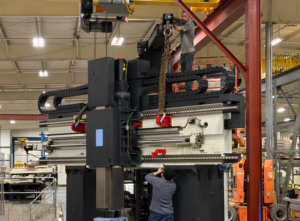
CNC routers, panel saws, edgebanders, press brakes, plasma tables, and CMMs are precision instruments, not furniture. Rigging them requires:
- Proper lifting points and load distribution — using the manufacturer’s specified lift points, not improvised strapping, to avoid frame twisting or bearing damage
- Climate-controlled transport for sensitive electronics, especially CNC control cabinets and any machine with onboard computers or sensors
- Careful handling of granite bases and reference surfaces, particularly for CMMs, which can be permanently thrown out of calibration by even minor shock or uneven loading
- Post-move recalibration and test runs before the machine is cleared for production use
Shops that use general movers instead of riggers experienced with industrial and fabrication equipment often end up paying for it later — either in machine damage, calibration costs, or warranty issues with manufacturers who require proof of proper rigging procedures.
Step 5: Protect Work-in-Progress and Material Inventory
A relocation is also an inventory management problem. Losing track of which cut parts, panels, or partially assembled units belong to which job order can create rework, missed deadlines, and confused crews in the new facility.
Best practices include:
- Tagging all WIP with job number, customer, and next production step before it’s packed
- Photographing staged material and cut lists for reference
- Moving WIP in the same sequence it will re-enter production, so it doesn’t get buried behind newer material
- Auditing raw material inventory during the move — since a relocation is a natural opportunity to catch and correct inventory discrepancies
Step 6: Communicate Proactively With Customers
Even with a well-executed move, some disruption is often unavoidable. Shops that get ahead of this by notifying clients, builders, and GCs of the relocation timeline — and being specific about which order dates might shift — generally retain far more goodwill than shops that go quiet during the transition and let customers find out about delays after the fact.
A simple communication plan includes:
- Notifying active customers 30–60 days before the move
- Being specific about which orders, if any, will be affected
- Offering a single point of contact for questions during the transition period
- Confirming the new facility address, hours, and any changes to logistics or delivery pickup
Step 7: Build in a Recalibration and Test-Run Period
Before declaring the new facility “open for business,” it’s worth running a short internal test period — running sample parts through each machine, checking dust collection airflow, verifying dimensional accuracy on CNC and measuring equipment, and confirming utility systems are stable under full load. Catching an issue during a controlled test run is far less costly than catching it mid-production on a customer’s job.
Common Mistakes That Extend Downtime
Shops that end up with longer-than-expected downtime almost always share a few common mistakes:
- Underestimating utility installation timelines — electrical and compressed air work often takes longer than contractors initially estimate, especially with permitting delays
- Using general movers for specialized equipment — leading to damage or recalibration costs that dwarf the savings from a cheaper rigging quote
- Not confirming floor load capacity in advance — discovering on moving day that a mezzanine or upper floor can’t support a heavy machine
- Failing to phase the move — attempting to relocate everything at once, resulting in a full shutdown rather than a staggered transition
- Skipping test runs — putting machines directly into production without verifying calibration, leading to scrapped material and rework
Putting It All Together
A cabinet shop or fabrication facility relocation is a production-continuity project first and a logistics project second. The shops that pull it off with minimal downtime are the ones that start early, prep the new facility before equipment arrives, sequence the move around what keeps revenue flowing, and use riggers who understand the specific demands of precision fabrication equipment — not general movers unfamiliar with three-phase hookups, dust collection systems, or machine calibration requirements.
Done right, a relocation can even become an opportunity: a chance to reconfigure shop floor layout for better workflow, upgrade dust collection or power infrastructure, and start fresh in a facility that’s better suited to the business than the one being left behind.
Why Alltracon Is the Right Partner for Your Facility Relocation
Relocating heavy equipment isn’t a generalist’s job — it requires riggers who understand the specific demands of fabrication and cabinet shop machinery. Alltracon specializes in heavy equipment moving, with the experience to handle CNC routers, panel saws, press brakes, and precision machinery like CMMs without compromising calibration or safety. From pre-move site assessments to proper rigging techniques and post-move setup, Alltracon’s team plans each relocation around minimizing production downtime, not just moving boxes from point A to point B. For Ohio-based cabinet shops and fabrication facilities looking to relocate without losing customers or revenue, Alltracon brings the specialized equipment, trained crews, and project-management approach needed to keep the move on schedule — and your shop running.