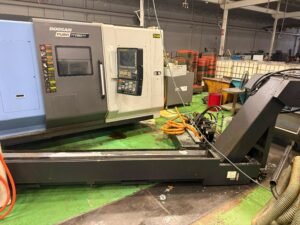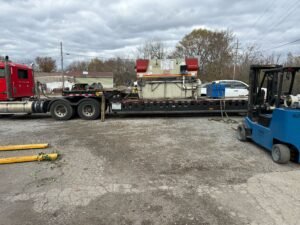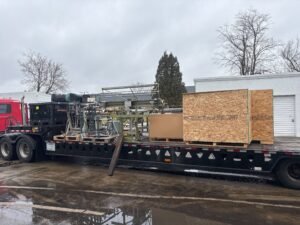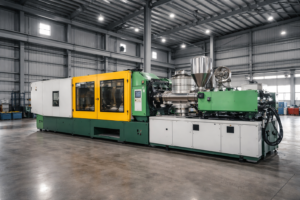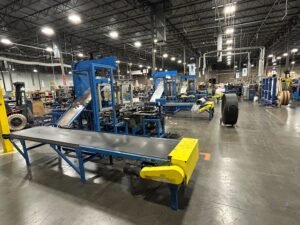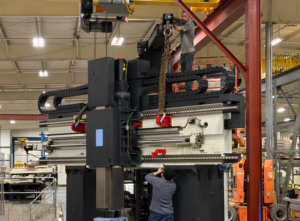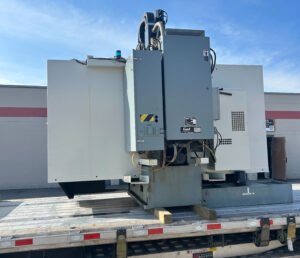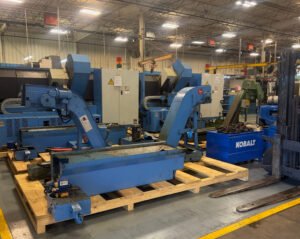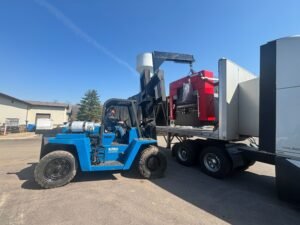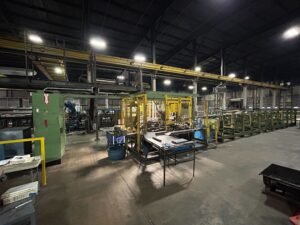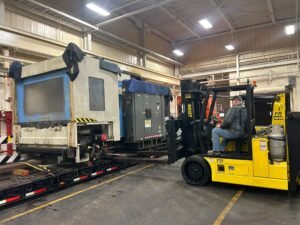
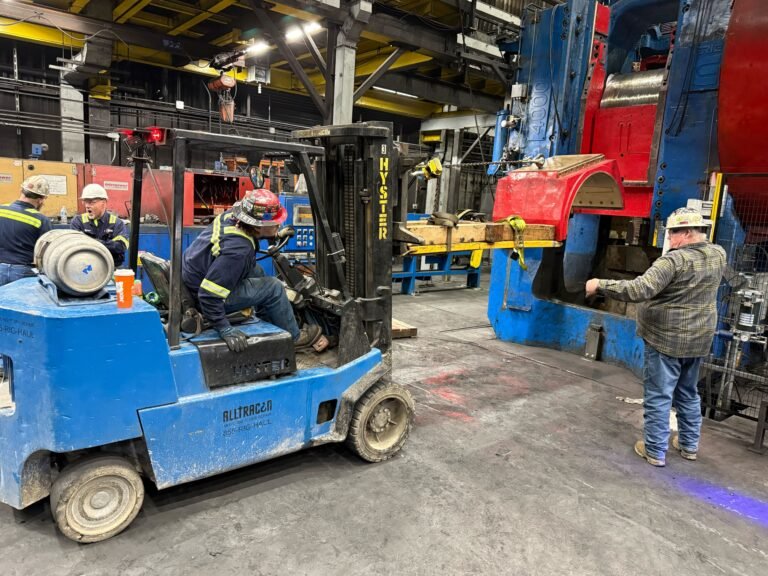
Moving heavy machinery does not always mean transporting equipment from one facility to another. In many manufacturing plants, machine shops, warehouses, laboratories, and production facilities, equipment needs to be moved inside the same building. This may involve shifting a CNC machine to a new production cell, moving a vertical end mill across the shop floor, relocating a press to improve workflow, or repositioning inspection equipment to support a new layout.
Internal machinery moving may sound easier than long-distance machinery transport, but it still requires careful planning, proper rigging equipment, trained personnel, and a strong understanding of the building environment. Heavy equipment can weigh thousands of pounds, and even a short move across the building can create safety risks if the process is not handled correctly.
This guide explains what internal machinery moving involves, when it is needed, how to plan it, what equipment is commonly used, and why professional rigging support is often the safest and most efficient option.
What Is Internal Machinery Moving?
Internal machinery moving is the process of relocating industrial equipment, manufacturing machines, production systems, or heavy assets within the same facility. Instead of loading equipment onto a truck for transportation to another site, the equipment is moved from one area of the building to another.
This type of move may include:
- Moving equipment from one production line to another
- Repositioning machines for workflow improvement
- Relocating CNC mills, lathes, presses, or grinders
- Moving machinery from storage into production
- Shifting equipment during plant reorganization
- Relocating machines to prepare for new equipment installation
- Moving machinery away from renovation or construction zones
- Repositioning quality control or metrology equipment
- Moving equipment from one department to another
Although the move may only cover a short distance, the machinery may still be extremely heavy, delicate, unbalanced, or difficult to maneuver. That is why internal machinery moving requires more than basic labor. It requires a planned rigging approach.
Why Facilities Need Internal Machinery Moving
Companies relocate machinery inside their buildings for many reasons. As production needs change, equipment layouts must also evolve. A machine that was once in the perfect location may later become an obstacle to efficiency, safety, or expansion.
Production Layout Changes
One of the most common reasons for internal machinery moving is a change in production layout. Manufacturers may reorganize machines to reduce material handling time, improve operator movement, increase output, or create a smoother production flow.
For example, a facility may move a CNC mill closer to a lathe, inspection station, or assembly area to reduce unnecessary movement between processes. Even a small layout improvement can save time over thousands of production cycles.
New Equipment Installation
When new machinery arrives, existing equipment may need to be moved to make space. This may involve moving one machine across the building, shifting several machines within a work cell, or completely reorganizing a production area.
Internal machinery moving is often part of a larger installation project. The success of the new installation depends on safely clearing the area, preparing access routes, and placing each machine in the correct position.
Increased Production Capacity
As companies grow, they may need to add new machines, expand production lines, or create more efficient work areas. Existing equipment may need to be relocated to support added capacity.
This is common in machine shops, packaging plants, metalworking facilities, automotive suppliers, food processing plants, and other production environments where floor space is limited.
Maintenance and Repairs
Some machines must be moved to allow access for repairs, foundation work, electrical upgrades, or floor improvements. In these cases, equipment may need to be temporarily relocated and then moved back after the work is complete.
Safety and Compliance Improvements
A facility may move equipment to improve aisle clearance, operator access, forklift movement, emergency exits, ventilation, or safety zones. Internal equipment relocation can support OSHA-related safety improvements and better workplace organization.
Lean Manufacturing and Workflow Optimization
Many facilities move machinery as part of lean manufacturing improvements. The goal may be to reduce waste, shorten travel distance, improve process flow, or create dedicated production cells.
Internal machinery moving helps companies adjust their physical layout to match better production practices.
Common Types of Equipment Moved Across a Building
Internal machinery moving can involve many different types of industrial equipment. Each machine has its own weight, footprint, center of gravity, utility connections, and handling requirements.
Common equipment moved inside facilities includes:
- CNC mills
- CNC lathes
- Vertical end mills
- Horizontal machining centers
- Manual mills and lathes
- Press brakes
- Stamping presses
- Hydraulic presses
- Cold forging machines
- Injection molding machines
- Packaging machines
- Conveyor systems
- Robotic cells
- Inspection and metrology equipment
- ZEISS, CMM, and CT inspection machines
- Compressors and pumps
- Tanks and process equipment
- Fabrication machinery
- Assembly line equipment
- Food processing machinery
- Printing and converting equipment
Some machines are rugged and compact, while others are highly sensitive to shock, vibration, or alignment changes. For example, moving a small vertical end mill weighing around 2,930 lbs requires different planning than moving a 10,500 lb metrology machine or a large industrial press.
Why Internal Machinery Moving Is More Complex Than It Looks
Because the equipment remains inside the same building, some facility managers assume the move will be simple. However, internal moves often involve tight spaces, limited access, floor load concerns, and production-area obstacles.
A machine may only need to move 100 feet, but that route may include narrow aisles, overhead obstructions, uneven floors, low doorways, electrical drops, anchor bolts, floor drains, pits, or nearby equipment. These challenges make internal machinery moving a specialized task.
Heavy Weight in Limited Space
Many machines weigh several thousand pounds or more. Moving that kind of weight through a crowded production area requires careful control. There may be very little room for forklifts, cranes, or turning equipment.
Center of Gravity Concerns
Machines are not always evenly balanced. Some are top-heavy, side-heavy, or have uneven weight distribution. A machine that looks stable may become unsafe when lifted or rolled.
Understanding the machine’s center of gravity is critical before lifting, jacking, skidding, or moving it.
Sensitive Components
CNC machines, inspection machines, and precision manufacturing equipment can contain sensitive spindles, control panels, glass scales, sensors, hydraulic systems, or electrical components. Rough handling can cause expensive damage.
Floor Conditions
Internal moves depend heavily on floor conditions. The floor must be able to support the machine’s weight as well as the moving equipment. Cracks, slopes, floor coatings, expansion joints, drains, or weak concrete areas can affect the move.
Obstructions and Access Limitations
A route may appear open at first but still contain obstacles such as low-hanging lights, air lines, ducts, mezzanine supports, guardrails, columns, door frames, or other machines.
A professional machinery moving team surveys the route before the move to identify these risks.
Planning an Internal Machinery Move
Good planning is the foundation of a safe and efficient internal machinery move. The planning stage should happen before any machine is disconnected, lifted, or moved.
Step 1: Identify the Equipment to Be Moved
The first step is to clearly identify the machine or machines being relocated. Important details include:
- Machine name and model
- Overall dimensions
- Approximate weight
- Footprint
- Height
- Center of gravity information, if available
- Manufacturer handling points
- Required clearances
- Utility connections
- Anchoring method
- Sensitivity to vibration or tilt
If the machine manual is available, it may include lifting diagrams, safe handling instructions, or weight distribution information.
Step 2: Determine the New Location
The new location should be measured and prepared before the move begins. The team should confirm that the machine will fit properly and that there is enough clearance for operation, maintenance, loading, and operator access.
The new location should also be checked for:
- Floor strength
- Levelness
- Utility availability
- Electrical service
- Air supply
- Hydraulic connections
- Ventilation
- Drainage
- Safety clearance
- Material flow
- Access for future maintenance
A machine should not simply be moved into a space because it fits physically. It must also function safely and efficiently in that location.
Step 3: Survey the Travel Path
The route from the current location to the new location must be inspected carefully. This is one of the most important parts of internal machinery moving.
The route survey should check:
- Aisle width
- Turning radius
- Door openings
- Ceiling height
- Floor condition
- Floor load capacity
- Slopes or ramps
- Expansion joints
- Floor drains
- Overhead utilities
- Fire protection systems
- Nearby machines
- Pedestrian traffic
- Forklift traffic
- Temporary obstructions
In some cases, temporary removal of guardrails, doors, panels, or equipment may be needed to create a safe travel path.
Step 4: Choose the Right Moving Method
The moving method depends on the machine’s weight, shape, sensitivity, route, and available space.
Common methods include:
- Forklift moving
- Crane lifting
- Gantry lifting
- Machine skates
- Toe jacks
- Hydraulic jacking systems
- Rollers
- Skidding systems
- Air bearings
- Versa-Lift or compact industrial lifts
- Forklift and skate combinations
The correct method depends on the job. A small machine may be moved with a forklift and skates, while a heavy or delicate machine may require hydraulic gantries or specialized rigging systems.
Step 5: Create a Safety Plan
Before work begins, everyone involved should understand the safety plan. This includes communication, exclusion zones, load control, emergency procedures, and responsibilities.
The safety plan should address:
- Who is in charge of the move
- Who is allowed inside the work zone
- How communication will happen
- What PPE is required
- What equipment will be used
- How the load will be lifted and moved
- How pinch points will be controlled
- How pedestrian and forklift traffic will be managed
- What to do if conditions change
A controlled move is always safer than a rushed move.
Preparing Machinery Before Relocation
Before a machine is moved, it must be properly prepared. Skipping preparation can lead to equipment damage, oil leaks, electrical issues, or safety hazards.
Disconnect Utilities Safely
Machines may be connected to electrical power, compressed air, hydraulics, water, coolant, gas lines, dust collection, or network cables. These connections must be safely disconnected by qualified personnel.
Lockout/tagout procedures should be followed when required. This helps prevent accidental startup during the move.
Drain or Secure Fluids
Some machines contain coolant, hydraulic fluid, lubricants, or process fluids. These may need to be drained, capped, or secured before moving.
Fluid leaks can create slip hazards, contaminate floors, or damage the machine.
Secure Moving Parts
Machine components such as tables, doors, arms, heads, spindles, guards, tanks, or panels should be secured before movement. Unsecured parts can shift during lifting or rolling.
For CNC machines and precision equipment, specific manufacturer procedures may be required to protect sensitive components.
Remove Loose Items
Tools, fixtures, stock, scrap, accessories, manuals, and loose parts should be removed before the move. These items can fall, shift, or interfere with rigging.
Check Anchors and Foundation Connections
Many machines are bolted to the floor. Anchor bolts must be removed properly. If the machine is grouted or mounted on a special foundation, extra work may be needed before it can be moved.
Protect the Machine
Depending on the equipment, protective wrapping, padding, blocking, or bracing may be used. Control panels, screens, exposed wiring, precision surfaces, and delicate components should be protected.
Rigging Equipment Used for Internal Machinery Moving
Professional machinery movers use specialized equipment to safely lift, move, and place heavy machines. The right tools allow a machine to be moved with better control and lower risk.
Forklifts
Forklifts are commonly used for smaller or medium-sized machinery moves. However, forklift capacity, load center, attachment type, and operator experience are critical.
A machine may weigh less than the forklift’s rated capacity but still be unsafe if the load center is too far forward or the machine is unbalanced.
Machine Skates
Machine skates are heavy-duty rolling platforms placed under equipment. They are useful for moving machines across relatively smooth floors.
Skates help distribute weight and allow controlled rolling movement. However, they require proper jacking, careful steering, and good floor conditions.
Toe Jacks
Toe jacks are used to lift machinery from a low clearance point so that skates, blocks, or cribbing can be placed underneath. They are especially useful when a forklift cannot easily access lifting points.
Hydraulic Gantries
Hydraulic gantries are used for lifting heavy machinery when overhead cranes are not available. They provide controlled lifting and can be useful in tight indoor environments.
Industrial Cranes
Some facilities have overhead bridge cranes, jib cranes, or mobile cranes that can assist with internal machinery relocation. Crane use requires proper rigging points, lifting plans, and trained operators.
Air Bearings
Air bearings allow heavy equipment to float slightly on a thin cushion of air. They are useful for moving sensitive equipment across smooth floors with minimal vibration. However, they require proper floor conditions and compressed air supply.
Skidding Systems
Skidding systems are used to move heavy equipment along a controlled track or path. They are useful when loads are extremely heavy or when precise movement is required.
Cribbing and Blocking
Cribbing and blocking provide temporary support during lifting, jacking, or staging. Proper cribbing is essential for safety when working around heavy loads.
Important Safety Risks During Internal Machinery Moving
Internal machinery moving involves serious safety risks. A machine weighing thousands of pounds can cause severe damage or injury if it shifts, tips, drops, or rolls unexpectedly.
Tip-Over Risk
Top-heavy machines can tip if lifted incorrectly, moved too quickly, or turned sharply. Even a small shift in center of gravity can create danger.
Pinch Points
Machinery moving creates pinch points between the load, floor, walls, columns, skates, forklifts, and other equipment. Workers must stay clear of dangerous areas.
Floor Failure
If the floor cannot support the concentrated load of the machine or moving equipment, cracks or failure may occur. This is especially important for upper floors, mezzanines, older buildings, or areas with trenches and pits.
Load Shifting
A load can shift during lifting, turning, lowering, or rolling. Proper rigging, slow movement, and constant monitoring reduce this risk.
Equipment Damage
Improper handling can damage machine frames, leveling feet, control cabinets, wiring, hydraulic lines, spindles, or precision components.
Production Disruption
A poorly planned internal move can block aisles, delay operations, or create downtime. Coordination with production schedules is important.
Moving CNC Mills and Lathes Across a Facility
CNC mills and lathes are common candidates for internal relocation. These machines are valuable, heavy, and sensitive to alignment.
Before moving CNC equipment, the team should confirm the machine’s weight, lifting points, leveling requirements, and manufacturer recommendations. Control panels, doors, way covers, coolant tanks, chip conveyors, and accessories may need special handling.
After relocation, the machine often needs to be leveled, reconnected, and tested before production resumes. In some cases, calibration or service technician support may be required.
The key concern with CNC machines is not just moving the weight. It is preserving accuracy, alignment, and machine condition.
Moving a Vertical End Mill Across the Building
A vertical end mill may seem smaller than other industrial machines, but it can still weigh several thousand pounds. For example, a vertical end mill weighing approximately 2,930 lbs requires careful handling, especially if it must be moved across a building.
Important considerations include:
- Confirming the machine’s weight and dimensions
- Checking if the head or table should be secured
- Inspecting the route for floor cracks or obstacles
- Choosing the correct forklift, skate, or jack method
- Avoiding sudden movement or sharp turns
- Protecting the machine from tipping
- Leveling the machine after placement
Because many vertical mills are tall compared to their footprint, center of gravity must be considered carefully. A top-heavy machine should never be moved casually.
Relocating Precision Inspection and Metrology Equipment
Metrology equipment, CT inspection systems, and coordinate measuring machines require special care. These machines are often sensitive to vibration, shock, leveling changes, and environmental conditions.
For example, removing or relocating a large ZEISS Metrotom machine weighing around 10,500 lbs would require detailed planning because the equipment is both heavy and precise.
Important concerns include:
- Protecting sensitive measuring components
- Avoiding sudden shock or vibration
- Following manufacturer handling instructions
- Maintaining controlled movement
- Preparing the new location properly
- Checking electrical and environmental requirements
- Allowing for recalibration after placement
Precision equipment relocation should always be approached with extra caution.
Internal Moving of Presses and Heavy Production Machines
Industrial presses, hydraulic presses, Panstone presses, cold forging machines, and similar equipment can be extremely heavy. These machines may also have unusual weight distribution and limited lifting points.
Press relocation may require:
- Detailed lift planning
- Heavy-capacity rigging equipment
- Forklift or gantry support
- Anchoring removal
- Hydraulic system preparation
- Fluid containment
- Route reinforcement
- Controlled load-out or internal repositioning
Even if a press is only moving across the building, the risk level can be high due to weight and balance.
Preparing the Destination Area
The destination area should be completely ready before the move begins. Delays during placement can create safety risks and increase downtime.
The destination area should be:
- Clean and clear
- Measured and marked
- Structurally suitable
- Free of unnecessary traffic
- Ready for utility reconnection
- Accessible for rigging equipment
- Prepared for leveling and anchoring
- Checked for operator clearance
- Checked for maintenance access
If the machine requires anchoring, the anchor points should be planned carefully. If it requires leveling pads or grout, those materials should be ready.
Placement, Leveling, and Reconnection
The move is not complete when the machine reaches the new location. Final placement is one of the most important stages.
Accurate Positioning
Industrial equipment often needs to be positioned within tight tolerances. A few inches can affect workflow, utility connections, operator access, or maintenance clearance.
Leveling
Many machines must be leveled after placement. CNC machines, mills, lathes, presses, and inspection equipment often require proper leveling for performance and accuracy.
Anchoring
Some machines must be anchored to the floor. Anchoring helps prevent movement, vibration, and instability during operation.
Utility Reconnection
Electrical, air, coolant, hydraulic, dust collection, and data connections must be reconnected safely. Qualified technicians should handle these systems.
Testing
After reconnection, the machine should be tested before returning to full production. Testing may include startup checks, motion checks, safety interlock checks, calibration, and trial operation.
How to Reduce Downtime During Internal Machinery Moving
Downtime is one of the biggest concerns during any machinery move. A well-planned internal move can reduce lost production time.
Schedule During Off-Hours
If possible, the move can be scheduled during weekends, evenings, maintenance windows, or planned shutdowns.
Prepare the Route in Advance
Removing obstacles, clearing aisles, and marking the route before the move saves time.
Disconnect Utilities Before the Rigging Team Arrives
When safe and appropriate, utility disconnection can be completed before the moving work begins.
Have the Destination Ready
The new location should be clean, marked, and ready for placement. Waiting until the machine arrives to prepare the space causes delays.
Coordinate All Teams
Production, maintenance, safety, electricians, riggers, and equipment operators should all understand the schedule.
Use Professional Machinery Movers
Experienced movers work more efficiently because they know how to handle common problems, choose the right equipment, and avoid mistakes.
Internal Machinery Moving Checklist
A simple checklist can help facility managers prepare for an internal move.
Before the Move
- Identify machine weight and dimensions
- Review manufacturer handling instructions
- Confirm the destination location
- Survey the travel route
- Check floor conditions
- Identify overhead and side obstructions
- Disconnect utilities safely
- Secure loose parts and moving components
- Remove anchors or mounting hardware
- Prepare rigging equipment
- Establish safety zones
- Communicate the move schedule
During the Move
- Keep unauthorized people away
- Move slowly and carefully
- Monitor load balance
- Watch for floor obstacles
- Maintain clear communication
- Avoid sudden turns or stops
- Keep hands and feet away from pinch points
- Use spotters when needed
After the Move
- Position the machine accurately
- Level the machine
- Anchor it if required
- Reconnect utilities
- Inspect for damage
- Test machine operation
- Calibrate if needed
- Clear the work area
- Document the completed move
Common Mistakes to Avoid
Internal machinery moving becomes risky when teams underestimate the task. Here are common mistakes to avoid.
Moving Without Knowing the Exact Weight
Guessing the weight of a machine can lead to equipment failure or unsafe lifting. Always confirm the weight from nameplates, manuals, drawings, or reliable documentation.
Ignoring the Center of Gravity
A machine’s weight may not be evenly distributed. Lifting or pushing from the wrong point can cause tipping.
Using the Wrong Equipment
A forklift, jack, or skate that is not rated for the load can create major safety risks.
Failing to Check the Route
A blocked aisle, weak floor, low doorway, or tight turn can stop the move midway and create problems.
Not Securing Machine Components
Loose parts can shift, fall, or become damaged during the move.
Rushing the Job
Rushing increases the chance of mistakes. Heavy machinery should be moved slowly, with full control.
Skipping Post-Move Leveling
Many machines must be leveled after placement. Skipping this step can affect accuracy, performance, and machine life.
Why Hire Professional Riggers for Internal Machinery Moving?
Professional riggers bring the equipment, training, and experience needed to move heavy machines safely. Even when a facility has forklifts and maintenance personnel, internal machinery moving may still require specialized support.
Professional riggers can help with:
- Lift planning
- Route evaluation
- Load control
- Equipment selection
- Safe jacking and skidding
- Forklift coordination
- Precision placement
- Heavy load handling
- Reduced downtime
- Risk reduction
Hiring professionals can also protect valuable equipment. A machine may cost tens of thousands or hundreds of thousands of dollars. Avoiding damage during relocation is often worth far more than the cost of professional rigging support.
Alltracon: Trusted Support for Internal Machinery Moving
Alltracon is a trusted service provider for internal machinery moving, industrial rigging, equipment relocation, and heavy machinery handling. Their experienced team helps manufacturers move equipment safely across buildings, production floors, and plant environments. From CNC machines and presses to complex industrial systems, Alltracon provides reliable planning, rigging, and placement support for demanding equipment relocation projects.
Final Thoughts
Internal machinery moving is more than simply pushing a machine from one side of a building to another. It involves planning, safety control, rigging expertise, route evaluation, equipment preparation, and accurate placement.
Whether a facility needs to move a vertical end mill, CNC lathe, hydraulic press, cold forging machine, packaging system, or precision inspection machine, the process should be handled carefully from start to finish.
A successful internal move protects workers, prevents machine damage, reduces downtime, and helps the facility operate more efficiently. By preparing properly and working with experienced machinery movers, companies can relocate equipment across the building with confidence and control.