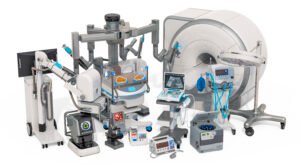
If you’ve ever tried to move a house, you know how stressful it can be to keep a grandmother’s china from cracking in a moving box. Now imagine that instead of dinnerware, you’re responsible for a $400,000 mass spectrometer, an MRI coil sensitive enough to be thrown off by a stray magnetic field, or a centrifuge with tolerances measured in microns. That’s the world of medical and laboratory equipment relocation — and it’s a world where “we’ll just wrap it in some bubble wrap and hope for the best” simply isn’t an option.
Hospitals renovate. Labs relocate. Diagnostic centers expand into new buildings. Universities move research equipment between campuses. Whatever the reason, at some point almost every healthcare or scientific organization has to move equipment that is expensive, delicate, and often irreplaceable on short notice. Getting that move wrong doesn’t just cost money — it can delay patient care, set research back months, or void a manufacturer’s warranty entirely.
This is where custom crating and specialized moving solutions come in. In this article, we’ll walk through what actually goes into moving medical and lab equipment safely, why generic packing materials fall short, and what to look for in a provider who can handle the job without turning your relocation into a disaster story you tell for years.
There’s also a quieter cost to getting this wrong that doesn’t always show up on an insurance claim: trust. When a piece of equipment comes back from a move slightly “off” — reading a few percent low on a calibration check, or throwing intermittent errors it never threw before — staff start second-guessing every result it produces. Sometimes that mistrust is justified. Sometimes it’s not. Either way, it’s a problem that a well-executed move avoids entirely.
Why Medical and Lab Equipment Needs Special Treatment
It’s tempting to think of equipment moving as a one-size-fits-all service — after all, isn’t it all just “putting heavy things in boxes and driving them somewhere”? Not quite. Medical and laboratory equipment brings a specific set of challenges that most general movers simply aren’t equipped to handle.
It’s sensitive to vibration and shock.
Many lab instruments — think centrifuges, spectrometers, and analyzers — contain precision components that can be knocked out of calibration by even minor jolts. A pothole that wouldn’t bother a filing cabinet can be enough to throw off an instrument’s readings for weeks.
It’s sensitive to temperature and humidity.
Incubators, refrigerated centrifuges, and certain diagnostic equipment need to stay within tight environmental ranges, even while sitting in the back of a moving truck.
It’s often magnetically or electronically sensitive.
MRI machines and other imaging equipment can be affected by nearby metal, electromagnetic interference, or improper grounding during transport.
It’s expensive to replace and slow to re-certify.
Unlike office furniture, you can’t just order a replacement microscope overnight. And even once new equipment arrives, many medical devices require recalibration, inspection, or regulatory sign-off before they can be used again — which means damage during a move doesn’t just cost the price of the item, it costs weeks of downtime.
It’s regulated.
Depending on the equipment, there may be FDA, CLIA, or manufacturer-specific requirements around how devices are handled, transported, and reinstalled — particularly for anything involved in patient diagnosis or treatment.
It often has a lot of moving parts, literally.
Many devices are actually assemblies of several sub-components — a base unit, a detector, a cooling system, cabling — that were never designed to be shipped as one bulky object. Figuring out what needs to come apart, what can stay together, and how to keep track of every cable and bracket is its own small logistics project layered on top of the physical move.
Put all of that together, and it’s easy to see why “just hire movers” isn’t a strategy that holds up when the cargo is a cryostat or a flow cytometer.
What Custom Crating Actually Involves
A lot of people picture a “crate” as a simple wooden box — and for some equipment, that’s roughly accurate. But custom industrial crating for medical and lab equipment is closer to engineering than carpentry.
Designing Around the Equipment, Not the Other Way Around
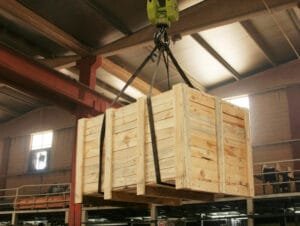
The process typically starts with a detailed assessment of the equipment itself: its dimensions, weight, center of gravity, and any protruding or fragile components. From there, a custom crate is designed specifically for that piece of equipment — not pulled off a shelf. This might mean built-in foam cutouts shaped to the exact contours of an instrument, internal bracing to prevent shifting, or a suspension system that isolates the equipment from shock and vibration during transport.
It’s worth pausing on why “not pulled off a shelf” matters so much here. A standard crate built for a generic 500-pound load distributes stress evenly across its frame, which works fine for something like packaged inventory. But a piece of lab equipment might have 80% of its weight concentrated in a base unit with a fragile optical assembly perched on top — and a generic crate has no way of accounting for that imbalance. Custom design means the crate’s internal structure is built around where the weight and fragility actually sit, not where a standard template assumes they sit.
Choosing the Right Materials
Depending on the sensitivity of the equipment, crating materials can range from standard plywood with foam padding to more advanced solutions like:
- Shock-isolating foam or gel mounts that absorb vibration during transport
- Vapor barrier film to protect against humidity and moisture damage
- Desiccant packs to control interior humidity during longer shipments
- ESD-safe materials for equipment sensitive to electrostatic discharge
- Climate-controlled crating with insulation for temperature-sensitive devices
Load Testing and Documentation
For high-value or particularly delicate equipment, reputable crating providers will often test the crate design — checking that it holds up under simulated transport conditions before it’s trusted with the real thing. Many also provide documentation of the crating specifications, which can matter for insurance purposes or for satisfying a manufacturer’s requirements around how equipment must be packed to maintain warranty coverage.
Built for the Whole Journey, Not Just the Truck
Good crating accounts for every stage of the move — not just the drive itself. That includes loading and unloading with a forklift or pallet jack, temporary storage that might involve stacking, and the final leg of getting equipment through doorways, elevators, and hallways at the destination. A crate that protects equipment perfectly in transit but can’t survive being tipped on its side during unloading isn’t doing its job.
Where Crating Ends and Moving Begins
Crating protects the equipment. Moving gets it where it needs to go. And for medical and lab equipment, the “moving” part involves its own set of considerations that go well beyond loading a truck.
Pre-Move Planning and Equipment Assessment
Before anything gets touched, an experienced moving team will typically walk the facility — both the origin and the destination — to identify potential obstacles. Are there narrow hallways or tight elevator doors? Does the new lab have adequate power and ventilation already in place? Is there a loading dock, or will equipment need to be carried up a flight of stairs? Answering these questions ahead of time prevents the kind of on-site surprises that turn a planned two-hour move into an all-day ordeal.
This is also the point where a good provider will ask questions you might not think to raise yourself — like whether the new space has been certified for the equipment’s power draw, whether there’s adequate floor loading for something heavy like an autoclave, or whether the HVAC system in the new lab is ready to maintain the environmental conditions certain instruments require. It’s a lot easier to catch a mismatch like this on paper, weeks before the move, than to discover it while equipment is sitting on a dolly in a hallway.
Decontamination and Compliance Considerations
Certain lab and medical equipment — particularly anything that’s come into contact with biological samples, chemicals, or radioactive materials — may need to be decontaminated or certified safe for transport before it can legally leave the facility. This is an area where cutting corners isn’t just risky, it can be a regulatory violation, so it’s worth confirming upfront that your moving provider understands these requirements or can coordinate with your facility’s safety officer.
Climate-Controlled Transport
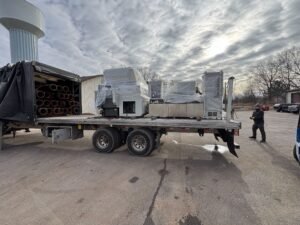
For equipment that can’t tolerate temperature swings, the moving vehicle itself matters as much as the crate inside it. Climate-controlled trucks maintain a stable environment throughout the drive, which is especially important for longer moves or moves happening in extreme summer or winter conditions.
Careful Handling at Every Touchpoint
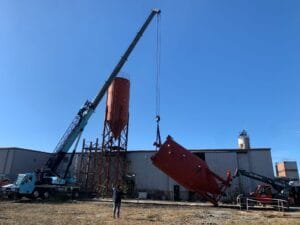
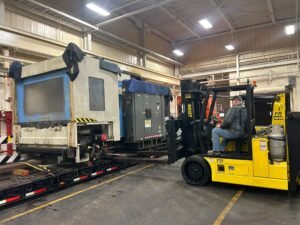
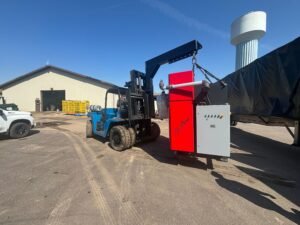
The riskiest moments in any equipment move usually aren’t the highway miles — they’re the transitions. Lifting equipment onto a dolly, navigating a tight doorway, loading it into the truck, and setting it down at the new site are the points where damage is most likely to happen. Experienced crews slow down at exactly these moments, using proper lifting techniques and appropriate equipment (hydraulic lift gates, air-ride suspension trucks, or even small cranes for larger items) rather than relying on brute force.
Reinstallation and Recalibration
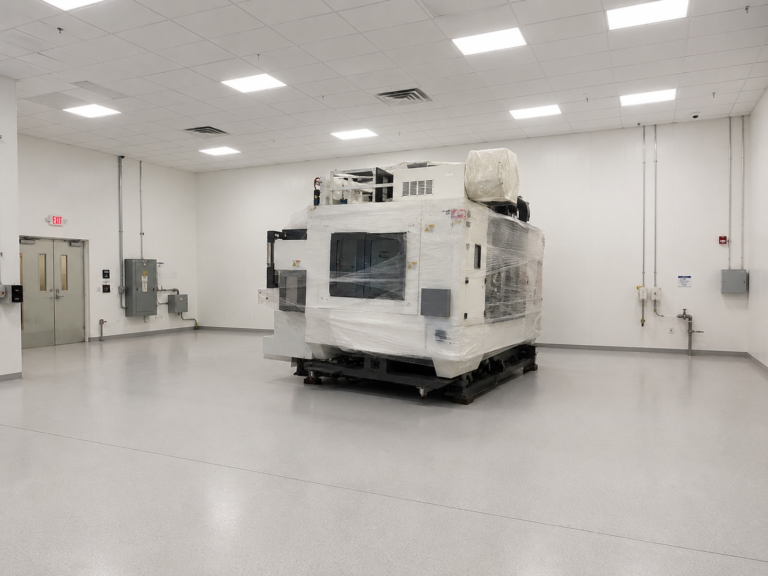
The move isn’t really finished when the truck pulls away — it’s finished when the equipment is back up and running correctly. Many providers coordinate with the original equipment manufacturer or a certified technician to handle reinstallation, recalibration, and testing once equipment arrives at its new home. This final step is often the difference between a lab that’s back to full productivity the next morning and one that’s waiting weeks for a technician to become available.
Common Mistakes That Lead to Equipment Damage
Having seen (or heard about) enough botched equipment moves, a few patterns tend to show up again and again:
- Using generic packing materials.
Standard moving blankets and bubble wrap weren’t designed for precision instruments, and they often don’t provide enough protection against vibration or impact. - Skipping the pre-move site walkthrough.
Discovering that an MRI won’t fit through a doorway on move day — instead of during planning — turns a routine relocation into an emergency. - Underestimating disassembly requirements.
Some equipment needs to be partially disassembled for safe transport, and improvising this on the spot increases the risk of damage or lost components. - Ignoring manufacturer guidelines.
Many equipment manufacturers publish specific handling and transport instructions. Ignoring them can void warranties even if the move itself goes smoothly. - Not planning for recalibration downtime.
Facilities sometimes assume equipment will be usable the moment it’s set down at the new location, without budgeting time for recalibration or inspection — leading to unexpected gaps in service. - Choosing a provider based on price alone.
The cheapest quote is rarely the cheapest outcome when it comes to a six-figure instrument. A lower bid often reflects generic materials, less experienced crews, or a rushed timeline — any of which can turn into far more expensive problems than the money saved upfront.
Questions to Ask a Crating and Moving Provider
Before trusting anyone with equipment this valuable, it’s worth asking a few pointed questions:
- Have you handled equipment similar to ours before, and can you share examples?
- Do you design custom crates in-house, or do you outsource that work?
- How do you handle equipment that requires climate-controlled transport?
- What’s your process for a pre-move site assessment?
- Do you coordinate with equipment manufacturers for reinstallation and calibration?
- What insurance coverage applies during transport, and what happens if something is damaged?
- Are your crews familiar with any regulatory requirements specific to our equipment (biohazard decontamination, radiation safety, etc.)?
A provider who answers these with specifics — rather than a generic “don’t worry, we’ve got it” — is usually the one worth trusting with equipment you can’t afford to lose.
Why Alltracon Is a Trusted Choice for Crating and Moving Solutions
For medical and laboratory equipment that simply can’t afford to be damaged in transit, Alltracon brings the careful planning and hands-on experience needed to get it right. With custom crating built around each instrument and a moving process that prioritizes safe handling at every step, Alltracon helps facilities relocate sensitive equipment with confidence and minimal downtime.
Conclusion
Moving medical and laboratory equipment is a different kind of challenge than moving furniture or general office equipment, and treating it the same way is how expensive mistakes happen. Custom crating built around the exact shape and sensitivity of each instrument, combined with a moving process that accounts for climate control, compliance, and careful handling at every step, is what actually keeps this equipment safe from the loading dock to the lab bench.
If your facility has a move on the horizon — whether it’s a single centrifuge or an entire diagnostic lab — the time spent finding a provider who genuinely understands this equipment is time that pays for itself many times over in avoided damage, avoided downtime, and a whole lot less stress on move day. The instruments in your lab took years of budgeting, grant applications, or capital planning to acquire. The move itself should take that same level of care to protect them.