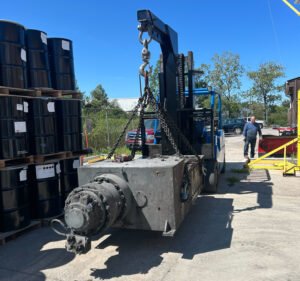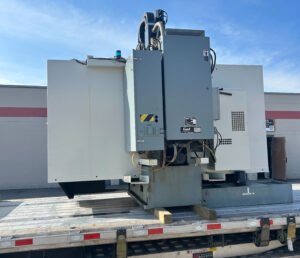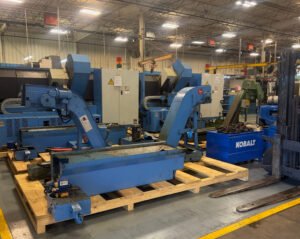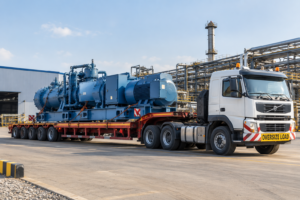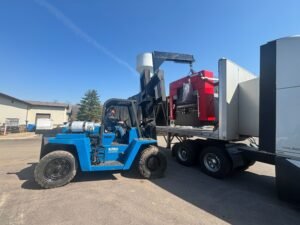
When it comes to moving heavy machinery inside factories, print shops, and industrial facilities, few pieces of equipment are as critical — or as misunderstood — as the Versa-Lift truck. While standard forklifts are built for warehouse pallet handling, they simply weren’t designed for the extreme point loads, awkward shapes, and tight clearances that come with relocating CNC machining centers, printing presses, injection mold presses, or vertical boring machines.
This is exactly where Versa-Lift trucks earn their reputation in the heavy equipment moving industry. Engineered specifically for rigging and machinery moving, these machines are built to achieve something standard material handling equipment simply cannot: precise, controlled load placement in confined industrial spaces, often within fractions of an inch.
This article breaks down exactly how Versa-Lift trucks accomplish this — the engineering behind them, the techniques operators use, and why this capability matters so much for industrial relocations.
What Makes Versa-Lift Trucks Different From Standard Forklifts
Before diving into how precise placement is achieved, it’s worth understanding why Versa-Lift trucks exist as a distinct category of equipment rather than just “heavy-duty forklifts.”
Built for Rigging, Not Pallets
Standard forklifts are optimized for uniform, palletized loads with predictable weight distribution. Industrial machinery is the opposite — irregular shapes, off-center weight, and often extremely high point loads concentrated in small areas (like the base of a CNC machining center or the frame rails of a printing press).
Versa-Lift trucks are purpose-built for these conditions, with design features specifically engineered around machinery rigging, including:
- Adjustable wheelbase and track width to adapt to different load shapes and facility layouts
- High load capacity relative to compact frame size, allowing them to lift extremely heavy machines without requiring a large operating footprint
- Extended reach capability, letting the load extend beyond the truck’s wheelbase for placement in tight corners or against walls
- Superior maneuverability, including tight turning radii that standard forklifts and cranes can’t match indoors
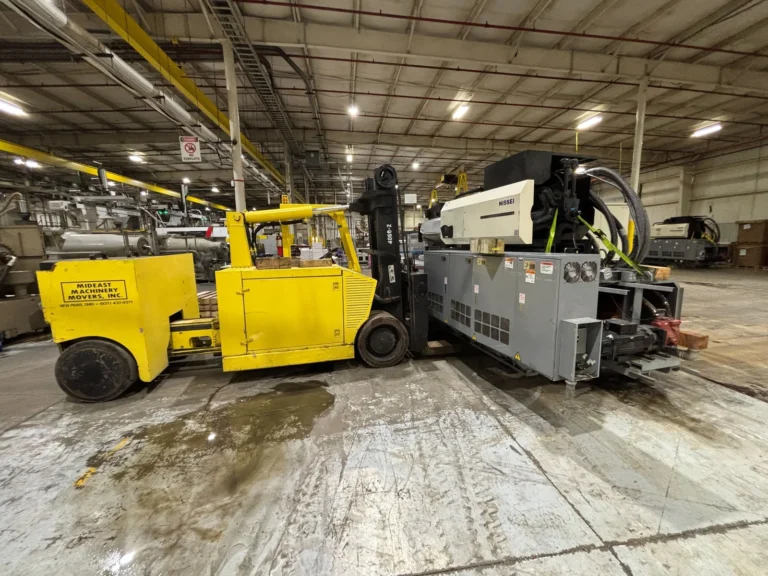
This combination is what allows Versa-Lift equipment to do something cranes and standard forklifts struggle with: maneuver a multi-ton machine through a facility and set it down with pinpoint accuracy, often in spaces only marginally larger than the machine itself.
The Core Engineering Behind Precise Placement
1. Adjustable Wheelbase and Counterweight Design
One of the defining features of Versa-Lift trucks is their adjustable wheelbase. Operators can widen or narrow the truck’s stance depending on the load being carried and the space available. This adjustability serves two purposes:
- Stability — A wider wheelbase increases stability when carrying extremely heavy or top-heavy loads, reducing tipping risk.
- Access — A narrower configuration allows the truck to navigate through doorways, aisles, or tight machine rows that a fixed-wheelbase vehicle couldn’t fit through.
This adjustability is paired with a counterweight system engineered to balance extreme point loads without the truck needing the massive footprint a comparably rated crane or standard forklift would require.
2. Extended Reach Capability
Versa-Lift trucks are engineered with reach capability that lets the load extend well beyond the truck’s own wheelbase. This is critical in tight facility environments because it allows the operator to:
- Position machinery against walls or into corners without needing to maneuver the entire truck body into that tight space
- Reach over obstacles like conveyor systems, low barriers, or adjacent equipment
- Place machines in exact final position without repeated repositioning of the truck itself
This reach advantage is often the difference between a machine being placed correctly on the first attempt versus requiring multiple risky repositioning maneuvers in a cramped space.
3. Hydraulic Precision Controls
Modern Versa-Lift trucks use hydraulic systems engineered for fine, incremental control rather than the coarser movements typical of standard forklifts. This allows operators to:
- Make small, controlled adjustments in load height, tilt, and side-shift
- Slowly “walk” a machine into final position with minimal margin for error
- Maintain load stability even during slow, precise movements — critical when a fraction of an inch matters for aligning a machine with anchor bolts or existing foundation points
4. Low Center of Gravity Design
Despite their high lift capacities, Versa-Lift trucks are engineered with a notably low center of gravity relative to their load capacity. This design choice directly supports precise placement because it:
- Minimizes load sway during movement
- Reduces the risk of tipping when maneuvering heavy, off-center loads
- Allows for slower, more controlled final positioning without the instability that taller-profile equipment would introduce
How Operators Achieve Precision in Practice
Engineering is only half the equation — operator skill and technique are what actually translate that engineering into millimeter-level placement accuracy.
Pre-Placement Planning
Before a load ever moves, experienced operators:
- Study the exact final position required, including any anchor points, foundation markings, or alignment references
- Identify the safest, most efficient path through the facility, accounting for doorways, columns, and floor load ratings
- Communicate with ground crew about sightlines, since operators often can’t see the exact landing zone directly
Slow, Incremental Movement
Precision placement isn’t about speed — it’s about controlled, incremental adjustments. Skilled operators:
- Move the truck in small increments, checking position frequently
- Use hydraulic fine controls to make height and tilt adjustments without repositioning the entire truck
- Rely on ground crew signals and, increasingly, laser alignment tools to confirm exact positioning before final lowering
Ground Crew Coordination
Precise placement is a team effort. Ground crew members typically:
- Guide the operator using clear hand signals or radio communication
- Monitor clearances on all sides of the load, especially in tight spaces where the operator’s visibility is limited
- Confirm final alignment against markings, anchor bolts, or adjacent equipment before the load is set down
Use of Laser Alignment and Measurement Tools
For machines requiring exact positioning — such as CNC machining centers or printing press units that need to align with existing foundation bolts — laser levels and measurement tools are often used to verify placement accuracy before the machine is fully lowered and secured.
Why Tight-Space Placement Matters So Much
In many industrial relocation projects, the challenge isn’t lifting the machine — it’s getting it into its exact final position within a facility that wasn’t designed with machinery relocation in mind.
Common Tight-Space Scenarios
- Retrofitting older facilities where aisles and doorways were built before modern machinery dimensions existed
- Placing machines between existing equipment in an active production floor with minimal clearance
- Aligning machines with pre-existing foundation bolts or utility connections that leave zero margin for error
- Positioning equipment near walls or structural columns where a crane’s swing radius simply won’t work
In these scenarios, a crane’s limited maneuverability or a standard forklift’s inability to handle the load safely makes Versa-Lift equipment the only practical solution. Their combination of high capacity, extended reach, and precise hydraulic control is specifically what allows machines to be placed accurately without damaging the facility, the equipment, or nearby structures.
Comparing Versa-Lift to Other Equipment for Tight-Space Placement
| Equipment | Load Capacity | Maneuverability | Placement Precision | Best Use Case |
|---|---|---|---|---|
| Standard Forklift | Low-Moderate | Good | Moderate | Palletized, uniform loads |
| Crane | Very High | Limited (swing radius) | Moderate (requires rigging expertise) | Outdoor or open-space heavy lifts |
| Versa-Lift Truck | High | Excellent | Very High | Tight-space, high-precision machinery placement |
| Rigging Skates/Rollers | N/A (ground movement only) | Excellent for short distances | High (but slow) | Very short, controlled floor movements |
This comparison highlights why Versa-Lift trucks occupy a unique niche: they combine the load capacity of heavy equipment with the maneuverability and precision typically associated with much smaller machines — a combination that’s difficult to replicate with cranes or standard forklifts alone.
Common Mistakes That Compromise Placement Precision
1. Skipping pre-placement measurements Operators who don’t verify exact clearances and target positions before moving the load risk multiple repositioning attempts — increasing both time and risk.
2. Moving too quickly Precision placement requires patience. Rushed movements increase the risk of misalignment or contact with nearby structures and equipment.
3. Poor ground crew communication Since operators often can’t see the exact landing zone, unclear signals or communication gaps are a leading cause of placement errors.
4. Ignoring floor load capacity Even with a Versa-Lift’s stability advantages, placing an extremely heavy machine on a floor not rated for that concentrated load can cause structural damage.
5. Underestimating counterweight requirements Incorrect counterweight configuration for a given load can compromise stability during the final, most delicate phase of placement.
Industries That Rely on Versa-Lift Precision Placement
Versa-Lift trucks are especially valuable across industries where machinery must be placed with extreme accuracy in constrained spaces:
- Manufacturing and machine shops — CNC machining centers, lathes, and vertical boring machines requiring alignment with existing foundations
- Printing and packaging — Multi-unit presses that must align precisely across sections
- Plastics and injection molding — Heavy presses requiring exact positioning relative to utility connections
- Medical and diagnostic equipment — Sensitive machines like X-ray systems requiring careful, controlled placement
- General industrial and heavy manufacturing — Any facility retrofitting or relocating large equipment within existing, space-constrained buildings
Questions to Ask a Rigging Company About Versa-Lift Capabilities
Before hiring a company for a tight-space machinery placement job, ask:
- What Versa-Lift models do you operate, and what are their rated capacities?
- How do your operators handle placement verification — visual, laser alignment, or both?
- What’s your process for planning the route and final placement before the move begins?
- How do you coordinate between the operator and ground crew during tight-space placement?
- Can you provide examples of similar tight-space machinery placements you’ve completed?
A company with genuine Versa-Lift expertise will be able to answer these with specific detail about equipment, process, and past project examples — not generic reassurances.
Why Alltracon Is the Best Choice for Precision Machinery Placement
Alltracon operates Versa-Lift equipment with experienced, trained operators who specialize in precise machinery placement in the tightest industrial spaces. From careful pre-placement planning to laser-verified final positioning, Alltracon delivers the accuracy your equipment and facility demand — every time.
Final Thoughts
Precise load placement in tight industrial spaces isn’t a matter of luck — it’s the result of purpose-built equipment, skilled operators, and disciplined process. Versa-Lift trucks combine high load capacity, extended reach, hydraulic precision, and a low center of gravity to achieve placement accuracy that standard forklifts and cranes simply can’t match in confined environments.
For facilities relocating or installing heavy machinery in space-constrained buildings, understanding this capability — and partnering with a moving company that has genuine Versa-Lift expertise — is what ensures equipment lands exactly where it needs to be, safely and without costly rework.